ART WIKI32 963 em exposição
MapaColeçãoArtistasMuseusExposiçõesRevista
Entrar

ART WIKI

Onde está a obra-prima, e a que horas se abre a porta.

Coleções: Art Institute of Chicago, Galeria Nacional de Arte, Galeria Tretiakov, Getty Villa, Harvard Art Museums, Hermitage, Hirshhorn Museum and Sculpture Garden, Instituto de Artes de Minneapolis, Museu de Arte de Cleveland, Museu de Arte Moderna, Museu do Louvre, Museu Estatal de Amesterdão, Museu J. Paul Getty, Museu Metropolitano de Arte, Museu Nacional de Arte da Dinamarca, Museu Pushkin, Museu Russo, Museu Smithsoniano de Arte Americana, Museu Vitória e Alberto, Museu Whitney de Arte Americana, National Museum of Asian Art, National Portrait Gallery, Catálogo Estatal do Fundo Museológico da Rússia (274 museus), Europeana (19 museus), Wikidata (6 museus), Paris Musées (12 museus) e Joconde, a base de museus do Ministério da Cultura de França (495 museus). As imagens pertencem aos titulares dos direitos.

Secções

  • Mapa
  • Pesquisa
  • Coleção
  • Obras-primas
  • Em exposição agora
  • Artistas

Mais

  • Museus e galerias
  • Exposições
  • Revista
  • De onde vêm os dados
  • Privacidade e cookies
InícioMapaCatálogo
  1. Coleção/
  2. Art Institute of Chicago/
  3. Untitled (The Bird People)
Untitled (The Bird People), Max Ernst, 1942
Max Ernst, retratoMax ErnstFrança, 1891–1976

Untitled (The Bird People)

1942 · Drawing and Watercolor

Será possível contemplá-la?

Sim, recebe visitas

Art Institute of Chicago

Chicago, Estados Unidos

Sala397

Exposta ao público. Quem o garante vem indicado abaixo.

Verificado
há 3 dias
Neste estado desde
19 de ago. de 2026
Fonte
O museu
No mapaPágina do museu

Pormenores

1942 · aos 51 anos
18911976
Número de inventário
2018.320

No catálogo

Desenhos e aguarelasGizModernismoSéculo XXEstados Unidos

Fontes

  • Art Institute of Chicago
  • Imagem: Art Institute of Chicago — © the artist or rights holder

Entretanto, na vida de Max Ernst

A vida inteira
  1. 1940

    The house is sold and Leonora is in Spain

    Returning to Saint-Martin, Ernst found the house sold and Leonora, who had suffered a breakdown after his arrest, taken to Spain by a friend. He lived on help from his friend Joë Bousquet, who bought his paintings, and began a second version of Europe after the Rain.

  2. May – July 1940

    Arrested again: Saint-Nicolas camp and two escapes

    In May 1940 Ernst was sent back to Les Milles on a denunciation that he had signalled to the enemy with lights; as the German army approached, the internees were put on a train south to the Saint-Nicolas camp near Nîmes. Ernst escaped from it twice and in July obtained release thanks to his marriage to the French citizen Marie-Berthe, concealing, with her consent, that they were divorced.

  3. 1940–1941

    Escape from Europe: Marseille, Madrid, Lisbon

    In December 1940 Ernst reached Marseille, where Varian Fry handed him the papers obtained by Alfred Barr; there he met Breton and met Peggy Guggenheim, who bought a dozen of his works and resolved to help him leave. Via Madrid, where customs officers, admiring his paintings, let him through despite problems with his papers, he reached Lisbon and waited several weeks for a seat on a plane.

  4. 14 July 1941

    Arrival in the US and three days in detention

    On 14 July 1941 Ernst flew to the United States and was detained at the airport as a German citizen, but was released three days later, not without Peggy Guggenheim’s help. With her, her daughter and his son Jimmy he travelled around America, returning to New York in December.

  5. late 1942

    Dorothea Tanning and “Birthday”

    Selecting pictures for an exhibition of women artists at Peggy’s gallery, Ernst noticed Dorothea Tanning’s Birthday. Julien Levy introduced him to the painter, and a few meetings were enough for him to fall in love.

  6. October 1942

    “First Papers of Surrealism” and “Art of This Century”

    In October 1942 the exhibition First Papers of Surrealism opened, its catalogue laid out as a list of modern myths in which “interplanetary communication” was credited to Ernst. That month Peggy Guggenheim’s gallery Art of This Century opened on 57th Street, and Ernst drew the cover of its catalogue.
Mais obras de Max Ernst

Todas as obras
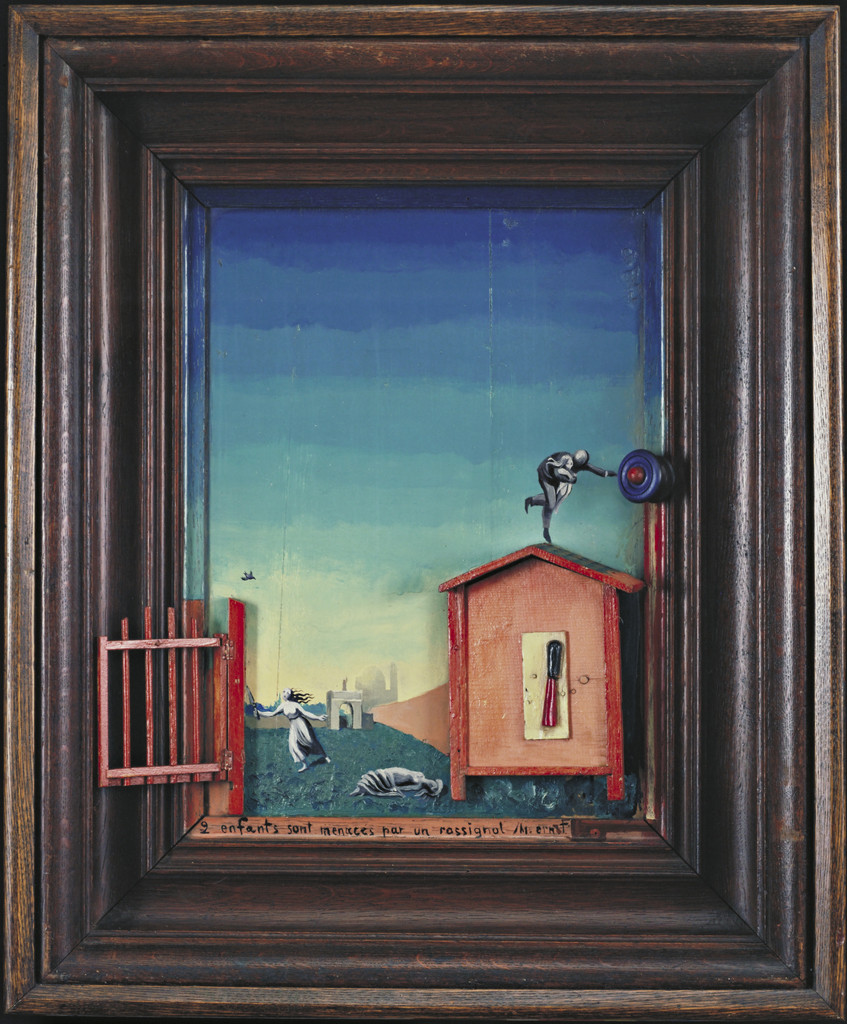
Two Children Are Threatened by a Nightingale (Deux Enfants sont menacés par un rossignol), Max Ernst, 1924

Two Children Are Threatened by a Nightingale (Deux Enfants sont menacés par un rossignol)

1924 · Museu de Arte Moderna

Birds above the Forest (Oiseaux au-dessus de la forêt), Max Ernst, 1929

Birds above the Forest (Oiseaux au-dessus de la forêt)

1929 · Museu de Arte Moderna

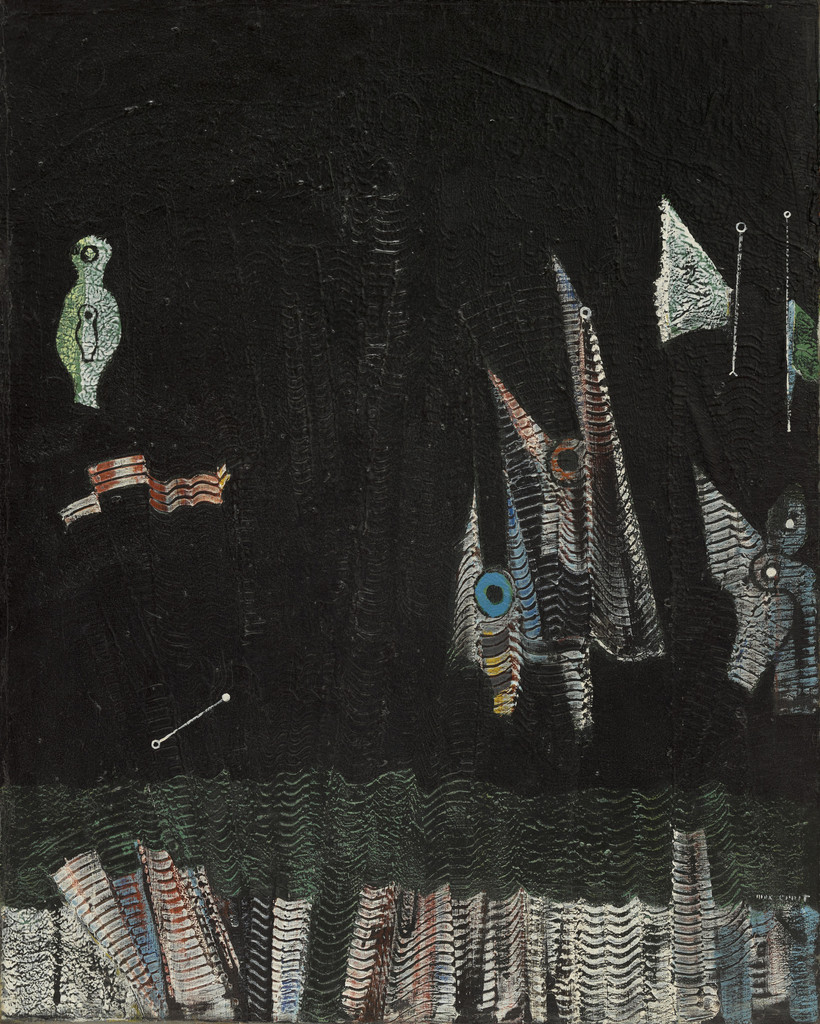
Bird-Head (Oiseau-tête), Max Ernst, 1934-35

Bird-Head (Oiseau-tête)

1934-35 · Museu de Arte Moderna

A Moment of Calm, Max Ernst, 1939

A Moment of Calm

1939 · Galeria Nacional de Arte

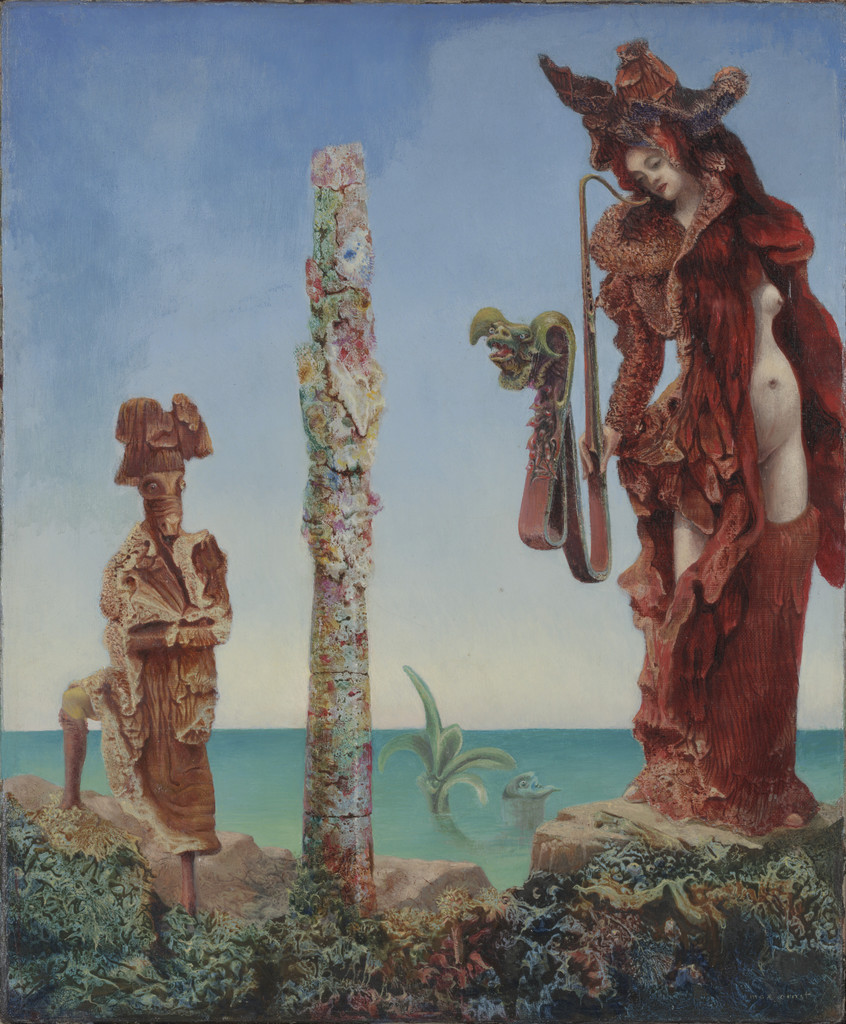
Napoleon in the Wilderness, Max Ernst, 1941

Napoleon in the Wilderness

1941 · Museu de Arte Moderna

Forest and Sun, Max Ernst, 1927

Forest and Sun

1927 · Art Institute of Chicago

Self-Constructed Little Machine, Max Ernst, 1919/20

Self-Constructed Little Machine

1919/20 · Art Institute of Chicago

The Massacre of the Innocents, Max Ernst, 1920

The Massacre of the Innocents

1920 · Art Institute of Chicago

Vizinhas de sala: Art Institute of Chicago

Página do museu
The Bedroom, Vincent van Gogh, 1889

Vincent van Gogh

The Bedroom, 1889

A Sunday on La Grande Jatte — 1884, Georges Seurat, 1884–86, border added 1888–89

Georges Seurat

Tarde de Domingo na Ilha de Grande Jatte, 1884–86, border added 1888–89

Paris Street; Rainy Day, Gustave Caillebotte, 1877

Gustave Caillebotte

Paris Street; Rainy Day, 1877

Two Sisters (On the Terrace), Pierre-Auguste Renoir, 1881

Pierre-Auguste Renoir

As Duas Irmãs, 1881

The Basket of Apples, Paul Cézanne, c. 1893

Paul Cézanne

A Cesta de Maçãs, c. 1893

Stacks of Wheat (End of Summer), Claude Monet, 1890–91

Claude Monet

Stacks of Wheat (End of Summer), 1890–91

American Gothic, Grant Wood, 1930

Grant Wood

Gótico Americano, 1930

Nighthawks, Edward Hopper, 1942

Edward Hopper

Nighthawks, 1942