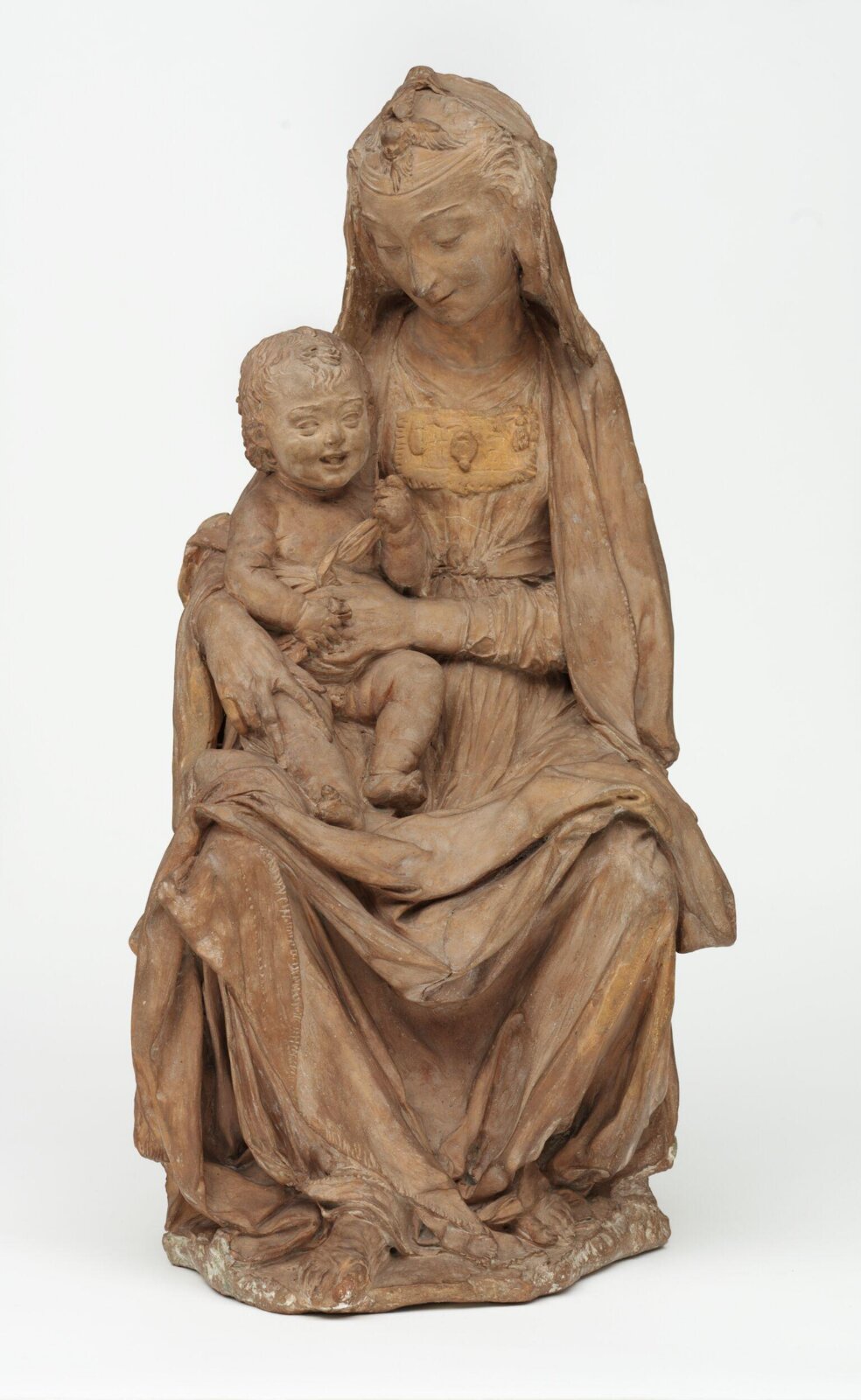
The Virgin with the laughing Child
Será possível contemplá-la?
Sim, recebe visitas

Londres, Reino Unido
SalaMedieval & Renaissance, Room 64a, The Robert H. Smith Gallery
Exposta ao público.
- Verificado
- Neste estado desde
- Fonte
- O museu
Sobre a escultura
This sculpture is one of the most famous pieces in the Victoria and Albert Museum - and yet we are not certain who modelled it. The leading fifteenth-century Florentine sculptors Antonio Rossellino, Andrea del Verrocchio and Desiderio da Settignano are amongst those who have been named. The terracotta was for many years attributed to Rossellino, but when the sculpture was lent for the first time to an exhibition in Florence in spring 2019, scholars presented an attribution to the young Leonardo da Vinci, while he was in Verrocchio's workshop (c.1472). This idea was first put forward in 1899, and won favour for several years. The maker intriguingly combines stylistic elements from each of the named sculptors. But the emphasis on the human relationship between mother and child and the naturalistic treatment of the subject are typical of the time.
Ler mais
The statuette has generally been considered to be a sketch model for a larger marble group. However, it is probably one of the small-scale devotional objects that were so popular in Florentine homes, but now stripped of its naturalistic paint, traces of which appear to remain. Thermoluminenscence testing can provide a guide as to when a terracotta was last fired. Tests undertaken on the sculpture indicate that the earliest date is 1460, although the sculpture is likely to be later in date. Technical and art-historical research is continuing with the view to unravel more of the sculpture's unknown history.
Museu Vitória e Alberto
Pormenores
- Número de inventário
- 4495-1858
O que mostra
No catálogo
Fontes
- Museu Vitória e Alberto
- Imagem: Museu Vitória e Alberto — © Victoria and Albert Museum, London