John Everett MillaisReino Unido, 1829–1896
The Ransom
Será possível contemplá-la?
Sim, recebe visitas
Exposta ao público. Quem o garante vem indicado abaixo.
- Verificado
- Neste estado desde
- Fonte
- Os dados da própria coleção do museu
About the painting
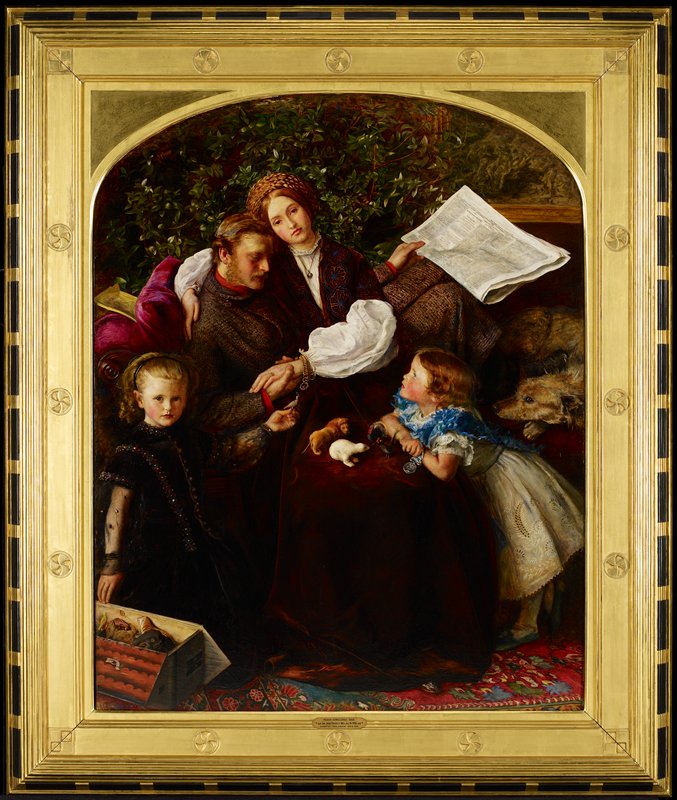
An armored knight, still in his riding boots and accompanied by his page in mud-splattered stockings, seems to have hastily gotten off his horse to meet for this ransom exchange. The knight’s daughters embrace him while he tries to hand over precious jewels, but their arms are still being held by the kidnapper, whose plainer clothing contrasts with their finery. The page in a blue and white striped ensemble is watching closely and reaches into his purse, sensing that the kidnappers will demand more ransom. These characters—not based on any historical or literary source, but invented by the artist—dramatize a narrative through their expressive gestures and glances. The outcome still seems uncertain and even the dog looks expectantly at the central figures for the resolution of the story.
Read on
British artist John Everett Millais set this imaginary drama in the 1500s and looked to his family, friends, and surroundings to stage the painting. His wife Effie researched and made the period costumes; his friend Mr. Miller posed for the head of the knight; a railway guard named "Strong" was the model for the knight's body; and the two girls were painted from a single model, Helen Petrie. The tapestry in the background was based on a Flemish tapestry in the South Kensington Museum (now the Victoria and Albert Museum) not far from the artist’s home.
Museu J. Paul Getty
Pormenores
- Número de inventário
- 72.PA.13
No catálogo
Fontes
- Museu J. Paul Getty: the museum's own open data · obtido há 9 horas
- Imagem: Museu J. Paul Getty — Open Content
Entretanto, na vida de John Everett Millais
A vida inteira28 de novembro de 1858
Daughter born: Effie Gray Millais
13 de maio de 1860
Son born: Mary Hunt Millais
10 de abril de 1862
Daughter born: Alice Sophia Caroline Millais
1863
Becomes a full member of the Royal Academy
A decade after becoming an associate, in 1863 Millais was elected a full member of the Royal Academy of Arts, in which he was a prominent and active participant.
18 de setembro de 1863
Son born: Sir Geoffrey William Millais, 4th Bt.
1864
Illustrations of Christ’s parables and the Kinnoull windows
In 1864 his complex illustrations of the parables of Jesus were published; his father-in-law commissioned stained-glass windows based on them for Kinnoull Parish Church. Millais was also very successful as a book illustrator, notably of Anthony Trollope’s novels and Tennyson’s poems, and provided illustrations for magazines such as Good Words.