The Oyster Meal
Posso vê-la?
Não exposta de momento
Onde está «The Oyster Meal» hoje? Coleção: Museu Vitória e Alberto, Londres. Não exposta de momento. Verificado 25 de setembro de 2026.

Londres, Reino Unido
Pertence à coleção, mas de momento não está exposta.
- Verificado
- Neste estado desde
- Fonte
- O museu
Sobre a pintura
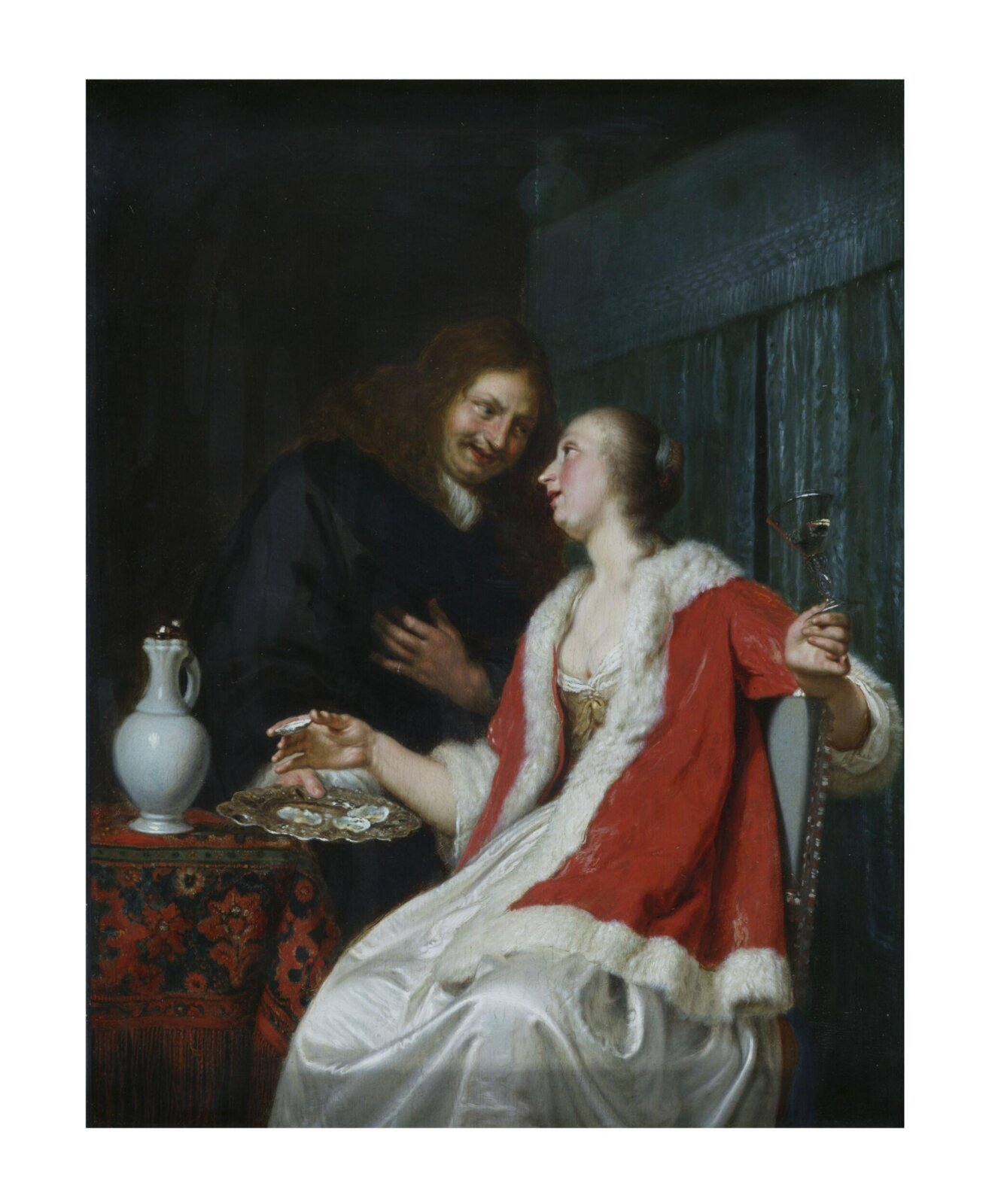
Frans van Mieris (1635-1681) was trained by Abraham Toorenvliet (ca. 1620-1692) and by Gerrit Dou (1613-1675), one of the most eminent Rembrandt's pupils in Leyden. He specialised in small scale genre painting with exceptional refinement and had a strong influence on younger painters, anticipating the late 17th-century development of a more stylised and precious form. Among his pupils were Carel de Moor (1655-1738) and his own son, Willem (1662-1747) (see Museum No. 186-1894).
Ler mais
This painting is one of the many copies of a very popular picture, The oyster meal, executed in 1661 by Frans van Mieris the Elder (Mauristhuis, The Hague). It shows an illegitimate couple formed by a young woman and an older man in the act of offering her a plate of oysters, a dish known, as well as the wine, for its aphrodisiac virtues. As she is taking one oyster and holding the glass of wine, it is clear that the girl accepts the man's proposal, the curtained bed behind them being an allusion of the consequences. As a Leiden 'Fine' painter, Frans van Mieris was particularly skilled in representing all sorts of textures: here the fur-trimmed cape and a silk white dress are masterly rendered as well as the sparkles of light reflecting in the jar, the tin plate and the glass. Frans van Mieris was particularly attentive to make his brushstrokes invisible.
He expanded significantly the range of subjects commonly depicted in Leiden and influenced other contemporary masters such as Gabriel Metsu (1629-1667), Jan Steen (ca. 1625-1679), Jacob Ochtervelt (1634-1682) and Johannes Vermeer (1632-1675).
Museu Vitória e Alberto
Pormenores
- Número de inventário
- 499-1882
No catálogo
Fontes
- Museu Vitória e Alberto
- Imagem: Museu Vitória e Alberto — © Victoria and Albert Museum, London