 Rembrandt van RijnPaíses Baixos, 1606–1669
O Moinho
The Mill
Será possível contemplá-la?
De momento, não recebe

Galeria Nacional de Arte
Washington, D.C., Estados Unidos
Pertence à coleção, mas de momento não está exposta.
- Verificado
- Neste estado desde
- Fonte
- O museu
Sobre a pintura
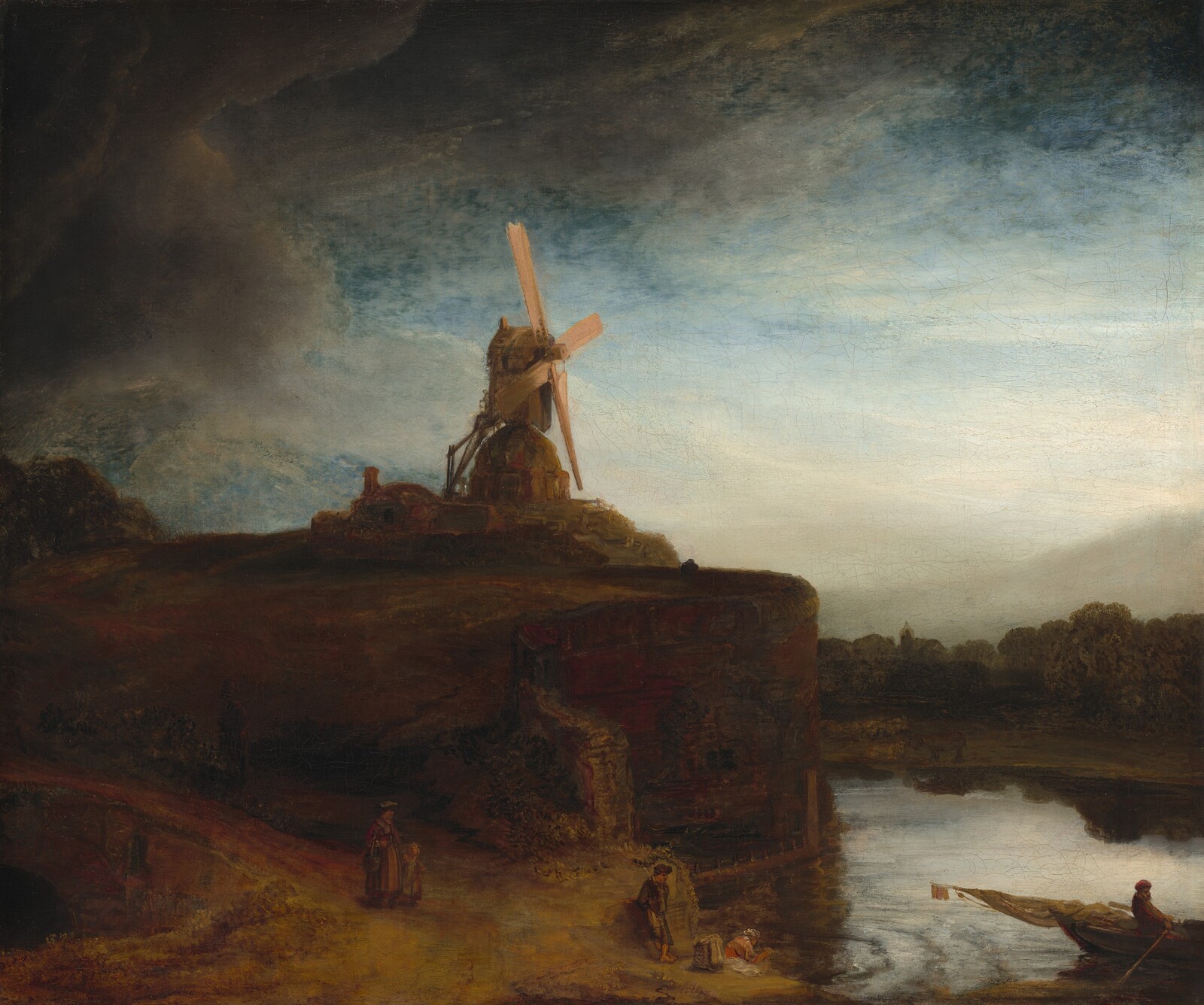
The Mill is a painting by Dutch baroque artist Rembrandt Harmenszoon van Rijn. It is in the permanent collection of the National Gallery of Art in Washington, DC. For a long time, the attribution to Rembrandt was regarded as doubtful; it has been restored in recent years, although it is not universally accepted. The painting was formerly in the Orleans Collection. It was once owned by Peter Arrell Brown Widener.
Continuar a ler
This painting was documented by Cornelis Hofstede de Groot in 1915, who wrote:952. LANDSCAPE WITH A WINDMILL [commonly called, The Mill]. Sm. 601; Bode 142; Dut. 452; Wb. 211; B.-HdG. 345. Beside a broad moat, high above the circular scarp of a ruined bastion, stands a windmill with some low cottages. The path from the mill leads, on the left, over a little bridge across a sluice, to a landing-post in the foreground. A woman with a child goes down to the water; a man pushes a barrow upwards. In the centre foreground a woman at the water's edge is washing linen. A man behind watches her. From the right approaches a ferry-boat with the mast down, rowed by a man. To the right on the farther bank, amid dense groves of trees, are some cows, and beyond them a cottage. Evening light. The last rays of the sun illumine the right half of the sky and envelop the mill in their radiant glow. Painted about 1650. Canvas, 34 inches by 41 inches.
A copy on panel, 34 1/2 inches by 39 1/2 inches was exhibited at the Grafton Gallery, London, 1911, No. 67 [by T. Humphry Ward]. Etched by Mathieu, Dequevauviller, Turner, P. J. Arendzen. Mentioned by Bode, pp. 493, 579; Dutuit, p. 46; Michel, pp. 367, 555 [282 -3, 433]; Waagen, iii. 157. Exhibited at the British Institution, London, 1815, No. 37, and 1864, No. 112; at the Royal Academy Winter Exhibition, London, 1878, No. 172; 1888, No. 74; and 1899, No. 40.
Sale. Duc d'Orléans, 1798 (£525, W. Smith); see Buchanan, i. 196. In the collection of the Marquess of Lansdowne, Bowood, before 1836 (who is said by Sm. to have paid £840 for it); sold to P. A. B. Widener in 1911 (for £100,000). In the collection of P. A. B. Widener, Philadelphia.
The painting features a tonal arrangement in which the upraised vane of the windmill is light against a dark sky. The one opposite it is dark against light. The other two are subordinated: the one pointing toward the viewer is dark against dark, while the far one is light against light. Each vane of the windmill represents one of the four possible tonal arrangements.
Pormenores
- Número de inventário
- 1942.9.62
O que mostra
No catálogo
Fontes
- Galeria Nacional de Arte
- Imagem: Galeria Nacional de Arte — Museum open access
Entretanto, na vida de Rembrandt van Rijn
A vida inteira1631–1669 · Local de trabalho
Amsterdam
1639–1658 · Residência
Rembrandt House Museum
1642–1648
Pupil: Christopher Paudiß
1643–1646
Pupil: Samuel van Hoogstraten
1648–1652
Pupil: Nicolaes Maes
early 1649
Beginning of His Relationship with Hendrickje Stoffels
In early 1649 Rembrandt grew close to the 23-year-old Hendrickje Stoffels, who had previously served as his maid. Her image appears in many works of his late period.


![Ginevra de' Benci [obverse], Leonardo da Vinci, c. 1474/1478](https://api.nga.gov/iiif/8f29e3c9-a289-4d53-abf0-31a66e9e98fa/full/!2400,2400/0/default.jpg)
![Wreath of Laurel, Palm, and Juniper with a Scroll inscribed Virtutem Forma Decorat [reverse], Leonardo da Vinci, c. 1474/1478](https://api.nga.gov/iiif/ff62e8d0-45c4-498f-ad36-6358de827e04/full/!2400,2400/0/default.jpg)