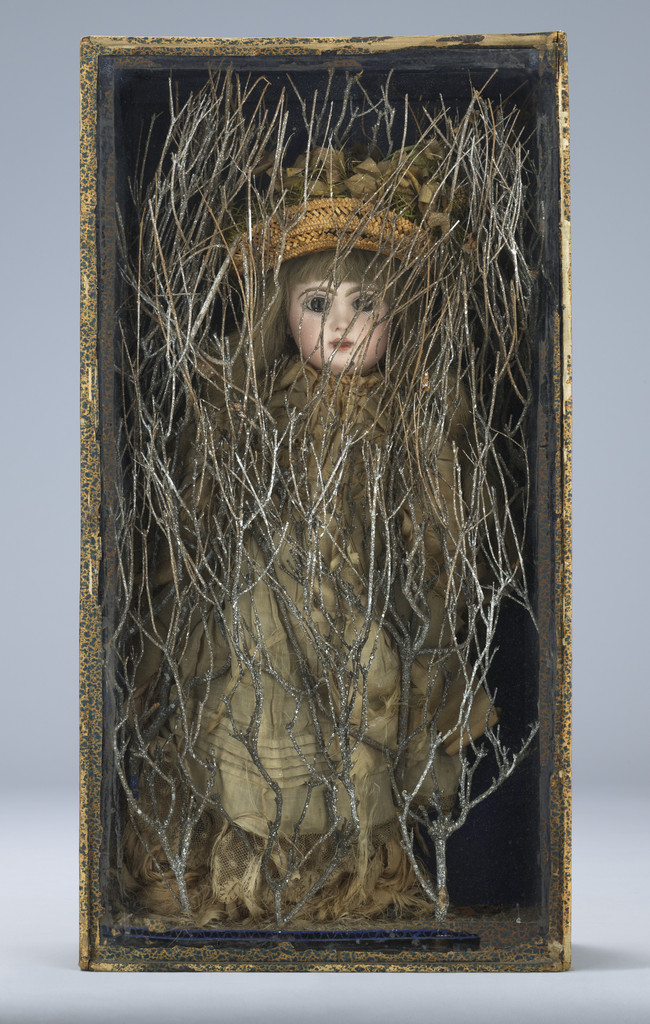
The Eagle, the Arrow, and the Dolphin
Posso vê-la?
Sim, exposta agora
Onde está «The Eagle, the Arrow, and the Dolphin» hoje? Art Institute of Chicago, Sala 397, Chicago. Sim, exposta agora. Verificado 29 de setembro de 2026.

Chicago, Estados Unidos
Aberto agora· até às 17:00
Exposta ao público.
- Verificado
- Neste estado desde
- Fonte
- O museu
Sobre a obra
The title of this box refers to a small section of a map of the heavens attached to the top of the box’s interior left wall. It reproduces several constellations with their Latin names, including AQUl(LA) (Eagle), SAGITTA (Arrow), and DELPHINUS (Dolphin). Cornell used the larger illustration attached to the box’s interior back wall, showing a group of constellations labeled CEPHEUS, URSA MINOR, DRACO, and CAUDA DRACONIS, in several other boxes, including Pavilion. The original image appears to have been photographically reproduced, and then partially colored in by hand by Cornell himself. The artist used it again in Cauda Draconis of 1958 (New York, Xavier Fourcade, Inc.; Waldman 1977, pl. 33), a box that offers a close comparison to The Eagle, the Arrow, and the Dolphin. Both boxes are horizontal in their construction and include metal rods supporting a rolling ball. The Eagle, the Arrow, and the Dolphin,, however, has two metal rings rather than one and lacks the row of wine glasses with blue marble balls arranged on a shelf in Cauda Draconis.
Ler mais
A comparison between Pavilion and The Eagle, the Arrow, and the Dolphon draws attention not only to their shared imagery but also to an interesting similarity in their formal construction. Although one box is vertical and the other horizontal, the spatial divisions created by the wood or metal rods, which function as either “columns” or “shelves,” seem to follow the same proportional rules. Strong geometric and structural principles often underlie the heterogeneous collections of materials and objects within Cornell‘s boxes.
The study of the constellations had many layers of significance for the artist Constellations were connected to ancient mythology and bore witness to the power of the human imagination to imprint images and patterns on chaos. The illustration pasted into these boxes exemplifies these aspects in its particularly pleasing combination of science and fantasy. Cornell associated favorite constellations, such as Andromeda, Orion, and the Dragon, with friends, film stars, or ballerinas. The very term “ constellation” took on a particular significance for him in his effort to understand and describe his working process, as he sought patterns in his experiences, his feelings, and his works. A handwritten note in his diary reads: “What about ‘constellations’ for experiments in going over past experiences on various subjects and picking out certain points for a presentation” (Cornell Papers, AAA, reel 1060; see Cornell 1993, p. 227).
— Entry, Dawn Ades, Surrealist Art: The Lindy and Edwin Bergman Collection at the Art Institute of Chicago, 1997, p. 88-89.
Art Institute of ChicagoCC BY 4.0
Pormenores
- Número de inventário
- 1982.1849
No catálogo
Fontes
- Art Institute of Chicago
- Imagem: Art Institute of Chicago — © the artist or rights holder