 Charles Le BrunFrança, 1619–1690
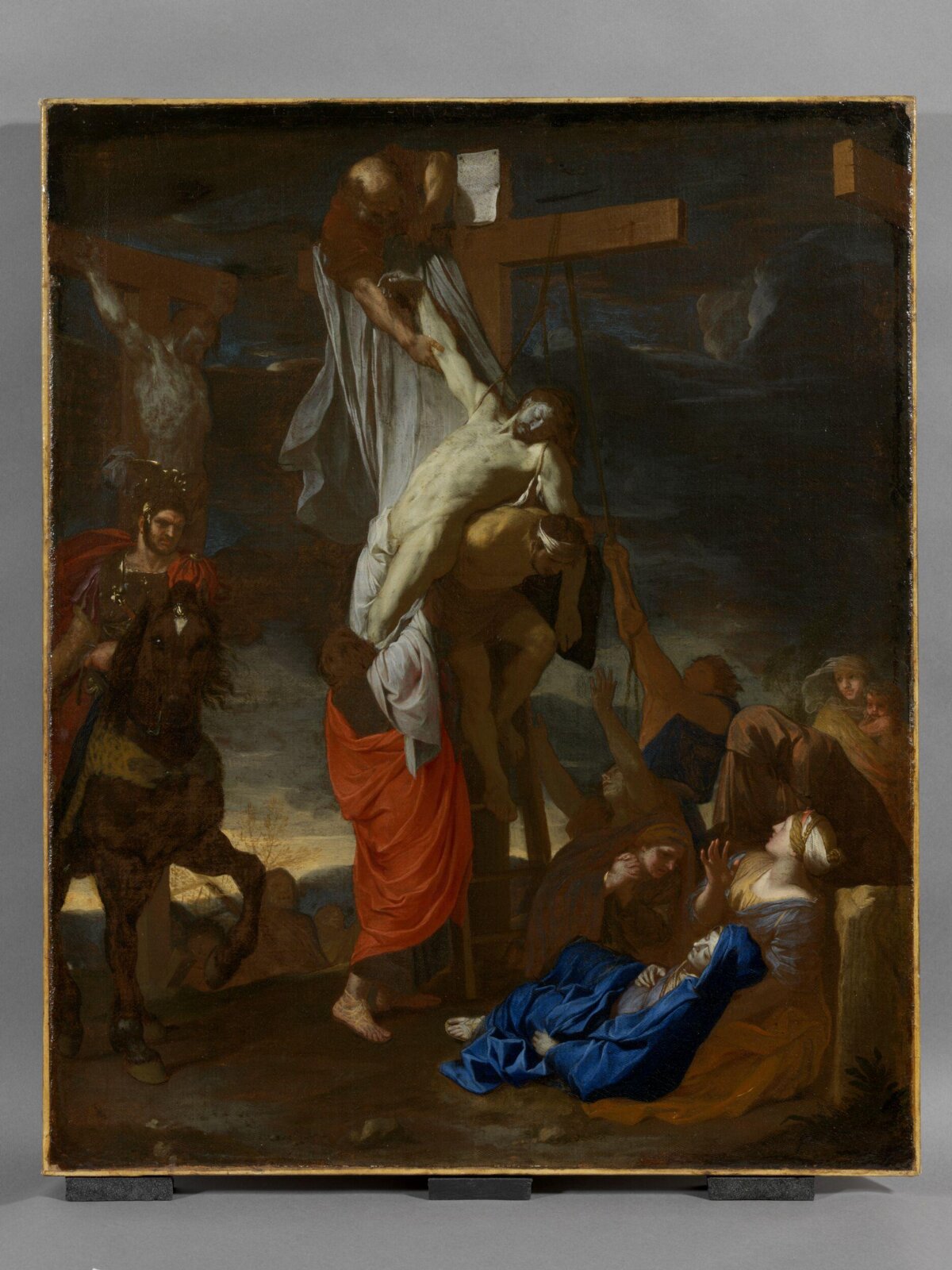
The Descent from the Cross
Posso vê-la?
Sim, exposta agora
Onde está «The Descent from the Cross» hoje? Museu Vitória e Alberto, Europe 1600-1815, Room 5, The Friends of the V&A Gallery, Londres. Sim, exposta agora. Verificado 25 de setembro de 2026.

Londres, Reino Unido
SalaEurope 1600-1815, Room 5, The Friends of the V&A Gallery
Fechado· abre às 10:00
Exposta ao público.
- Verificado
- Neste estado desde
- Fonte
- O museu
Sobre a pintura
Charles Le Brun (1619-1690) was born in Paris and soon achieved a great success becoming the court painter of Louis XIV. He trained with François Perrier (1594-1649) and then collaborated with Simon Vouet (1590-1649) during the mid 1630s. He made a decisive trip for his artistic development to Italy with Nicolas Poussin (1594-1665) in 1642 and returned to Paris only three years later. He then became quickly very successful and produced many history and religious paintings as well as designs for the royal palaces.
Ler mais
This painting is a fine example of Charles Le Brun’s Baroque style who dominated 17th-century French painting. It shows the Descent from the Cross of Christ’s body by Nicodemus and St John the Evangelist while a group of mourning women gathered around the feinted Virgin Mary. This austere composition is pervaded with dramatic intensity enhanced by touches of vivid colours against the dark background. This work, of which several versions are known, was particularly popular and inspired the next generation of artists.
Museu Vitória e Alberto
Pormenores
- Número de inventário
- 9103-1863
O que mostra
No catálogo
Fontes
- Museu Vitória e Alberto
- Imagem: Museu Vitória e Alberto — © Victoria and Albert Museum, London
Na vida de Charles Le Brun
A vida inteira1642
He travels to Rome with Poussin
In 1642 he sets out for Rome with Poussin; thanks to a scholarship from Chancellor Séguier he works there for four years under Poussin, studies ancient Roman sculpture, copies Raphael and meets local artists.
1642
Teacher: Nicolas Poussin
1646
He returns to Paris: new patrons, Fouquet
In 1646 he returns to Paris and finds numerous patrons; the most important is Nicolas Fouquet, for whom he paints a large portrait of Anne of Austria.





![[Das Reitergefecht; The Cavalry Fight; Sujet de bataille], Rembrandt, 1629](https://diglib.hab.de/varia/haum/rembrandt-ab3-0142/max/000001.jpg)
![[Die drei Kreuze; Christus am Kreuz zwischen den Schächern; Christ Crucified Between the Two Thieves (The 'Three Crosses'); Les trois Croix], Rembrandt, 1653](https://diglib.hab.de/varia/haum/rembrandt-v2-4568/max/000001.jpg)

![Sketch of a Swordsman Standing Over His Defeated Opponent [recto], William Blake, c. 1780/1785](https://api.nga.gov/iiif/f102a194-3eed-4a1f-b779-a1cb6d46f8ea/full/!2400,2400/0/default.jpg)