 Thomas EakinsEstados Unidos, 1844–1916
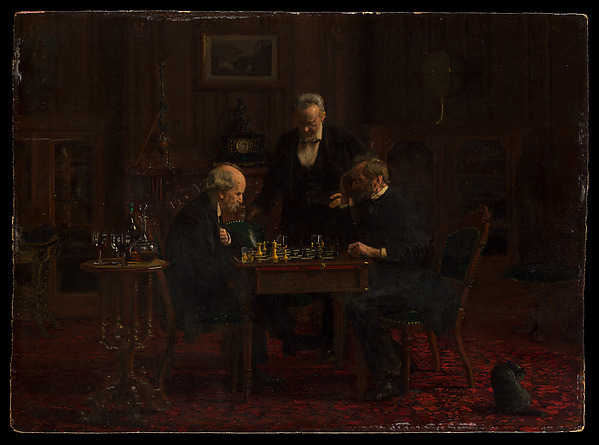
The Chess Players
Será possível contemplá-la?
Sim, recebe visitas

Museu Metropolitano de Arte
Sala730Nova Iorque, Estados Unidos
Exposta ao público. Quem o garante vem indicado abaixo.
- Verificado
- anteontem
- Neste estado desde
- 26 de set. de 2026
- Fonte
- Os dados da própria coleção do museu
About the painting
The Chess Players é uma pintura de gênero de 1876 do artista norte-americano Thomas Eakins (1844–1916). É uma pequena Óleo sobre tela retratando o pai de Eakins observando uma partida de xadrez. Os dois jogadores são Bertrand Gardel (esquerda), um professor de francês idoso, e de alguma forma o jovem George Holmes, um pintor. Os homens estão num escuro, num salão de festas Vitoriano almofadado em madeira com um tipo de luz que sugere um final de tarde. A partida está bem desenvolvida e muitas peças foram removidas do tabuleiro. Holmes, o mais jovem, parece estar vencendo a partida uma vez que capturou a Dama do seu oponente (cujo topo aparece na gaveta lateral da mesa), e sua Dama está bem posicionada no centro do tabuleiro. Eakins pintou o quadro para seu pai, e o assinou em Latim, "BENJAMINI. EAKINS. FILIUS. PINXIT. '76"—"o filho de Benjamin Eakins pintou isto"—em pequenas letras na gaveta da mesa.
Read on
O autor Martin Berger analisou o contéudo da pintura em detalhes, encontrando uma evocação da passagem do tempo e relacionando com um significado altamente pessoal da vida de Eakins. O jogador jovem tenta matar o Rei do jogador mais velho numa analogia ao Complexo de Édipo.
Pormenores
- Número de inventário
- 81.14
What it shows
No catálogo
Fontes
- Museu Metropolitano de Arte: the museum's own open data · obtido há 5 dias
- Imagem: Museu Metropolitano de Arte — Open Access (CC0)
Entretanto, na vida de Thomas Eakins
A vida inteira1870–1916 · Local de trabalho
Philadelphia
1874
Engaged to Kathrin Crowell
Eakins became engaged to Kathrin Crowell, the sitter of his first large portrait; the engagement lasted five years, until her death.
1875
Meets Susan Macdowell
At the Hazeltine Gallery, where “The Gross Clinic” was on show, Eakins met the 25-year-old Susan Macdowell, daughter of a Philadelphia engraver. Unlike many, she was impressed by the painting and went to study with him at the Academy for six years, winning the Mary Smith Prize for the best painting by a woman student.
1876
Centennial Exhibition: “The Gross Clinic” rejected
The committee of the Centennial Exhibition rejected “The Gross Clinic” for the Art Gallery — it was shown in an exhibit of a U.S. Army Post Hospital — while “The Chess Players” was accepted, much admired and praised by critics. One reviewer knew of nothing greater ever executed in America, but the blood on the canvas troubled the public, and the college finally bought the picture for just $200.
1876
Begins teaching at the Pennsylvania Academy
After the Academy's new building designed by Frank Furness opened, Eakins returned to teach there, at first as a volunteer; in 1878 he became a salaried professor.