John RuskinInglaterra, 1819–1900
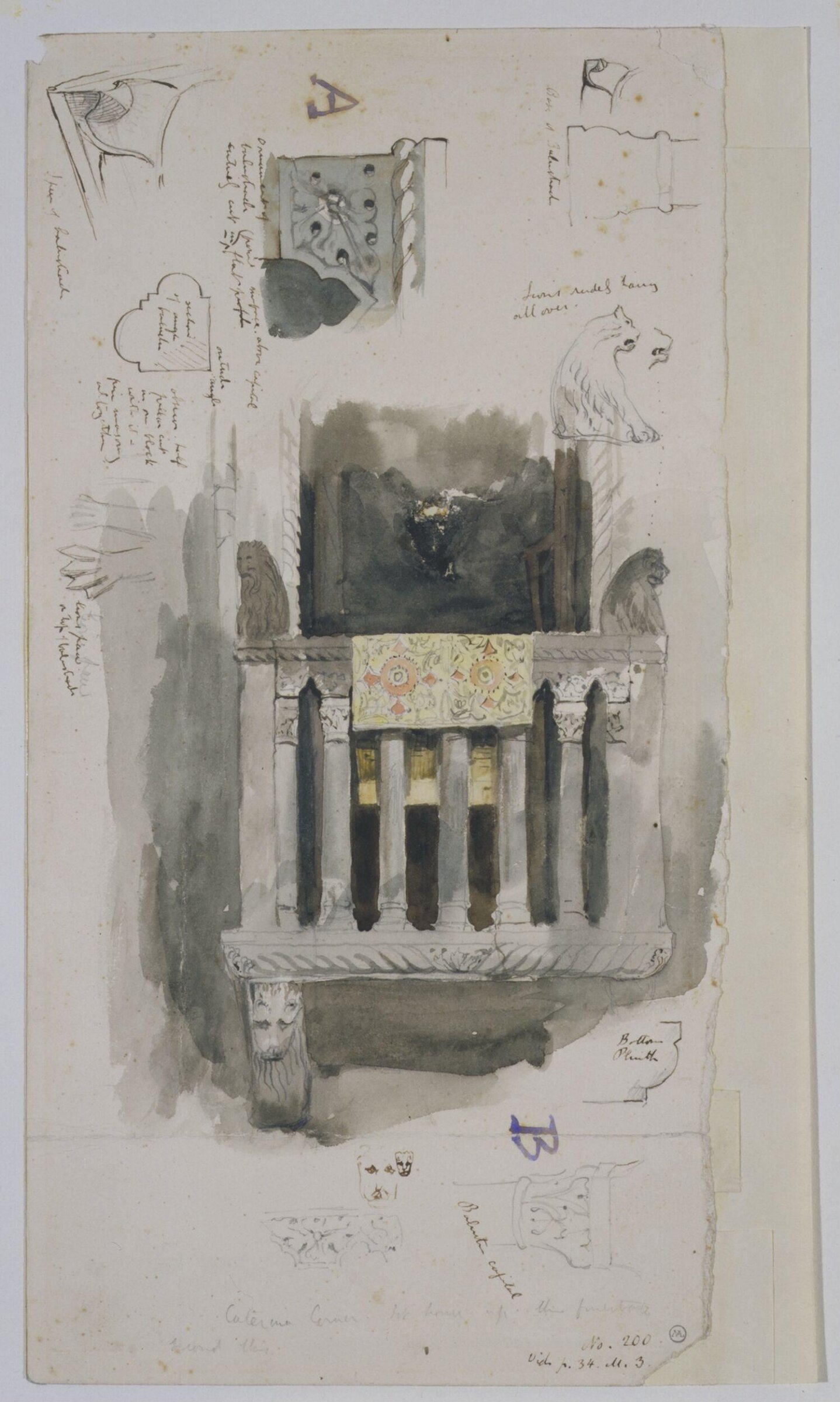
The Casa Loredan, Venice
Posso vê-la?
Desconhecido
Onde está «The Casa Loredan, Venice» hoje? Coleção: Museu Isabella Stewart Gardner, Boston. Desconhecido.

Boston, Estados Unidos
O proprietário é conhecido; não se sabe se hoje está exposta.
- Neste estado desde
- Fonte
- O museu
Pormenores
- Número de inventário
- P17e32
No catálogo
Fontes
- Wikidata
- Imagem: Museu Isabella Stewart Gardner — John Ruskin · Public domain · Wikimedia Commons
Na vida de John Ruskin
A vida inteira1834–1900 · Local de trabalho
Great Britain
10 de abril de 1848
Married: Effie Gray
1849
The Alps without Effie: beauty and the peasants' poverty
Effie is too unwell for the European tour of 1849, so Ruskin visits the Alps with his parents, gathering material for the third and fourth volumes of “Modern Painters”. The contrast between Alpine beauty and the poverty of the Alpine peasants stirs his increasingly sensitive social conscience.
1849
In Venice with Effie: the sketches behind “The Stones of Venice”
In November 1849 the couple stay at the Hotel Danieli: Effie looks for company, while Ruskin works alone and hurries to draw the Ca' d'Oro and the Doge's Palace, fearing that the occupying Austrian troops will destroy them. These sketches and notes will grow into “The Stones of Venice”.
May 1851
Letters to The Times defending the Pre-Raphaelites
Millais and his fellow artists approach Ruskin through their mutual friend Coventry Patmore; Millais's “Christ in the House of His Parents” (1849–50), which some considered blasphemous, at first fails to impress him, but in May 1851 he writes letters to The Times defending the Pre-Raphaelite Brotherhood.
1851–1853
The three-volume “Stones of Venice”
Growing from a technical history of Venetian architecture, from the Byzantine to the Renaissance, into a broad cultural history, the work is a warning to contemporary England about the moral and spiritual health of society: Ruskin explains the decline of Venice by the loss of true Christian faith. The chapter “The Nature of Gothic” from the second volume — a critique of the division of labour and industrial capitalism — will be published by William Morris as a separate book.