ART WIKI32 963 em exposição
MapaColeçãoArtistasMuseusExposiçõesRevista
Entrar

ART WIKI

Onde está a obra-prima, e a que horas se abre a porta.

Coleções: Art Institute of Chicago, Galeria Nacional de Arte, Galeria Tretiakov, Getty Villa, Harvard Art Museums, Hermitage, Hirshhorn Museum and Sculpture Garden, Instituto de Artes de Minneapolis, Museu de Arte de Cleveland, Museu de Arte Moderna, Museu do Louvre, Museu Estatal de Amesterdão, Museu J. Paul Getty, Museu Metropolitano de Arte, Museu Nacional de Arte da Dinamarca, Museu Pushkin, Museu Russo, Museu Smithsoniano de Arte Americana, Museu Vitória e Alberto, Museu Whitney de Arte Americana, National Museum of Asian Art, National Portrait Gallery, Catálogo Estatal do Fundo Museológico da Rússia (274 museus), Europeana (19 museus), Wikidata (6 museus), Paris Musées (12 museus) e Joconde, a base de museus do Ministério da Cultura de França (495 museus). As imagens pertencem aos titulares dos direitos.

Secções

  • Mapa
  • Pesquisa
  • Coleção
  • Obras-primas
  • Em exposição agora
  • Artistas

Mais

  • Museus e galerias
  • Exposições
  • Revista
  • De onde vêm os dados
  • Privacidade e cookies
InícioMapaCatálogo
  1. Coleção/
  2. Museu Van Gogh/
  3. The Blue Bird
The Blue Bird, Émile Bernard, 1889
Bernard, Emile, retratoBernard, EmileFrança, 1868–1941

The Blue Bird

1889 · Painting · 73 × 60 cm

Será possível contemplá-la?

Desconhecido

Museu Van Gogh

Amesterdão, Países Baixos

O proprietário é conhecido; não se sabe se hoje está exposta.

Neste estado desde
29 de set. de 2026
Fonte
O museu
No mapaPágina do museu

Pormenores

1889 · aos 21 anos
18681941
Número de inventário
s0393M1990

No catálogo

PinturasPintura francesaImpressionismoSéculo XIX

Fontes

  • Wikidata
  • Imagem: Museu Van Gogh — Poro amara · Public domain · Wikimedia Commons

Entretanto, na vida de Bernard, Emile

A vida inteira
  1. 1887

    Cloisonnism, developed together with Anquetin

    In 1887 Bernard and Louis Anquetin develop cloisonnism — bold forms separated by dark contours; in the spring they “turn against Neo-Impressionism”. Many, however, credit Anquetin with the technique, and Bernard was probably also influenced by the works of Cézanne he had seen.

  2. 1887–1888

    An exhibition in the restaurant on the Avenue de Clichy

    Back in Paris, Bernard attends the Académie Julian and meets van Gogh, who is impressed by his work. He finds a restaurant on the Avenue de Clichy where his work is shown alongside that of van Gogh, Anquetin and Toulouse-Lautrec; van Gogh calls the group the “School of the Petit Boulevard”.

  3. 1888

    On foot to Pont-Aven: friendship with Gauguin

    A year later Bernard again sets out for Pont-Aven on foot and sees Gauguin; their friendship and artistic partnership quickly grow strong. Bernard wants an art of the most extreme simplicity, accessible to all and practised collectively, and Gauguin is impressed by his ability to put his ideas into words. Other accounts have him living in Pont-Aven in 1886–1888 and joining the Pont-Aven group.

  4. 1890

    A religious crisis and a turn to the Middle Ages

    In 1890 Bernard goes through a religious crisis and turns to the subjects and themes of medieval art. In the same year he sets out to revive symbolism, which he saw as Christian in essence — the invisible expressed through the visible.

  5. 1891

    The break with Gauguin

    In 1891 Bernard breaks off his friendship with Gauguin. It was always his great frustration that Gauguin never named him as an influence on pictorial symbolism; one writer says his rivalry with Gauguin led him “out of spite” towards classicism.

  6. 1891

    Among the Symbolists and the Nabis

    In 1891 Bernard joins the group of Symbolist painters that includes Odilon Redon and Ferdinand Hodler, and in the same year becomes a member of the Nabis.

Mais obras de Bernard, Emile

Todas as obras
Still Life (Cup, Compote Dish, Teapot, and Fruit) 1890, Émile Bernard

Still Life (Cup, Compote Dish, Teapot, and Fruit) 1890

Museu Van Gogh

Le Repos du berger, Émile Bernard, 1900s

Le Repos du berger

1900s · Museu de Orsay

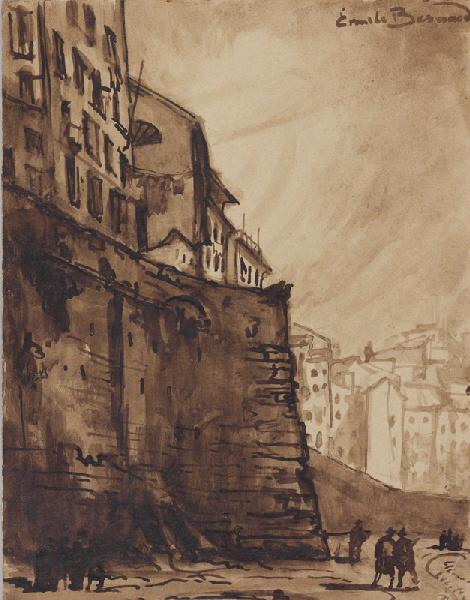
Les remparts, Emile Bernard, 4e quart 19e siècle, 1ère moitié 20e siècle

Les remparts

4e quart 19e siècle, 1ère moitié 20e siècle · Musée des Beaux-Arts de Brest

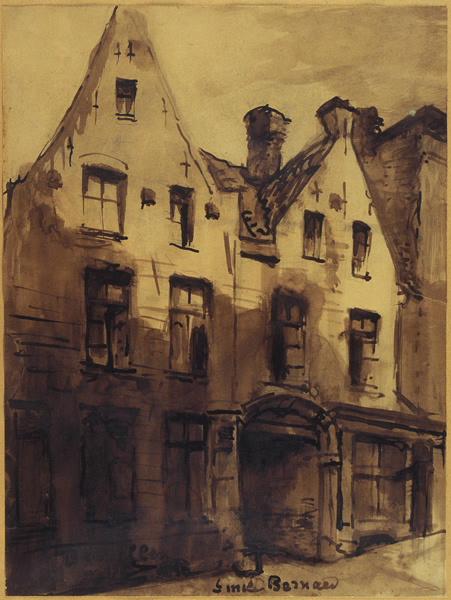
Maisons flamandes, Emile Bernard, 4e quart 19e siècle, 1ère moitié 20e siècle

Maisons flamandes

4e quart 19e siècle, 1ère moitié 20e siècle · Musée des Beaux-Arts de Brest

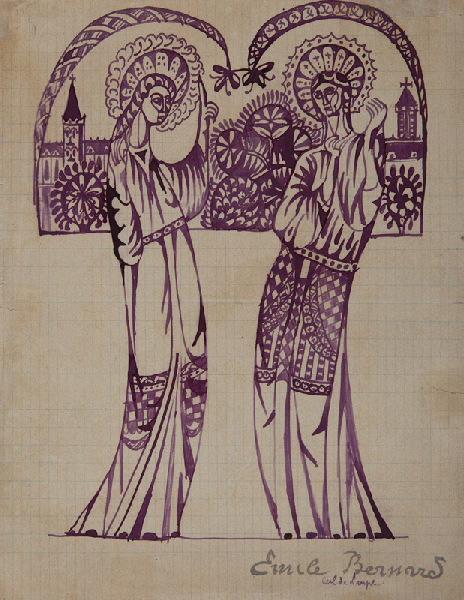
Personnages sur fond d'église, Emile Bernard, 4e quart 19e siècle, 1ère moitié 20e siècle

Personnages sur fond d'église

4e quart 19e siècle, 1ère moitié 20e siècle · Musée des Beaux-Arts de Brest

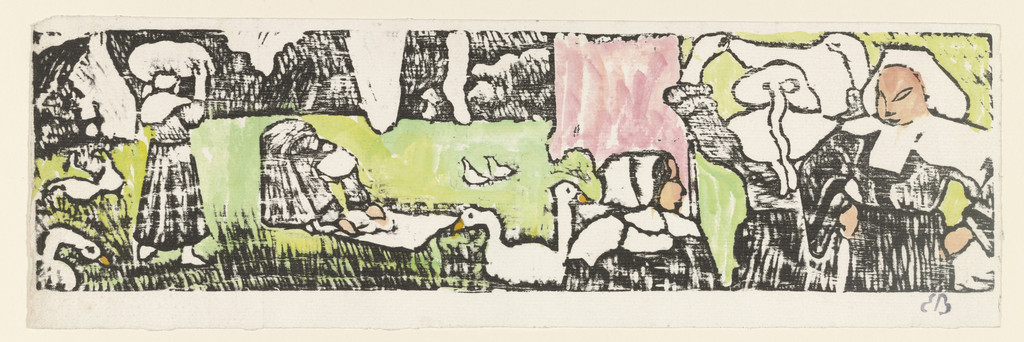
Breton Woman (Les Bretonnes), Émile Bernard, (1883)

Breton Woman (Les Bretonnes)

(1883) · Não exposta · Museu de Arte Moderna

Fisherman and Boat, Émile Bernard, 1885

Fisherman and Boat

1885 · Museu Van Gogh

Bretonne walking near a canal, Émile Bernard, 1886

Bretonne walking near a canal

1886 · Museu Van Gogh

Da coleção: Museu Van Gogh

Página do museu
La Corniche near Monaco, Claude Monet, 1884

Claude Monet

La Corniche bij Monaco, 1884

Reminiscence of Brabant, Vincent van Gogh, 1890

Vincent van Gogh

Reminiscence of Brabant, 1890

Ears of Wheat, Vincent van Gogh, 1890

Vincent van Gogh

Ears of Wheat, 1890

Tree Roots, Vincent van Gogh, 1890

Vincent van Gogh

Tree Roots, 1890

Farmhouse, Vincent van Gogh, 1890

Vincent van Gogh

Farmhouse, 1890

Garden with Butterflies, Vincent van Gogh, 1890

Vincent van Gogh

Garden with Butterflies, 1890

Landscape with Cottages, Vincent van Gogh, 1890

Vincent van Gogh

Landscape with Cottages, 1890

Landscape at Twilight, Vincent van Gogh, 1890

Vincent van Gogh

Landscape at Twilight, 1890