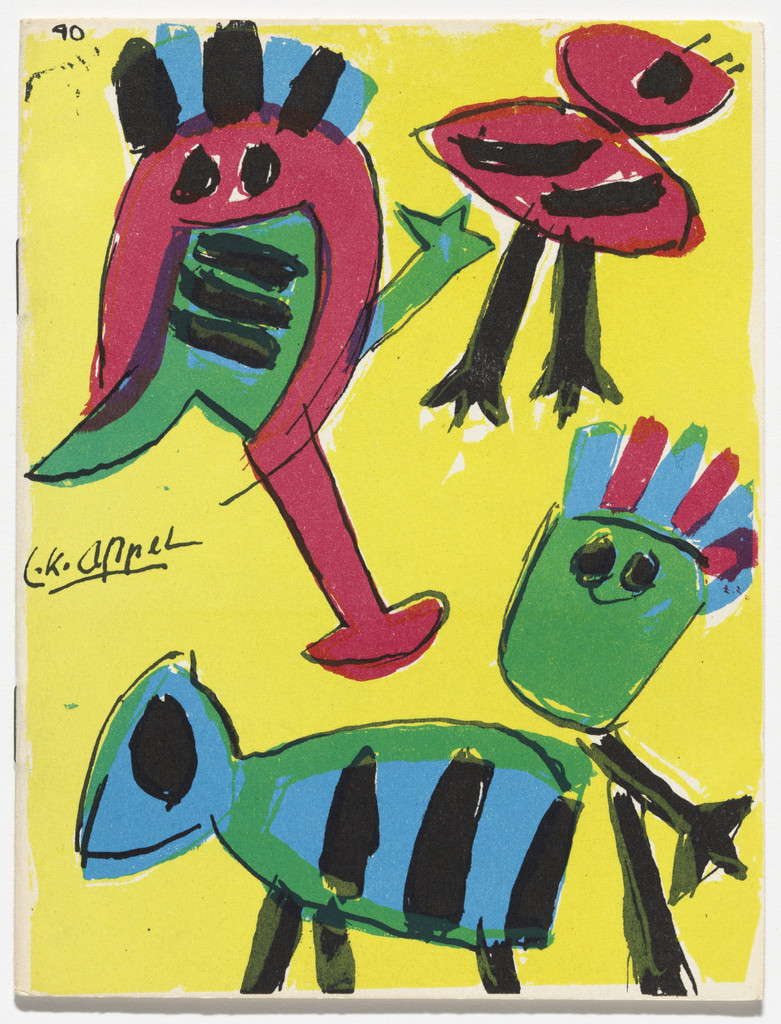
Karel AppelPaíses Baixos, 1921–2006
Square Man
Dá para ver?
Sim, exposta agora
Onde está “Square Man” hoje? Museu Estatal de Amesterdão, Room 3.3 · Freedom, Amesterdão. Sim, exposta agora. Verificado 23 de novembro de 2026.

Fechado· abre amanhã às 9:00
Exposta ao público.
- Verificado
- Com este status desde
- Fonte
- O museu
Sobre a pintura
Karel Appel painted Square Man in 1951; it is at the Rijksmuseum in Amsterdam. Like other Cobra artists seeking a fresh approach after the Second World War, he valued spontaneity. The figure presses against the physical boundaries of the nearly square canvas and has barely enough space to fit. Its meaning remains uncertain: the man could be intruding with impudent confidence or advancing towards us after a terrible experience has left him without clothes. Appel leaves these alternatives unresolved. The painting hangs in room 3.3.
Nas palavras do museu
Cobra Group artists, like Karel Appel, were looking for a new way of painting after the Second World War and spontaneity was the key word. Appel tested the physical limits of the canvas while painting: this man just barely fits in the almost square surface. It is unclear whether he is impertinently horning in, or walking towards us, stripped of his clothes by some terrible event.
Museu Estatal de Amesterdão
Detalhes
- Número de inventário
- SK-A-5002
O que mostra
No catálogo
Histórico de exposição
Em exposição · Room 3.3 · Freedom
Museu Estatal de Amesterdão · 29 de set. de 2026 — agora · Verificado
Não se sabe se estava exposta
Museu Estatal de Amesterdão · Não confirmado
Fontes
- Museu Estatal de Amesterdão
- Imagem: Museu Estatal de Amesterdão — © the artist or rights holder
Na vida de Karel Appel
A vida inteira1949
The scandalous CoBrA show at the Stedelijk Museum
Appel exhibited with the other CoBrA artists at the Stedelijk Museum Amsterdam; the show caused a huge scandal and many objections in the press and among the public.
14 March 1949
Scandal over his fresco in Amsterdam City Hall
Appel completed the fresco “Questioning Children” commissioned for the canteen of Amsterdam City Hall, whose sketch had been approved by a city council committee. It drew a wave of harsh criticism and was covered up for ten years; after the scandal Appel began calling himself a barbarian and kept up the image, literally hurling paint at the canvas and groaning loudly as he worked.
1950
Moves to Paris
Because of the controversy and other negative Dutch reactions to CoBrA, Appel moved to Paris. From there he built an international reputation, traveling to Mexico, the United States, Yugoslavia, Brazil, Japan and China; he also lived in New York and Florence.
1952
Leaves CoBrA and joins Art Informel
Appel left CoBrA and joined the French Art Informel movement.