Pierre-Auguste RenoirFrança, 1841–1919
Seated Bather
Será possível contemplá-la?
Sim, recebe visitas

Exposta ao público. Quem o garante vem indicado abaixo.
- Verificado
- Neste estado desde
- Fonte
- O museu
Sobre a pintura
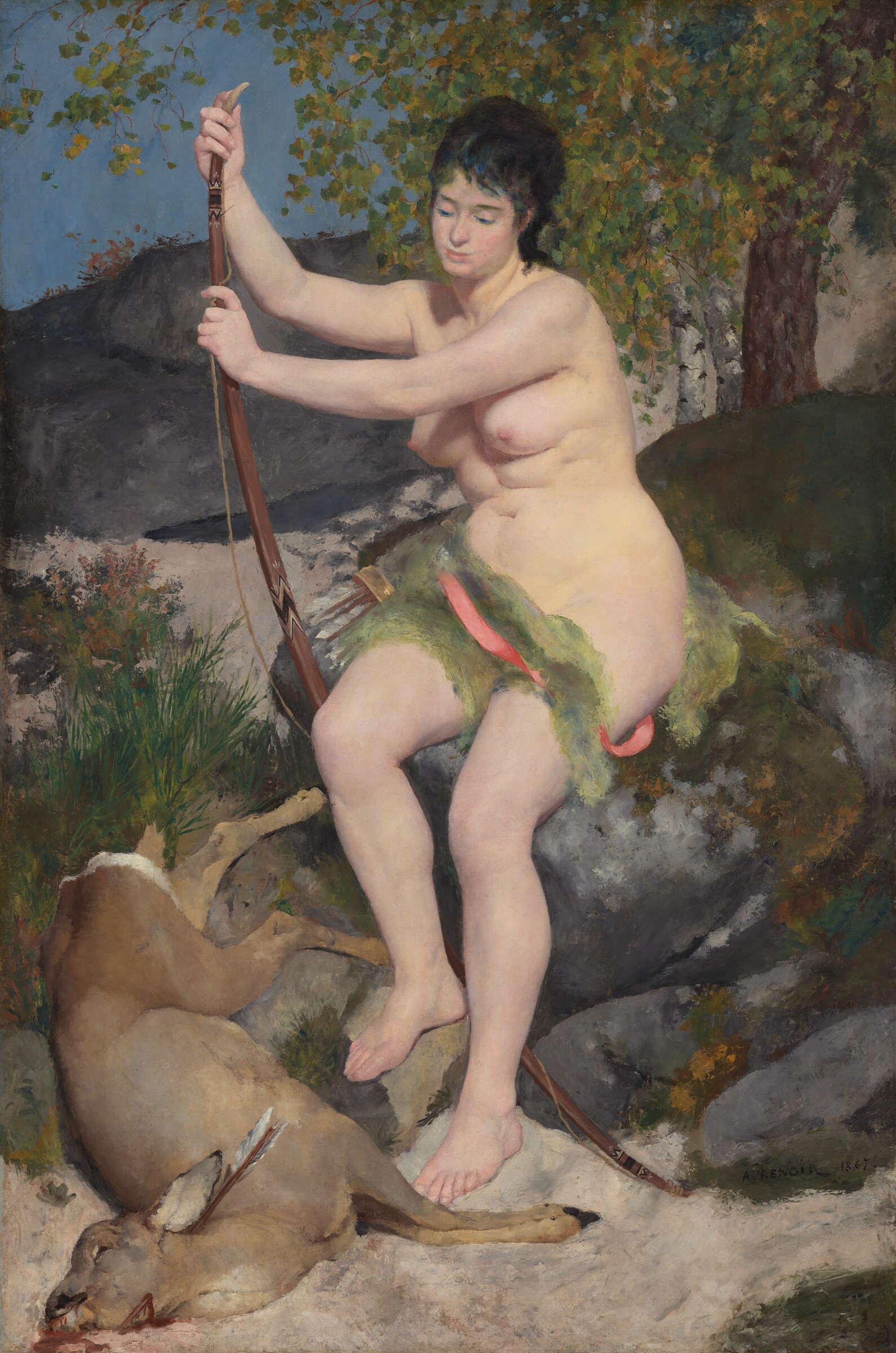
Following a trip to Italy in 1881–82 to study the masterpieces of ancient Roman and Renaissance painting, Renoir embarked on one of his most innovative periods. As he later recalled, “Around 1883 there occurred what seemed to be a break in my work. I had wrung impressionism dry.” Exploring the canonical theme of female nude bathers, Renoir titled a work similar to this one Naiad, or water nymph, highlighting the figure’s classical inspiration. Her pose recalls a well-known Roman sculpture of a bathing nymph; it also evokes a long tradition in painting of depicting nude figures in a landscape. While this work responds to these precedents, it also breaks with them. Renoir painted the figure and her drapery differently from the landscape, so that she appears to float in the setting. He also left her right foot unresolved where it meets the fabric, signaling that his pictorial approach was no longer a purely naturalistic enterprise.
Harvard Art Museums
Pormenores
- Número de inventário
- 1951.59
No catálogo
Fontes
- Harvard Art Museums
- Imagem: Harvard Art Museums — © President and Fellows of Harvard College
Entretanto, na vida de Pierre-Auguste Renoir
A vida inteira1881
Algeria, Madrid, Italy
Renoir traveled to Algeria, the land of Delacroix, then to Madrid to see the works of Velázquez, and to Italy, where he saw Titian in Florence and Raphael in Rome. The journey convinced him that with Impressionism he had "reached the limit," and turned him toward classicism.
6 de julho de 1881
Daughter born: Lucienne Bisson
1882
Pneumonia
Renoir suffered a bout of pneumonia that permanently damaged his respiratory system, and spent six weeks convalescing in Algeria.
15 January 1882
Portrait of Wagner in 35 minutes
In Palermo Renoir met the composer Richard Wagner and painted his portrait in just thirty-five minutes.
summer 1883
Summer on Guernsey
Renoir spent the summer on the island of Guernsey in the English Channel, producing fifteen paintings in little more than a month; most depict Moulin Huet Bay.
1883–1890
The "Ingres" period
Impressed by the classics of the Italian Renaissance and by Ingres, Renoir effectively broke with Impressionism: his lines became crisp, his colors more restrained and cooler. The artist himself called this period "sour"; it includes "Dance in the Country," "Dance in the City" and "Dance at Bougival."