Henri Edmond CrossFrança, 1856–1910
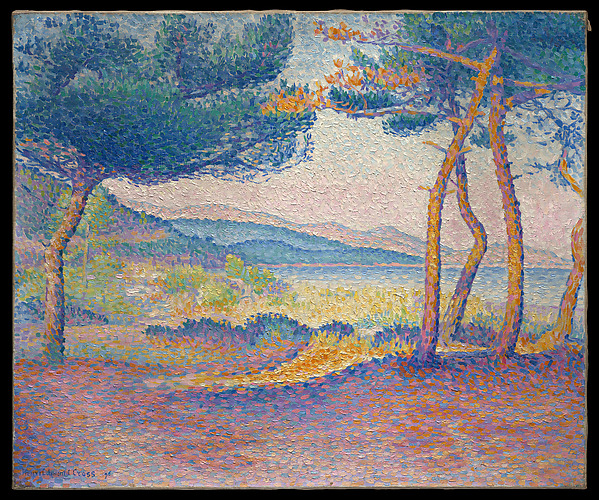
Seascape
Será possível contemplá-la?
Sim, recebe visitas

Cambridge, Estados Unidos
Sala2100, floor 2, European and American Art, 17th–19th century
Exposta ao público. Quem o garante vem indicado abaixo.
- Verificado
- Neste estado desde
- Fonte
- O museu
Sobre a pintura
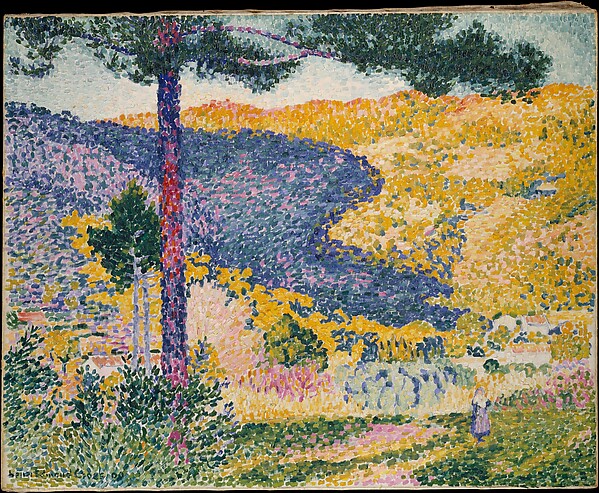
In the early 1890s, Cross adopted the distinctive “pointillist” style of the neo-impressionist movement, producing brilliantly colored views of the landscape along the Mediterranean in the south of France. Sketches like these, roughly painted on thin, unprimed wood, allowed him to experiment with composition and color arrangements in preparation for his canvases. Easily portable, the lightweight panels were designed to fit into standard paint boxes.
Continuar a ler
These small studies are related to finished paintings, each offering an intimate detail of what would become a much larger work. Cross’s pointillist technique can best be seen in "Seascape," in which the regularized strokes create the striated colors and reflections of the evening sky. Dappled white and blue dots delineate the interlaced trees and glittering water. Cross was enraptured with the Mediterranean light, which he described as “bathing all things in its radiance.”
[1937.9, 1937.10, 1937.11]
Harvard Art Museums
Pormenores
- Número de inventário
- 1973.11
No catálogo
Fontes
- Harvard Art Museums
- Imagem: Harvard Art Museums — © President and Fellows of Harvard College
Entretanto, na vida de Henri Edmond Cross
A vida inteiraearly 1880s
Trouble with his eyes begins
In the early 1880s he begins to have trouble with his eyes, which grows severe by the 1900s; he also suffers increasingly from arthritis. Partly because of these long-running illnesses, Cross’s body of work is relatively small.
1890s
Meets Fénéon, Gide and Verhaeren
In the 1890s he works alongside Signac and gets to know the writers and critics Félix Fénéon, André Gide and Emile Verhaeren.
1891
Moves to the south of France because of rheumatism
Having wintered in the south for years, he moves there for good in 1891 because of rheumatism. He lives first in Cabasson near Le Lavandou, then settles nearby in the small hamlet of Saint-Clair, where he stays for the rest of his life, leaving only for Italy and for the annual Indépendants exhibitions in Paris.
1891
Turns to Neo-Impressionism
In 1891 he begins painting in the Neo-Impressionist style and shows his first large piece in this technique at an Indépendants exhibition — a divisionist portrait of Madame Hector France, née Irma Clare.
1892
Signac settles nearby: gatherings in Cross’s garden
His friend Paul Signac moves to nearby Saint-Tropez; in Cross’s garden they often host gatherings attended by Henri Matisse, André Derain and Albert Marquet.
1893
Married: Irma Clare