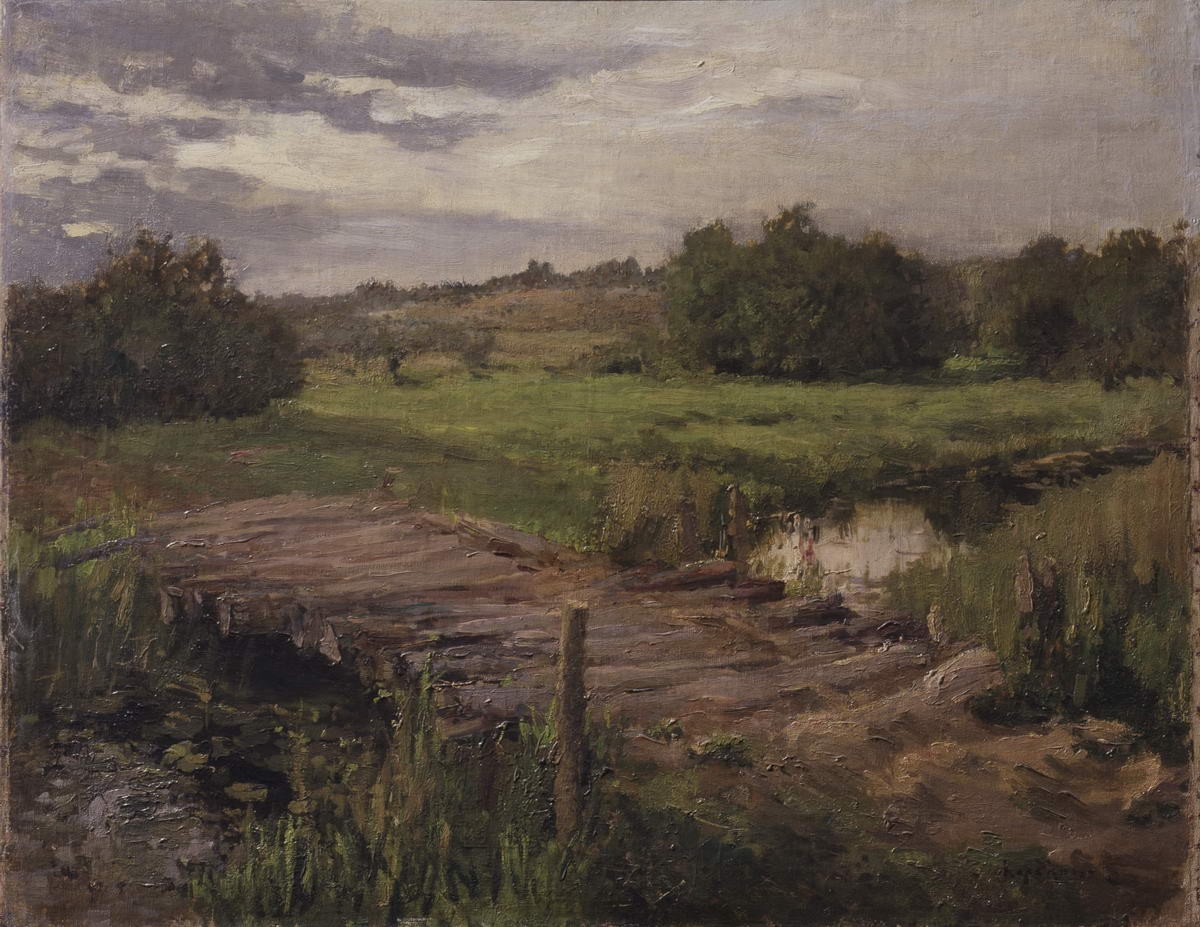
 Konstantin Korovin1861–1939
Ручей
Posso vê-la?
Desconhecido
Onde está «Ручей» hoje? Coleção: Museu Russo, São Petersburgo. Desconhecido.

São Petersburgo, Rússia
O proprietário é conhecido; não se sabe se hoje está exposta.
- Neste estado desde
- Fonte
- O museu
Pormenores
- Número de inventário
- Ж-4334
O que mostra
No catálogo
Fontes
- Museu Russo
- Imagem: Museu Russo — © State Russian Museum
Na vida de Konstantin Korovin
A vida inteira1881–1923 · Local de trabalho
Moscow
23 de junho de 1897
Son born: Aleksey Konstantinovich Korovin
1900
The Russian display at the World’s Fair in Paris
Korovin takes part in designing the Russian section: as an architect he designs the building of the Handicraft department, and as author of the exposition he paints 31 decorative panels (now in the Russian Museum). The fair awards him two gold and seven silver medals; other accounts say he designed the Central Asia section of the Russian Empire pavilion.
early 1900s
Moves to the Mariinsky and creates “mood” sets
At the beginning of the 20th century Korovin moves from Mamontov’s opera to the Mariinsky Theatre in St. Petersburg. Departing from traditional decor that only indicated the place of action, he creates mood decor conveying the general emotions of the performance, and also designs sets for Stanislavsky’s dramatic productions.
1900
Korovin’s name appears for the first time on a state theatre poster
Korovin’s name appears for the first time on the poster of a state theatre: he produces the sets for Alexander Dargomyzhsky’s opera Rusalka.
1900s
The chief designer of the production and tunics instead of corsets
Together with Alexander Golovin, Korovin introduces at the Bolshoi the figure of a chief designer of the production, working as co-author with the director or choreographer (his creative partner is Alexander Gorsky), and proposes replacing ballerinas’ corsets with looser tunics. The set turns from a mere background into a full object of the performance; Korovin regards work on it as just as much “pure art” as painting shown in exhibitions.


![Пруд. Осень, Konstantin Korovin, [Конец 19 в.]](/api/img?u=https%3A%2F%2Fgoskatalog.ru%2Fmuzfo-imaginator%2Frest%2Fimages%2Fpublic%2F1600%2F29700169%2F29700169.jpg)