Joseph Mallord William TurnerReino Unido, 1775–1851
Queen Mab's Cave
Será possível contemplá-la?
De momento, não recebe

Museu de Arte de Cleveland
Cleveland, Estados Unidos
Pertence à coleção, mas de momento não está exposta.
- Verificado
- Neste estado desde
- Fonte
- Os dados da própria coleção do museu
Sobre a pintura
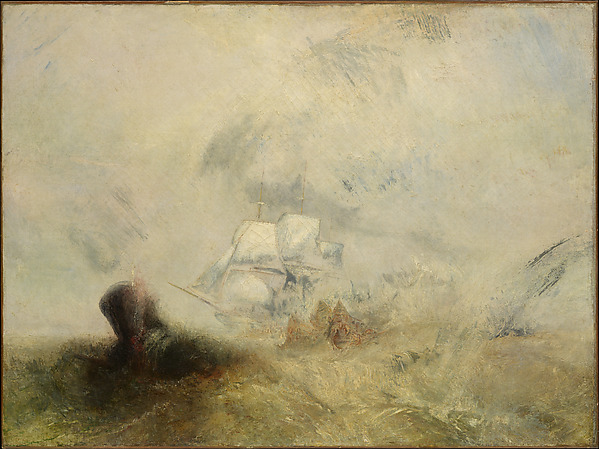
This work is a reduced copy of a painting first exhibited by Turner at the British Institution in 1846 that passed, with the rest of his immense bequest to the nation, into the collections of the National Gallery and finally, in 1954, the Tate Gallery. Several lines from Shakespeare's A Midsummer Night's Dream and Turner's manuscript poem "Fallacies of Hope" were appended to the title in the British Institution catalogue, but they did little to explicate the nearly unintelligible concoction of fairies and Welsh ruins that make up this composition. Copies of Queen Mab's Cave by anonymous artists are abundant.
Museu de Arte de Cleveland
Pormenores
- Número de inventário
- 1916.1036
No catálogo
Fontes
- Museu de Arte de Cleveland: os dados abertos do museu · obtido há 8 dias
- Imagem: Museu de Arte de Cleveland — CC0 (Cleveland Museum of Art Open Access)
Entretanto, na vida de Joseph Mallord William Turner
A vida inteira1830–1840s
Criticism in the 1830s–1840s and Ruskin’s defence
His innovative works, bordering on abstraction, gave him a reputation for madness: the Victorian public preferred realism and sentimentality, and Queen Victoria refused to knight him. John Ruskin came to his defence, calling him “the greatest artist of all time”.
1840–1844
Last journeys: Venice and Switzerland
On a second trip to Venice (1840) he also visited Trieste and Coburg, and in 1841 and 1844 he made two final trips to Switzerland, in his sixties.
1845–1851
Life as “Mr Booth” in Chelsea
In his seventies he formed a relationship with the widow Sophia Caroline Booth and often stayed with her, under the pseudonym “Mr Booth” or “Admiral Booth”, in her house at 6 Davis’s Place (now Cheyne Walk) in Chelsea, where he died in 1851.