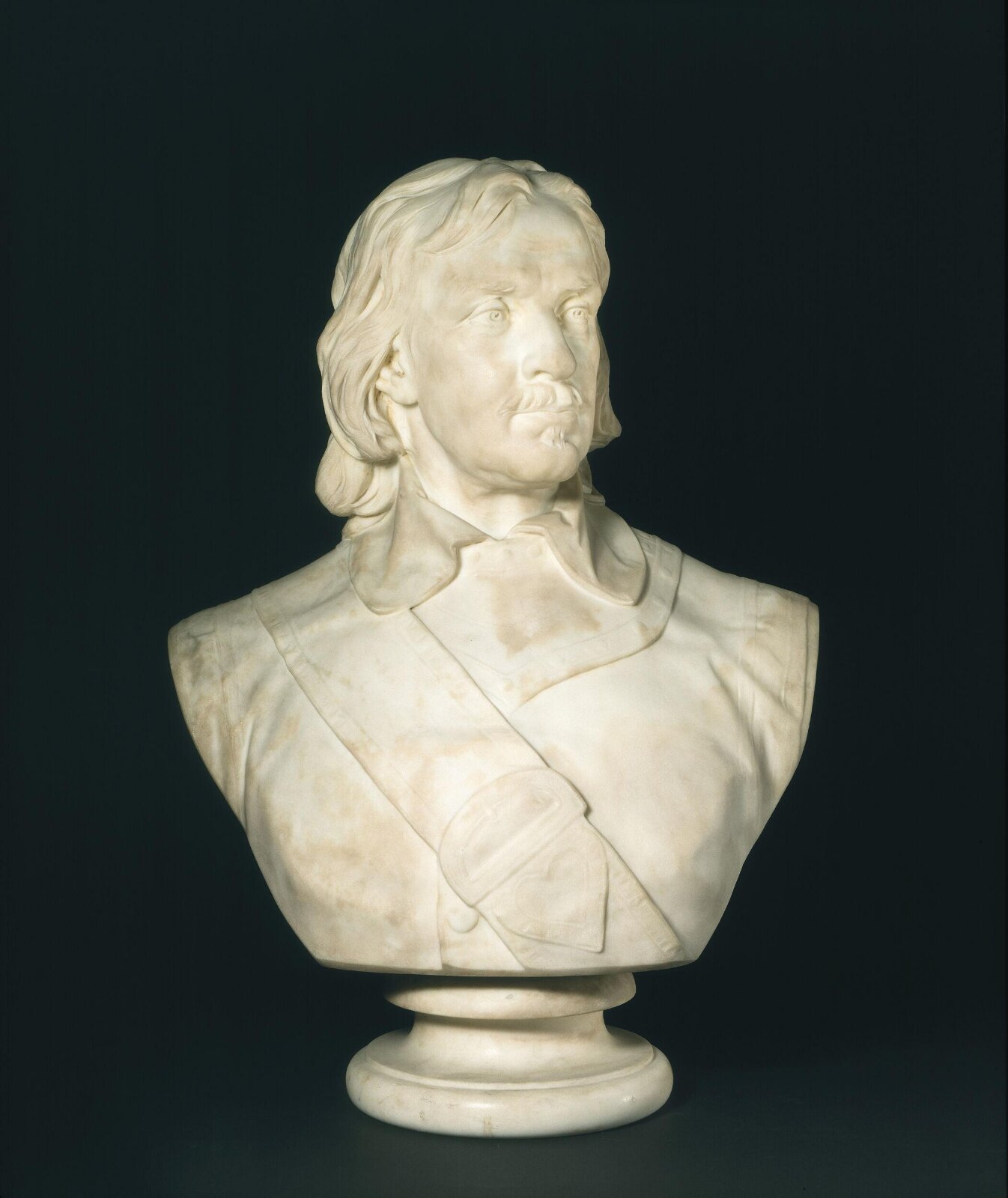
Oliver Cromwell (1599-1658)
Posso vê-la?
Não exposta de momento
Onde está «Oliver Cromwell (1599-1658)» hoje? Coleção: Museu Vitória e Alberto, Londres. Não exposta de momento. Verificado 25 de setembro de 2026.

Londres, Reino Unido
Pertence à coleção, mas de momento não está exposta.
- Verificado
- Neste estado desde
- Fonte
- O museu
Sobre a escultura
The British regicide and de facto ruler of the British Isles in the 1650s, the 'Lord Protector' Oliver Cromwell (1599-1658), was both revered and loathed in Victorian times. Numerous admirers commissioned portraits, including busts. Matthew Noble's (1817 - 1876) other busts of Cromwell are in the Reform Club, London, and Manchester City Hall. He also made a bronze statue of Cromwell in 1875 for Wythenshawe Park, Manchester.
Noble trained in London under John Francis (1780-1861). His 1856 monument to the Duke of Wellington in Manchester made his reputation as a sculptor.
Ler mais
The great Puritan general of the Parliamentary Army during the English Civil War, Oliver Cromwell lived with his family as a gentleman farmer until 1640, when he was elected MP for Cambridge in the Short and Long Parliaments. A fiercely religious idealist who spoke out against oppression, Cromwell and his troops successfully defeated the Royalists in a string of military victories before he emerged as the creator of the New Model Army in 1645. The aftermath of the execution of King Charles I in January 1649 saw Cromwell lead successful campaigns to conquer Ireland and Scotland, as well as managing the crushing defeat of Prince Charles's attempt to recover the Crown at Worcester in 1651, and the launching of victorious wars against the Dutch, Spain, and Tunisian piracy.
In 1653 England was established as a Commonwealth with Cromwell designated Lord Protector, a title he retained until his death in 1658. Cromwell's reputation abroad had meanwhile blossomed, and although he refused pleas to assume the Crown, as time passed he lived more and more with the splendour of a monarch. Following the Restoration in 1660, Cromwell's body was dug up from its resting place in Westminster Abbey and ceremoniously executed.
Museu Vitória e Alberto
Pormenores
- Número de inventário
- 448-1884
O que mostra
No catálogo
Fontes
- Museu Vitória e Alberto
- Imagem: Museu Vitória e Alberto — © Victoria and Albert Museum, London