Frederic Edwin ChurchEstados Unidos, 1826–1900
Niagara
Dá para ver?
Sim, exposta agora
Onde está “Niagara” hoje? Galeria Nacional de Arte, Sala 71 · Edifício Oeste, piso principal, Washington, D.C. Sim, exposta agora. Verificado 23 de novembro de 2026.

Fecha em breve· até às 17:00
Exposta ao público.
- Verificado
- Com este status desde
- Fonte
- O museu
Sobre a pintura
Niagara is an oil painting produced in 1857 by the American artist Frederic Edwin Church. Niagara, which portrays the Horseshoe Falls portion of Niagara Falls, was Church's most important work at the time and confirmed his reputation as the premier American landscape painter of the era.
Detalhes
- Número de inventário
- 2014.79.10
O que mostra
No catálogo
Histórico de exposição
Em exposição · Sala 71 · Edifício Oeste, piso principal
Galeria Nacional de Arte · 29 de set. de 2026 — agora · Verificado
Estava exposta · Sala 72 · Edifício Oeste, piso principal
Galeria Nacional de Arte · 19 de ago. de 2026 — 29 de set. de 2026 · Verificado
Fontes
- Galeria Nacional de Arte
- Imagem: Galeria Nacional de Arte — Museum open access
Na vida de Frederic Edwin Church
A vida inteira1854–1856
Canada, New England and Mount Desert Island
Church travelled in Canada and New England; like Cole, he was among the first city dwellers to summer on Mount Desert Island in Maine, now Acadia National Park.
1857
Second South American journey, with Louis Rémy Mignot
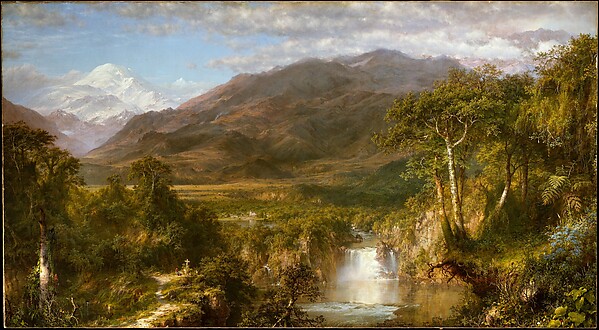
Church returned to South America with the painter Louis Rémy Mignot and added to his sketches; the two journeys produced “The Andes of Ecuador”, “Cayambe”, “The Heart of the Andes” and “Cotopaxi”.
1859
A one-picture show: “The Heart of the Andes” in New York
Thousands paid to see the canvas: its huge floor-standing frame served as a window onto the Andes, visitors sat on benches and studied the details through opera glasses, and Church arranged the room so that light from the skylights fell on the picture. It was an instant success; at this exhibition Church met his future wife, Isabel Carnes.
1859
To the icebergs: Newfoundland and Labrador
His friendship with the Arctic explorer Isaac Israel Hayes stirred Church’s interest in the far north, and with his friend the Rev. Louis Legrand Noble he travelled to Newfoundland and Labrador. Noble chronicled the trip in “After Icebergs with a Painter” (1861), published shortly before “The Icebergs” went on display.