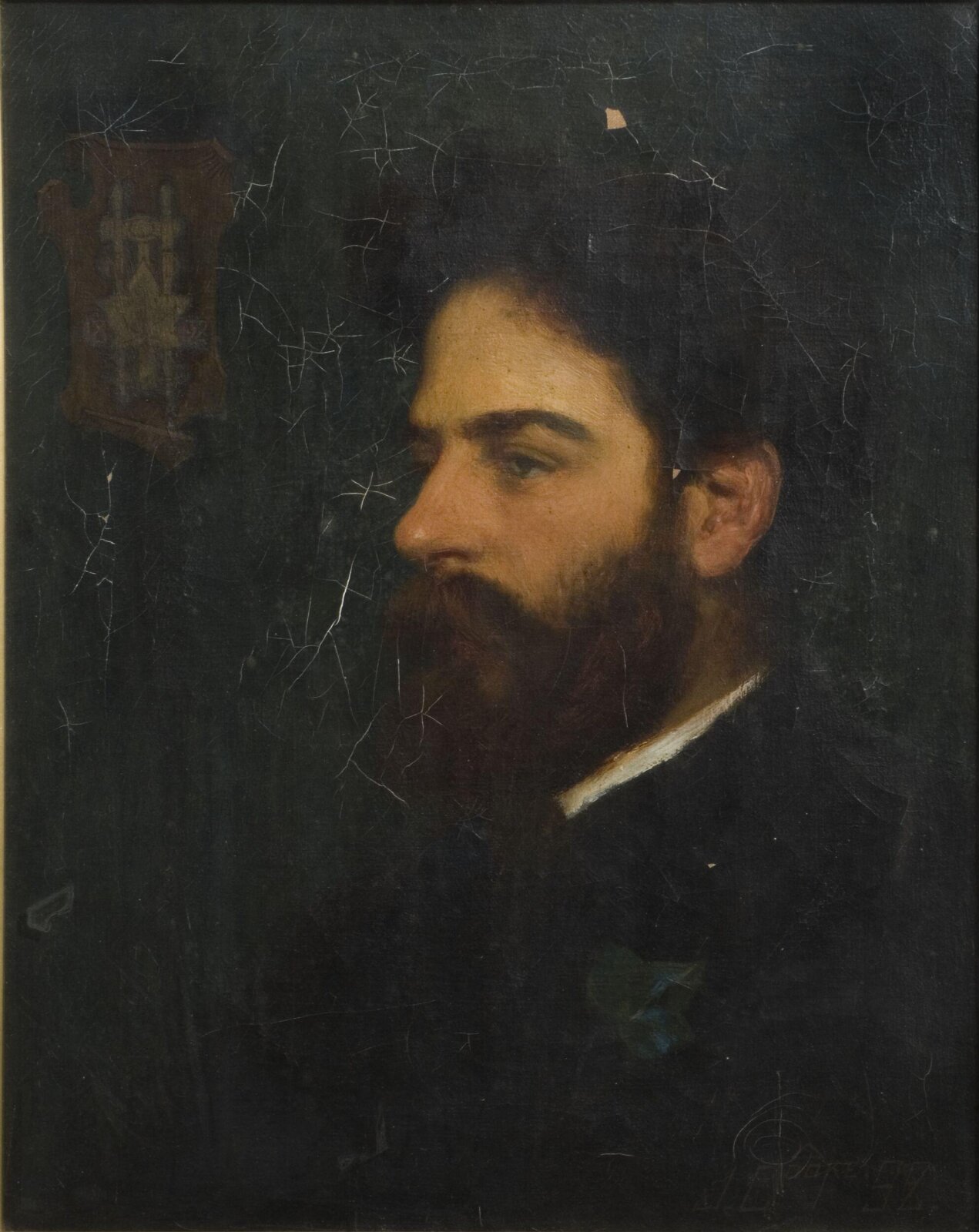
J. Cooke
Nelson Dawson
Será possível contemplá-la?
De momento, não recebe

Museu Vitória e Alberto
Londres, Reino Unido
Pertence à coleção, mas de momento não está exposta.
- Verificado
- há 9 dias
- Neste estado desde
- 25 de set. de 2026
- Fonte
- Os dados da própria coleção do museu
About the painting
After being trained in fine art and metalwork at the South Kensington Schools between 1885 and 1887, Dawson (1859-1941) began a career as a landscape artist. He married Edith Robinson, who had studied metalwork at the South Kensington Schools, in 1893. In 1895 Nelson and Edith Dawson began working predominantly in metalwork. Dawson designed and made metalwork items including lights, bath taps, church metalwork and the trowel used by Queen Victoria for laying the foundation stone of the Victoria & Albert Museum in 1899. In 1901 Dawson became the director of the newly founded Artificers' Guild. He became an active painter again in 1914.
Read on
The painting is signed J. Cooke in the bottom right corner of the canvas. The artist can probably be identified as John Cooke (exhibiting 1895-1907), who, like the subject, was working in the Trafalgar Studios, Manresa Road, Chelsea, in the 1890s.. In this portrait the artist is shown against a dark background in three quarter profile looking to the left. In the left hand corner is a quasi-heraldic device formed of two paintbrushes and a metalworker's hammer, overlaid with an ivy leaf, and the date 1892. This conveys the sitter's profession to the audience.
Museu Vitória e Alberto
Pormenores
- Número de inventário
- E.1406-2001
What it shows
No catálogo
Fontes
- Museu Vitória e Alberto: the museum's own open data · obtido há 9 dias
- Imagem: Museu Vitória e Alberto — © Victoria and Albert Museum, London