
 James GillrayReino Unido, 1757–1815
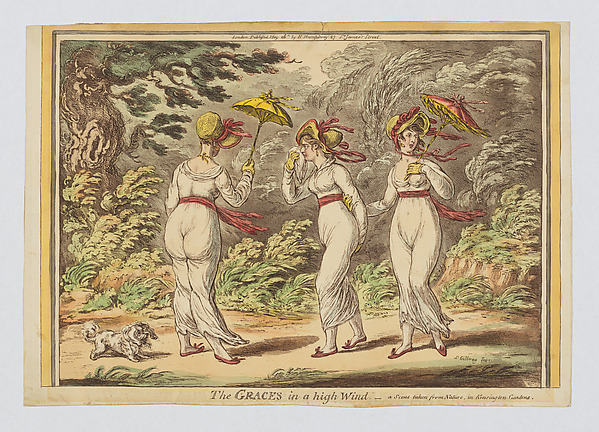
Modern Grace
Será possível contemplá-la?
De momento, não recebe

Galeria Nacional de Arte
Washington, D.C., Estados Unidos
Pertence à coleção, mas de momento não está exposta.
- Verificado
- anteontem
- Neste estado desde
- 19 de ago. de 2026
- Fonte
- Os dados da própria coleção do museu
Pormenores
- Número de inventário
- 2013.170.3
What it shows
Fontes
- Galeria Nacional de Arte: the museum's own open data · obtido há 5 dias
- Imagem: Galeria Nacional de Arte — Museum open access
Entretanto, na vida de James Gillray
A vida inteira1790s
A conservative stance during the French Revolution
During the French Revolution Gillray takes a conservative stance and issues caricature after caricature ridiculing the French and Napoleon (usually using Jacobin) and glorifying John Bull; a number of these are published in the Anti-Jacobin Review. He is not, however, to be thought of as a keen political adherent of either the Whig or the Tory party; his caricatures satirize members of all sides of the political spectrum.
1792–1810
Living with his publisher Hannah Humphrey
Throughout the period of his fame Gillray lives with Miss (often called Mrs) Hannah Humphrey, his publisher and print seller, whose shop was first at 227 Strand, then in New Bond Street, then in Old Bond Street and finally in St James’s Street; his plates are exposed in her shop window, where eager crowds examine them. It is believed that he several times thinks of marrying her and that on one occasion, on their way to the church, he says this is a foolish affair, that they live very comfortably together and had better let well alone; there is no evidence to support the stories scandalmongers invent about them.
1792–1810
His peak years: political and social satires
He issues the bulk of his etched political and social satires between 1792 and 1810: the targets include George III and Queen Charlotte, the Prince of Wales, Fox, Pitt the Younger, Burke, Napoleon, prime ministers and generals, and the prints circulate throughout Britain and Europe. After examining some of the sketches the king remarks that he does not understand these caricatures, and Gillray takes his revenge with A Connoisseur Examining a Cooper, satirizing at once the king’s pretensions to knowledge of art and his miserly habits. Nearly 1000 caricatures are attributed to him, and some consider him the author of as many as 1600 or 1700.
3 November 1798
Lord Bateman thanks him for making the Opposition ridiculous
Lord Bateman writes to Gillray that the Opposition are as low as they could wish them and that he has been of infinite service in lowering them and making them ridiculous, a testimony to the contemporary political influence of his prints. Towards the end of his life Napoleon allegedly stated that Gillray’s caricatures of him as unusually short did more than all the armies of Europe to bring him down.


![Ginevra de' Benci [obverse], Leonardo da Vinci, c. 1474/1478](https://api.nga.gov/iiif/8f29e3c9-a289-4d53-abf0-31a66e9e98fa/full/!2400,2400/0/default.jpg)
![Wreath of Laurel, Palm, and Juniper with a Scroll inscribed Virtutem Forma Decorat [reverse], Leonardo da Vinci, c. 1474/1478](https://api.nga.gov/iiif/ff62e8d0-45c4-498f-ad36-6358de827e04/full/!2400,2400/0/default.jpg)


