ART WIKI32 963 em exposição
MapaColeçãoArtistasMuseusExposiçõesRevista
Entrar

ART WIKI

Onde está a obra-prima, e a que horas se abre a porta.

Coleções: Art Institute of Chicago, Galeria Nacional de Arte, Galeria Tretiakov, Getty Villa, Harvard Art Museums, Hermitage, Hirshhorn Museum and Sculpture Garden, Instituto de Artes de Minneapolis, Museu de Arte de Cleveland, Museu de Arte Moderna, Museu do Louvre, Museu Estatal de Amesterdão, Museu J. Paul Getty, Museu Metropolitano de Arte, Museu Nacional de Arte da Dinamarca, Museu Pushkin, Museu Russo, Museu Smithsoniano de Arte Americana, Museu Vitória e Alberto, Museu Whitney de Arte Americana, National Museum of Asian Art, National Portrait Gallery, Catálogo Estatal do Fundo Museológico da Rússia (274 museus), Europeana (19 museus), Wikidata (6 museus), Paris Musées (12 museus) e Joconde, a base de museus do Ministério da Cultura de França (495 museus). As imagens pertencem aos titulares dos direitos.

Secções

  • Mapa
  • Pesquisa
  • Coleção
  • Obras-primas
  • Em exposição agora
  • Artistas

Mais

  • Museus e galerias
  • Exposições
  • Revista
  • De onde vêm os dados
  • Privacidade e cookies
InícioMapaCatálogo
  1. Coleção/
  2. Museu de Orsay/
  3. L'Orchestre de l'Opéra
L'Orchestre de l'Opéra, Edgar Degas, 1868
Edgar Degas, retratoEdgar DegasFrança, 1834–1917

L'Orchestre de l'Opéra

1868 · Painting · 56.5 × 45 cm

Será possível contemplá-la?

Desconhecido

Museu de Orsay

Paris, França

O proprietário é conhecido; não se sabe se hoje está exposta.

Neste estado desde
29 de set. de 2026
Fonte
O museu
No mapaPágina do museu

Sobre a pintura

The Orchestra at the Opera (c. 1870) is an oil-on-canvas painting by the French artist Edgar Degas (1834–1917).

The musicians depicted in the orchestra pit of the Salle Le Peletier the home of the Paris Opera (from 1821 until it burnt down in 1873) are mostly portraits of friends of Degas, foremost among them pictorially the bassoonist and composer Désiré Dihau (1838–1909), who commissioned the painting, at work on his instrument, and the cellist Louis-Marie Pilet (1815–1877) on his string instrument.

The painting was handed over, without further retouching possible, to its owner (Dihau), who exhibited it in Lille, which caused Degas' family, until then doubtful about the art of their "Raphael", to remark: "It is thanks to you that he has finally produced and completed a work, a real painting".

Continuar a ler

Blurring the distinction between portraiture and genre pieces, Degas painted his bassoonist friend, Désiré Dihau, in The Orchestra at the Opera as one of fourteen musicians in an orchestra pit, viewed as though by a member of the audience. Above the musicians can be seen only the legs and tutus of the dancers onstage, their figures cropped by the edge of the painting. Art historian Charles Stuckey has compared the viewpoint to that of a distracted spectator at a ballet, and says that "it is Degas' fascination with the depiction of movement, including the movement of a spectator's eyes as during a random glance, that is properly speaking 'Impressionist'."

The painting is the first instance in Degas' work where dancers from the ballet appear. He would depict dancers frequently for the rest of his career, and it is for his ballet pictures that he remains best known.

Wikipédia · CC BY-SA

Pormenores

1868 · aos 34 anos
18341917
Número de inventário
RF 2417

No catálogo

PinturasPintura francesaRealismoImpressionismoSéculo XIX

Fontes

  • Wikidata
  • Imagem: Museu de Orsay — Edgar Degas · Public domain · Wikimedia Commons

Entretanto, na vida de Edgar Degas

A vida inteira
  1. late 1860s

    The turn to modern life: racecourses, milliners, laundresses

    By the late 1860s Degas had moved from history painting to an original observation of contemporary life: racecourse scenes let him paint horses and riders in a modern setting, and then he turned to women at work — milliners and laundresses.

  2. late 1860s

    Begins modelling in wax

    Degas modelled small wax figures of dancers, bathers and jockeys for himself, in place of studies. He never worked in bronze or stone; he valued wax for its changeability, and his sculptor friend Bartholomé encouraged him.

  3. 1870

    A volunteer in the war; a flaw in his eyesight

    When the Franco-Prussian War broke out Degas volunteered; at the first shooting practice it turned out that he saw poorly with his right eye. It was the first sign of the macular degeneration that left him almost blind at the end of his life; he was transferred to the artillery and served there to the end of the war.

  4. early 1870s

    Meets Durand-Ruel

    Degas met the dealer Durand-Ruel, later the most prominent of the trusted dealers with whom he planned his strategy at auctions.

  5. 1870s

    From “de Gas” back to plain “Degas”

    The archives disproved the legend of an ancient noble line: the artist's paternal ancestors were bakers, and the name “de Gas” was invented by his father, who commissioned a false genealogy. In the 1870s Edgar returned to the plain spelling, Degas.
Mais obras de Edgar Degas

Todas as obras
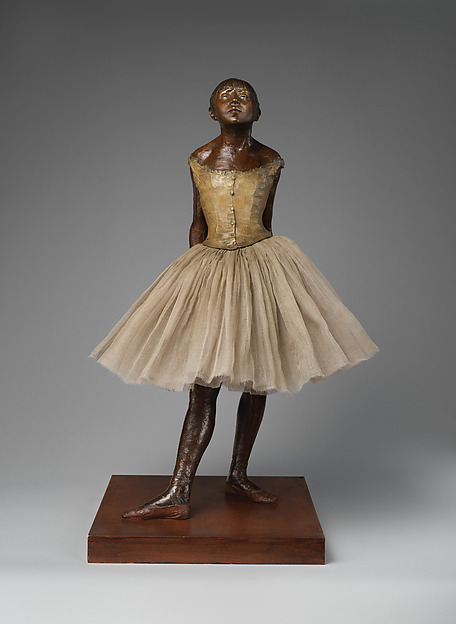
The Little Fourteen-Year-Old Dancer, Edgar Degas, modeled 1881, cast 1922, modern tutu

The Little Fourteen-Year-Old Dancer

modeled 1881, cast 1922, modern tutu · Museu Metropolitano de Arte

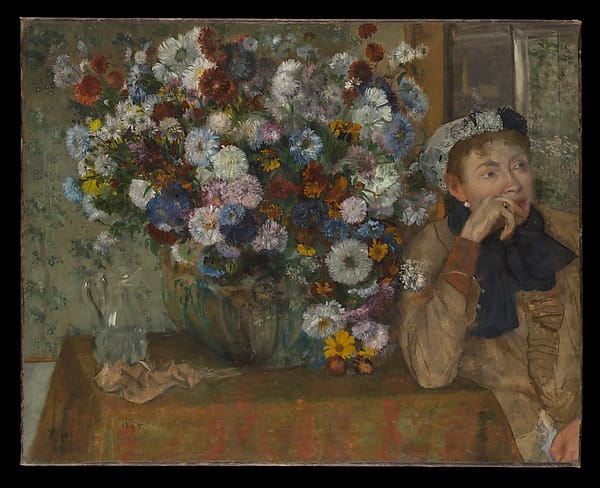
A Woman Seated beside a Vase of Flowers (Madame Paul Valpinçon?), Edgar Degas, 1865

A Woman Seated beside a Vase of Flowers (Madame Paul Valpinçon?)

1865 · Museu Metropolitano de Arte

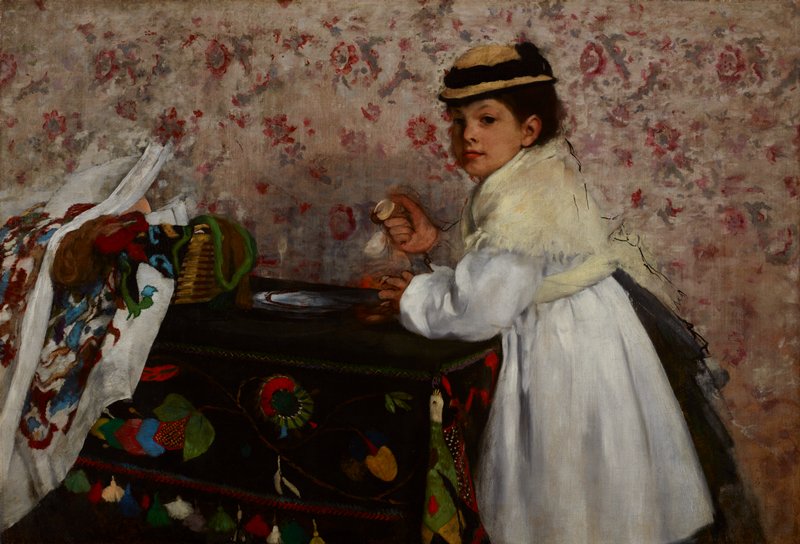
Portrait of Mlle. Hortense Valpinçon, Edgar Degas, c. 1871

Portrait of Mlle. Hortense Valpinçon

c. 1871 · Instituto de Artes de Minneapolis

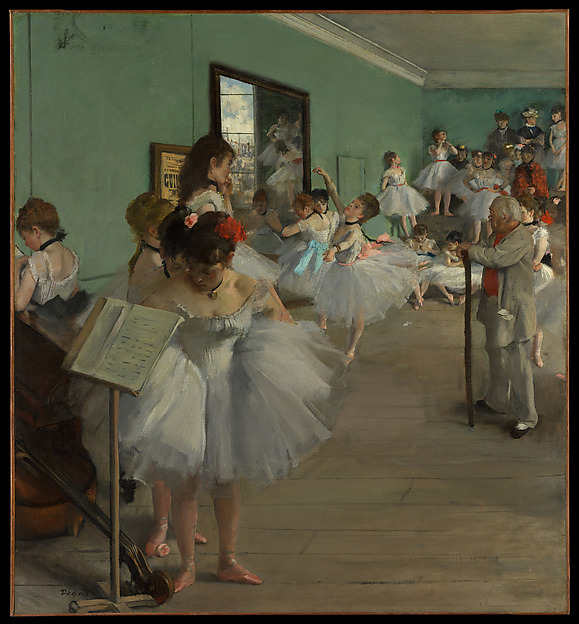
The Dance Class, Edgar Degas, 1874

The Dance Class

1874 · Museu Metropolitano de Arte

Woman Having Her Hair Combed, Edgar Degas, ca. 1886–88

Woman Having Her Hair Combed

ca. 1886–88 · Museu Metropolitano de Arte

Study in the Nude of Little Dancer Aged Fourteen (Nude Little Dancer), Edgar Degas, original wax c. 1878-1881, cast 1920/1926

Study in the Nude of Little Dancer Aged Fourteen (Nude Little Dancer)

original wax c. 1878-1881, cast 1920/1926 · Galeria Nacional de Arte

Horse Galloping on the Right Foot, Edgar Degas, late 1880s

Horse Galloping on the Right Foot

late 1880s · Galeria Nacional de Arte

Horse Trotting, the Feet Not Touching the Ground, Edgar Degas, 1870s

Horse Trotting, the Feet Not Touching the Ground

1870s · Galeria Nacional de Arte

Da coleção: Museu de Orsay

Página do museu
Still Life: Japanese Vase with Roses and Anemones, Vincent van Gogh, 1890

Vincent van Gogh

Still Life: Japanese Vase with Roses and Anemones, 1890

Chaumes de Cordeville, Vincent van Gogh, 1890

Vincent van Gogh

Chaumes de Cordeville, 1890

Doctor Gachet's Garden in Auvers, Vincent van Gogh, 1890

Vincent van Gogh

Doctor Gachet's Garden in Auvers, 1890

Two Children, Vincent van Gogh, 1890

Vincent van Gogh

Two Children, 1890

The siesta (after Millet), Vincent van Gogh, 1890

Vincent van Gogh

A Siesta, 1890

Marguerite Gachet in the Garden, Vincent van Gogh, 1890

Vincent van Gogh

Marguerite Gachet in the Garden, 1890

The Church at Auvers, Vincent van Gogh, 1890

Vincent van Gogh

A Igreja de Auvers, 1890

Portrait of Dr. Gachet, Vincent van Gogh, 1890

Vincent van Gogh

Portrait of Dr. Gachet, 1890