 Frans HalsPaíses Baixos, 1581–1666
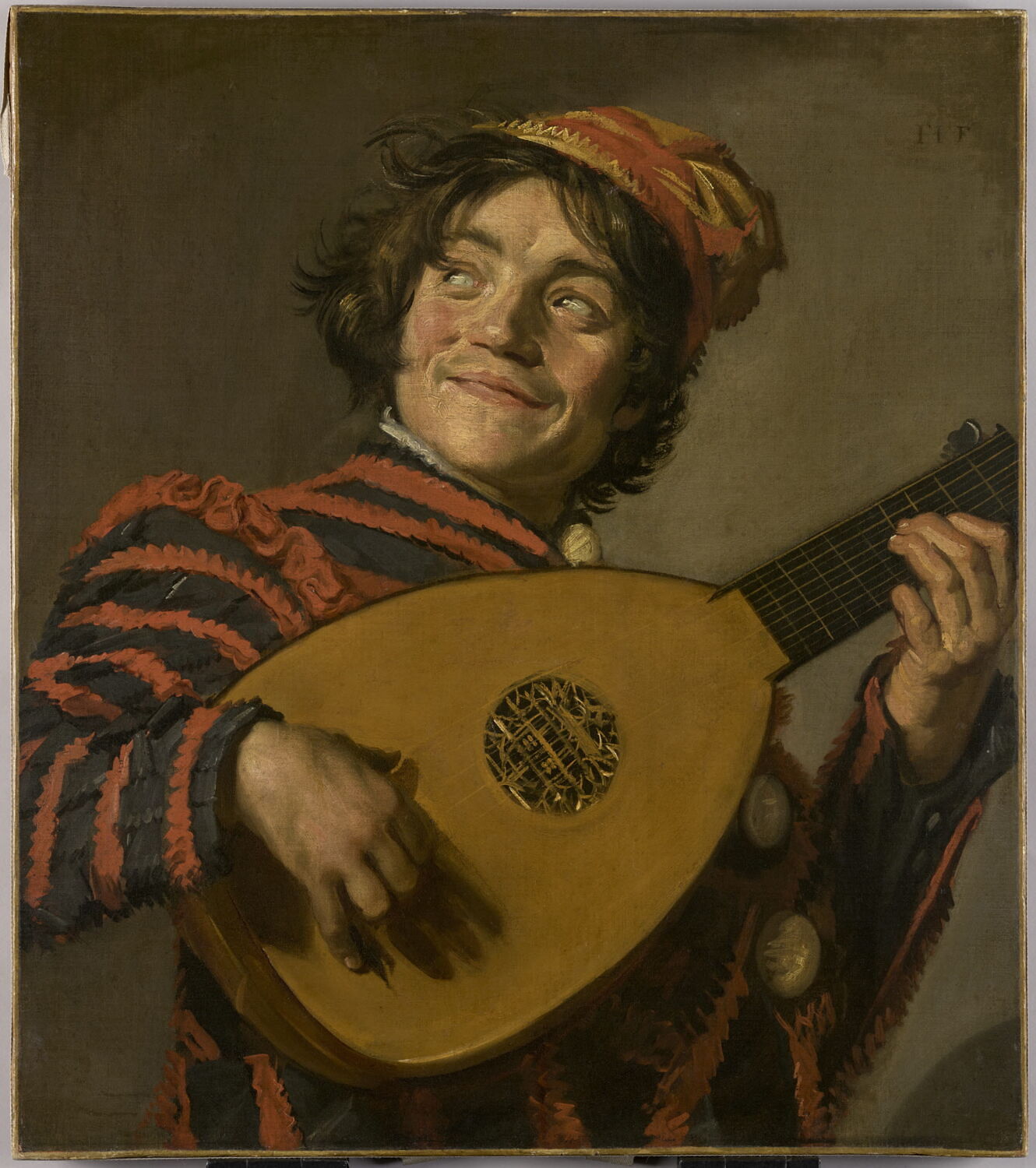
Le Bouffon au luth
Posso vê-la?
Sim, exposta agora
Onde está «Le Bouffon au luth» hoje? Museu do Louvre, Salle 846, Aile Richelieu, Niveau 2, Paris. Sim, exposta agora. Verificado 26 de setembro de 2026.

Exposta ao público.
- Verificado
- Neste estado desde
- Fonte
- O museu
Sobre a pintura
The Lute Player is an oil-on-canvas painting from 1623 or 1624 now in the Louvre by the Haarlem painter Frans Hals, showing a smiling actor wearing a jester's costume and playing a lute.
Ler mais
This painting was documented by Wilhelm von Bode in 1883, Ernst Wilhelm Moes in 1909 and Hofstede de Groot in 1910, who wrote:98. A FOOL WITH A MANDOLINE. B. 45; M. 216.- Half-length. A man turned half-right, in a red costume trimmed with yellow. He has long hair, and wears a red and yellow cap. His head is seen in full face; he looks up to the left. With his right hand he touches the strings of a mandoline; his left hand grasps the neck. Very freely handled. Especially good are the various contrasting flesh-tones, the red and yellow of the costume, and the reflections in the eyes. [Compare 95.] Signed in the right at top, F. H.; canvas, about 29 inches by 24 inches. A copy (B. 16, and see M. 216) is in the Rijksmuseum, Amsterdam, 1907 catalogue, No. 1093; it measures 26 inches by 24 inches, having rather less at the foot than the original. In the collection of Baron Gustave de Rothschild, Paris.
The theme of a lute player painted at half length originated in Italy, and the Dutch painter Dirck van Baburen first introduced this theme in the Northern Netherlands with his lute player of 1622. Baburen's player is pointing his lute towards the viewer with his mouth open in song. Hals' player is looking up and smiling naturally, as if he is playing with a singer or another musician not in view. This painting is a good example of Hals' "rough style" of painting with loose brush strokes.
A period copy now in the collection of the Rijksmuseum has been dated before 1626 based on an engraving, and it has been attributed variously to Hals, his brother Dirk, and Judith Leyster.
Two other paintings of lute players by Hals are:
Hals was not the only painter to be influenced by Baburen. Hendrik ter Brugghen painted several lute players in the 1620s, and a few of them seem to merge aspects of Baburen and Hals, though his later version seems to follow Hals more closely.
Pormenores
- Número de inventário
- RF 1984 32
No catálogo
Fontes
- Museu do Louvre
- Imagem: Museu do Louvre — © 2018 GrandPalaisRmn (musée du Louvre) / Mathieu Rabeau
Na vida de Frans Hals
A vida inteira1612–1624
Service in the Haarlem civic guard
From 1612 to 1624 Hals serves in the local civic guard (schutterij); he will paint his first “militia picture” in 1616 and his last in 1639.
1617–1666 · Local de trabalho
Haarlem
1618–1626
The chamber of rhetoric “The Vine Branches”
From 1618 to 1626 Hals is a member of Haarlem's chamber of rhetoric, the literary society “The Vine Branches” (De Wijngaertranken).
1623
Daughter born: Adriaentje Hals
dezembro de 1624
Son born: Jacob Hals
1626
Pupil: Adriaen van Ostade