 Gwen JohnReino Unido, 1876–1939
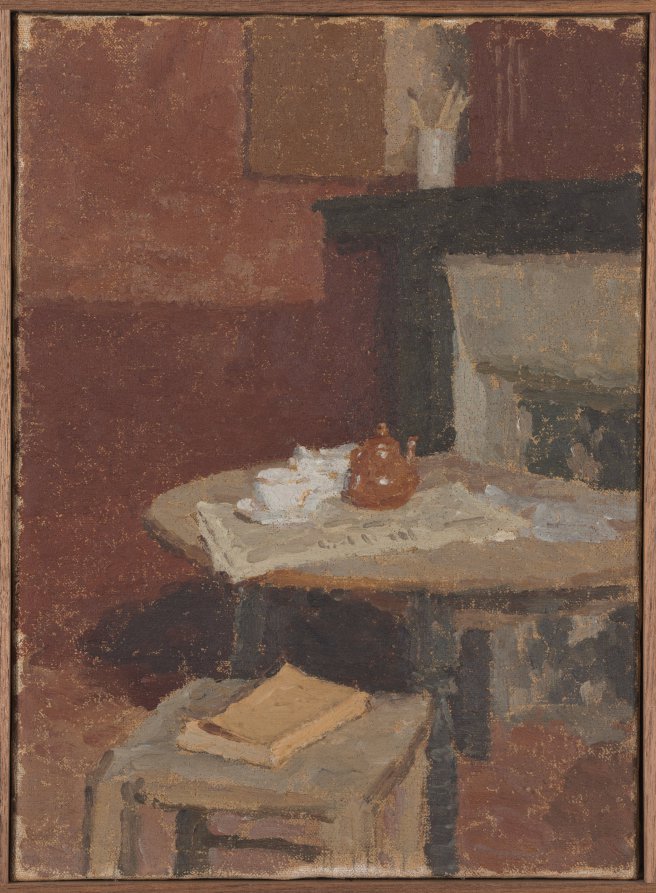
Interior
Dá para ver?
Sim, exposta agora
Onde está “Interior” hoje? Museu de Arte de Cleveland, 223 20th Century Avant-Garde, Cleveland. Sim, exposta agora. Verificado 16 de novembro de 2026.

Aberto agora· até às 17:00
Exposta ao público.
- Verificado
- Com este status desde
- Fonte
- O museu
Sobre a pintura
Gwen John painted a table with a teapot and cups in Interior, dated 1915 and now in the Cleveland Museum of Art, Cleveland. Its small scale and muted colors recur throughout her work. She painted slowly, completing fewer than two hundred pictures in her lifetime, and told a friend of her desire for an inward life. John returned to this subject four times. The other versions are in the National Museum of Wales and two Yale collections, the Center for British Art and the University Art Gallery. On view in gallery 223.
Nas palavras do museu
Gwen John worked slowly and meticulously, producing fewer than 200 paintings during her lifetime. Like this quiet interior with a table, teapot, and cups, her works were invariably small in size, muted in palette, and restrained in mood. About her life and art, she wrote to a friend, “I may never have anything to express, except this desire for a more interior life.” This is one of a series of four paintings of the same subject; the other versions are in the collections of the National Museum of Wales, the Yale Center for British Art, and the Yale University Art Gallery.
Museu de Arte de Cleveland
Detalhes
- Número de inventário
- 1982.6
No catálogo
Fontes
- Museu de Arte de Cleveland
- Imagem: Museu de Arte de Cleveland — Museum open access
Na vida de Gwen John
A vida inteira1904–1914
Ten years of devotion to Rodin: thousands of letters
Her devotion to Rodin, the most famous artist of his time and 35 years older than her, continued unabated for the next ten years, as documented in her thousands of fervent letters to him. Given to fierce attachments to both men and women that were sometimes disturbing to them, she was eventually kept at a distance by Rodin, despite his genuine feeling for her, through the use of concierges and secretaries.
c. 1913
Received into the Catholic Church
As her affair with Rodin drew to a close she sought comfort in Roman Catholicism and around 1913 was received into the Church; her notebooks of the period include meditations and prayers, and her desire to be “God’s little artist” and to “become a saint”.
17 de fevereiro de 1913 – 19 de maio de 1913
Exhibition: Armory Show