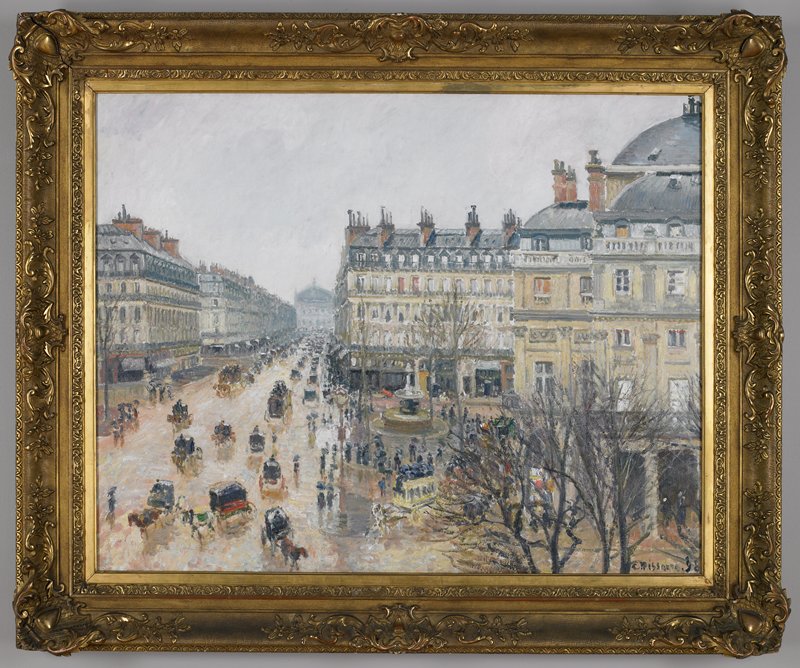
Camille Jacob PissarroFrança, 1830–1903
Haven van Rouen
Posso vê-la?
Desconhecido
Onde está «Haven van Rouen» hoje? Coleção: Museu Estatal de Amesterdão, Amesterdão. Desconhecido.

Amesterdão, Países Baixos
O proprietário é conhecido; não se sabe se hoje está exposta.
- Fonte
- O museu
Sobre a obra
Nas palavras do museu — em holandês
Gezicht op de haven van Rouen. Een aantal mannen zijn aan het werk op de kade.
Museu Estatal de Amesterdão
Pormenores
- Número de inventário
- RP-P-1944-2750
O que mostra
No catálogo
Fontes
- Museu Estatal de Amesterdão
- Imagem: Museu Estatal de Amesterdão — public domain
Na vida de Camille Jacob Pissarro
A vida inteira1872–1884
Life in Pontoise
Back in France, Pissarro lived in Pontoise from 1872 to 1884, where he painted a great many pictures, keeping in touch with fellow artists, above all Monet, Renoir and Cézanne.
1880s
A search for something new: peasant labour without idealisation
By the 1880s some Impressionists felt the movement had exhausted itself, and Pissarro returned to scenes of country life, showing people at work without idealising them; in 1882 Renoir called these works “revolutionary”.
1884
Settles at Éragny-sur-Epte
In April 1884 Pissarro and his family settled at Éragny-sur-Epte, a village near Gisors, where he lived for the rest of his life; he wrote to his son Lucien that the house was superb, with a garden and meadows. The house, garden, orchard, meadows and farm workers became recurring subjects for the last nineteen years of his career.
1885–1888
Pointillism: working beside Seurat and Signac
In 1885 Pissarro came into close contact with Georges Seurat and Paul Signac, whose technique juxtaposed small strokes of relatively pure colour, and until 1888 he experimented extensively with it, regarding it not as a rejection of Impressionism but as a possible continuation of it; among the older Impressionists this was unusual.
1886
The eighth Impressionist exhibition
At the eighth and final Impressionist exhibition Pissarro showed works in the new method in a separate grouping with Seurat, Signac and his son Lucien; the marked change in his technique attracted considerable attention from the critics.
late 1880s
Abandoning Neo-Impressionism
By the end of the 1880s Pissarro found the method of divided colour too restrictive: it made it hard to respond freely to changing effects of nature, movement and personal sensation; what remained from the experiment was a heightened attention to colour relationships and a more structured handling of the surface.