Claude LorrainFrança, 1600–1682
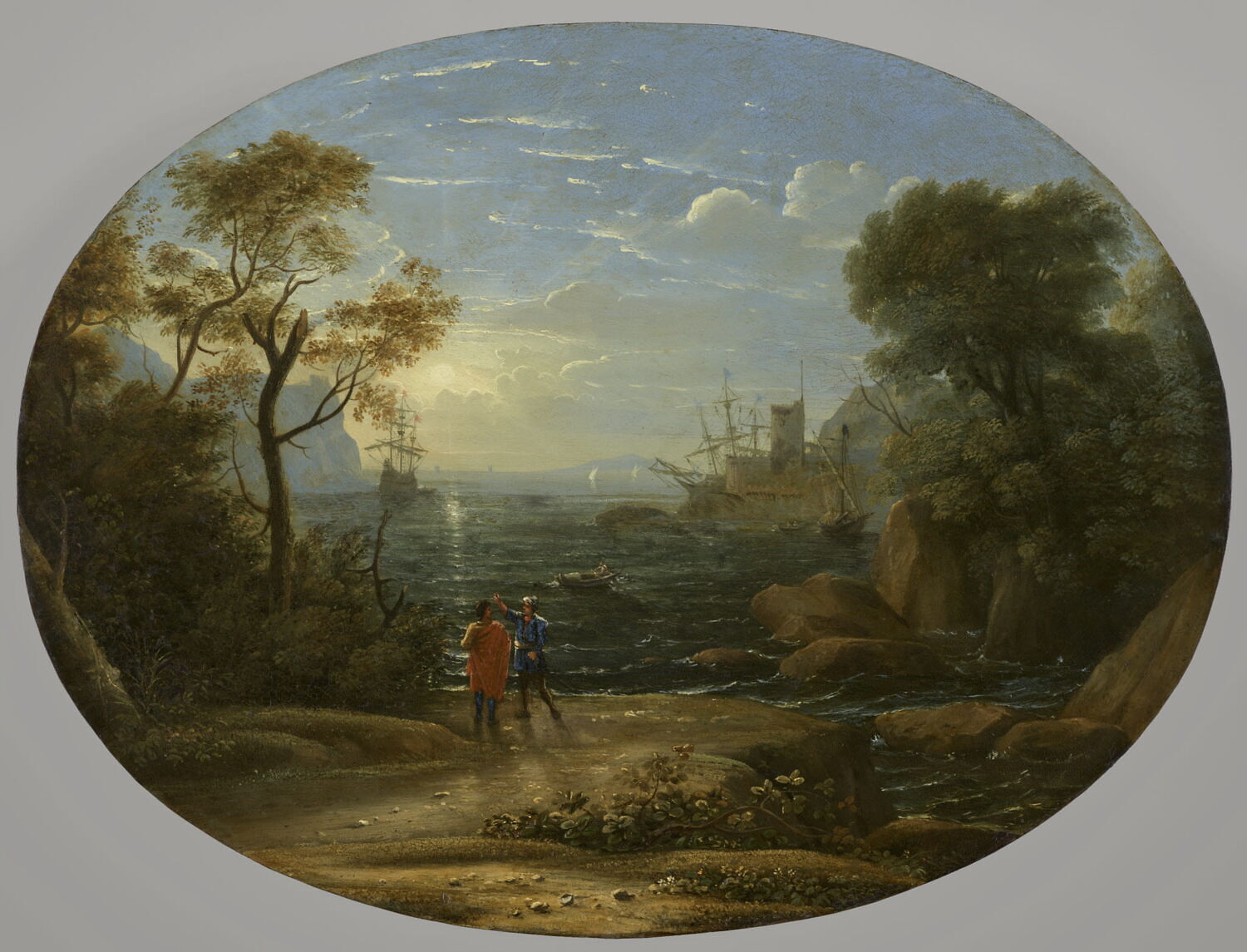
Harbour at Sunrise
Será possível contemplá-la?
Sim, recebe visitas

Exposta ao público.
- Verificado
- Neste estado desde
- Fonte
- O museu
Sobre a pintura
An imaginary harbour, at the first light of dawn. On the right, a Roman triumphal arch catches the early rays of the sun. Claude Lorrain – a Frenchman who worked in Rome – was a master at capturing the atmosphere of each particular time of day. His poetic, Italianate landscapes
influenced many of his contemporaries, including the Dutch Italianates.
Museu Estatal de Amesterdão
Pormenores
- Número de inventário
- SK-A-4977
O que mostra
No catálogo
Idas e vindas
Em exposição · Room 2.17 · Dutch painters in Italy
Museu Estatal de Amesterdão · 29 de set. de 2026 — agora · Verificado
Não se sabe se estava exposta
Museu Estatal de Amesterdão · Não confirmado
Fontes
- Museu Estatal de Amesterdão
- Imagem: Museu Estatal de Amesterdão — public domain
Entretanto, na vida de Claude Lorrain
A vida inteira1633–1635
Growing fame: commissions from the French ambassador and Philip IV
Claude’s growing reputation was shown by commissions from the French ambassador in Rome (1633) and from Philip IV of Spain (1634–35).
1635
Recognition: his pictures are in demand
From 1635 Claude’s work was recognised and his paintings were in great demand; his patrons included Pope Urban VIII (four works), Cardinal Bentivoglio and Prince Colonna.
1635–1638
Pope Urban VIII commissions four paintings
According to Baldinucci, Cardinal Guido Bentivoglio, impressed by the two landscapes Claude painted for him, recommended the artist to Pope Urban VIII; four paintings were made for the Pope in 1635–38, two large and two small on copper.
1637
The French ambassador buys two paintings
In 1637 the French ambassador to the Vatican bought two paintings from Claude, “View of the Roman Forum” and “View of a Port with the Capitol”, which are now in the Louvre.
late 1630s
Italy’s leading landscapist, with large fees
By the end of the 1630s Claude was established as the leading landscapist in Italy and enjoyed large fees; his landscapes gradually became larger but with fewer figures, more carefully painted and produced at a lower rate.
1639
Philip IV commissions seven paintings
In 1639 Philip IV of Spain commissioned seven paintings from Claude, now in the Prado, among them two landscapes with hermits.