 Edward Onslow FordReino Unido, 1852
Fate
Dá para ver?
Não está exposta no momento
Onde está “Fate” hoje? Coleção: Museu Vitória e Alberto, Londres. Não está exposta no momento. Verificado 25 de setembro de 2026.

Londres, Reino Unido
Pertence à coleção, mas no momento não está exposta.
- Verificado
- Com este status desde
- Fonte
- O museu
Sobre a escultura
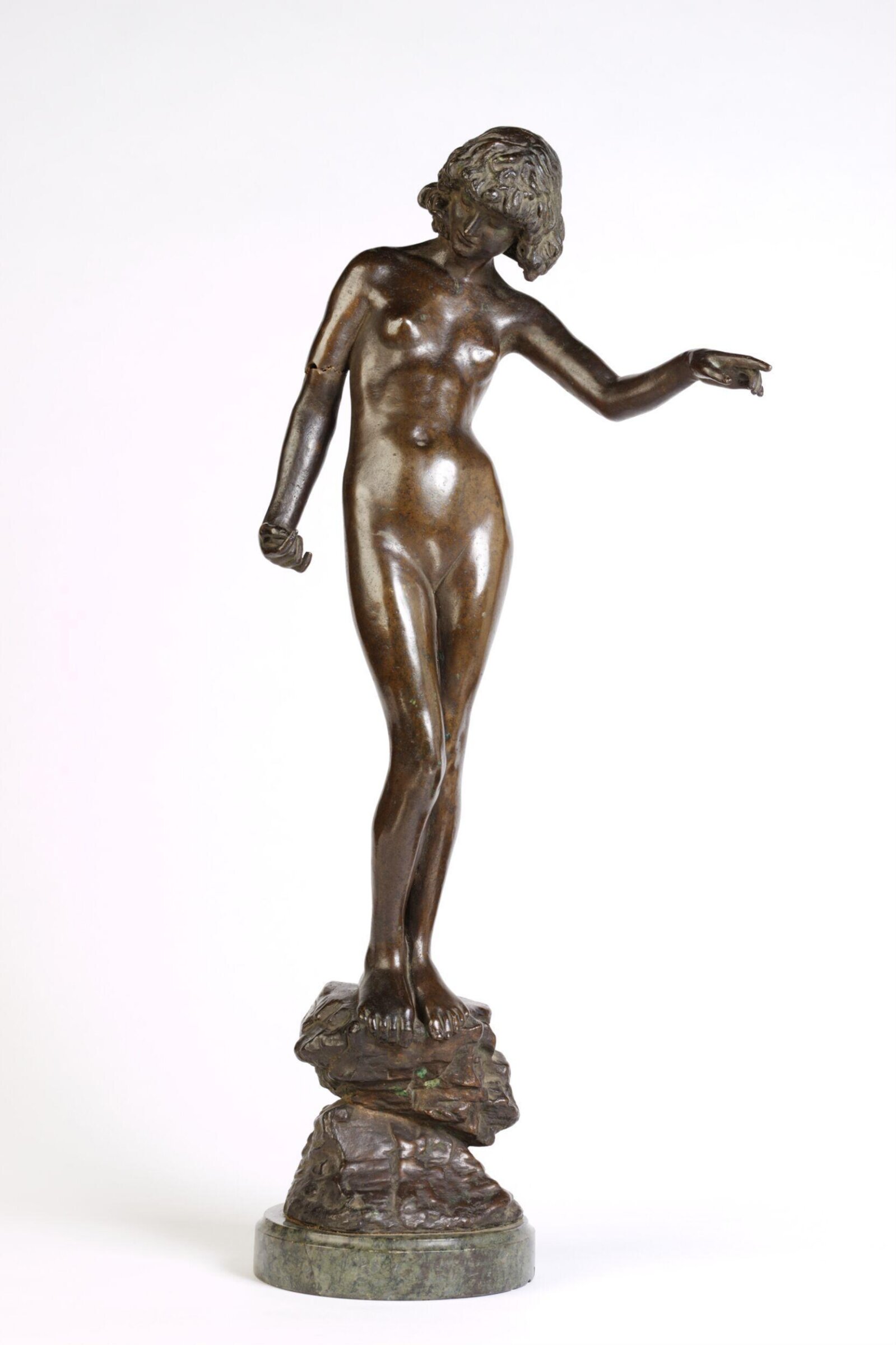
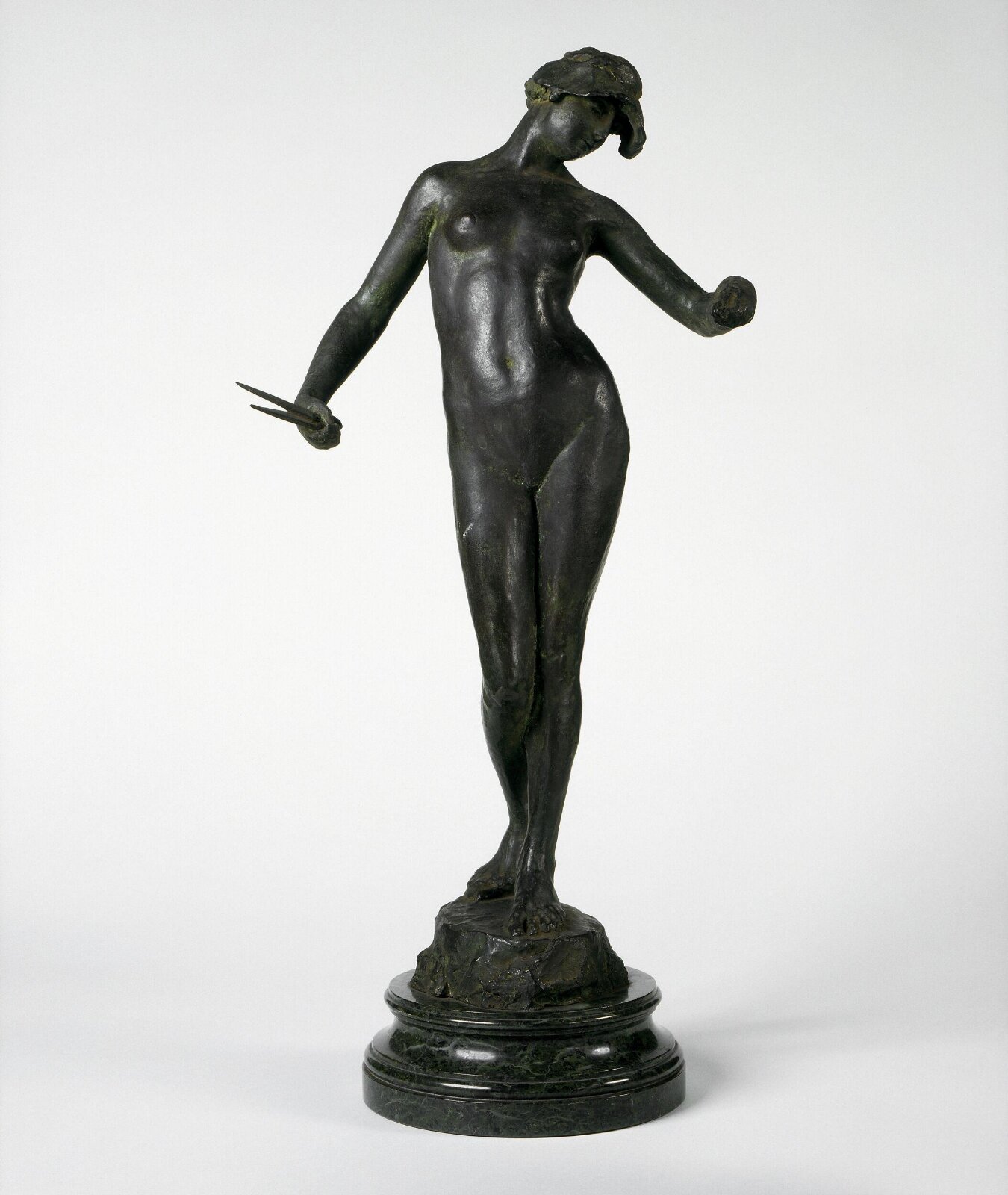
An exhibition of statuettes and busts by the late Edward Onslow Ford was held at the Fine Art Society, New Bond Street, London in 1905. The sculptor Thomas Brock (1847-1922) who acted for the Museum as an advisor, recommended, 'that the bronze statuette 'Fate' (sketch) be purchased for the Museum...Although unfinished the work has considerable charm and would, I think, be a valuable addition to the Collections of small bronzes now being formed in the Museum'. The feet and hands on this statuette are unfinished. The subject depicts Fate, the scissors in her right hand ready to cut the thread of life which would have been held in her left. A comparable version is held in the Lady Lever Art Gallery (inv.no. LL121).
Ler mais
This unfinished statuette is characteristic of the compositions favoured by the sculptor: a slender female nude gracefully balanced on a rocky pedestal. Here the mythological subject of Fate is represented by the scissors (to cut the thread of life) held in the figure's right hand.
This unfinished statuette of Fate made by the sculptor Edward Onslow Ford in ca. 1900 is characteristic of the compositions favoured by the sculptor: a slender female nude gracefully balanced on a rocky pedestal. Here the mythological subject of Fate is represented by the scissors (to cut the thread of life) held in the figure's right hand. The feet and hands are unfinished.
Ford (1852-1901) was an English sculptor who studied painting briefly in Antwerp and Munich before turning to sculpture in 1870. Although never officially attached to any one studio or school, he studied and worked as a sculptor in Munich for five years, sharing a studio with Edwin Roscoe Mullins (1848-1907). Returning to London in 1875, Ford set up as a portrait sculptor in marble and terracotta but did not receive his first public commission until 1881. This was the bronze monumental statue of Sir Rowland Hill, now standing in King Edward Street, London, in which his modelling brings life to the surfaces of an otherwise orthodox exercise. During these early years in England Ford displayed a taste for realism, encouraged by the work of Jules-Aimé Dalou and also taken up by William Hamo Thornycroft.
The conventional appearance of his first works, however, may be due to his early dependence upon professional assistants. Ford was inspired with wider ambitions by the stylistic renewal in English sculpture that was eventually termed the New Sculpture by Edmund Gosse in 1894; arising from the interest of the Aesthetic Movement in the pure and applied arts, it received enormous impetus from the early works of Alfred Gilbert.
Museu Vitória e Alberto
Detalhes
- Número de inventário
- 501-1905
O que mostra
No catálogo
Fontes
- Museu Vitória e Alberto
- Imagem: Museu Vitória e Alberto — © Victoria and Albert Museum, London