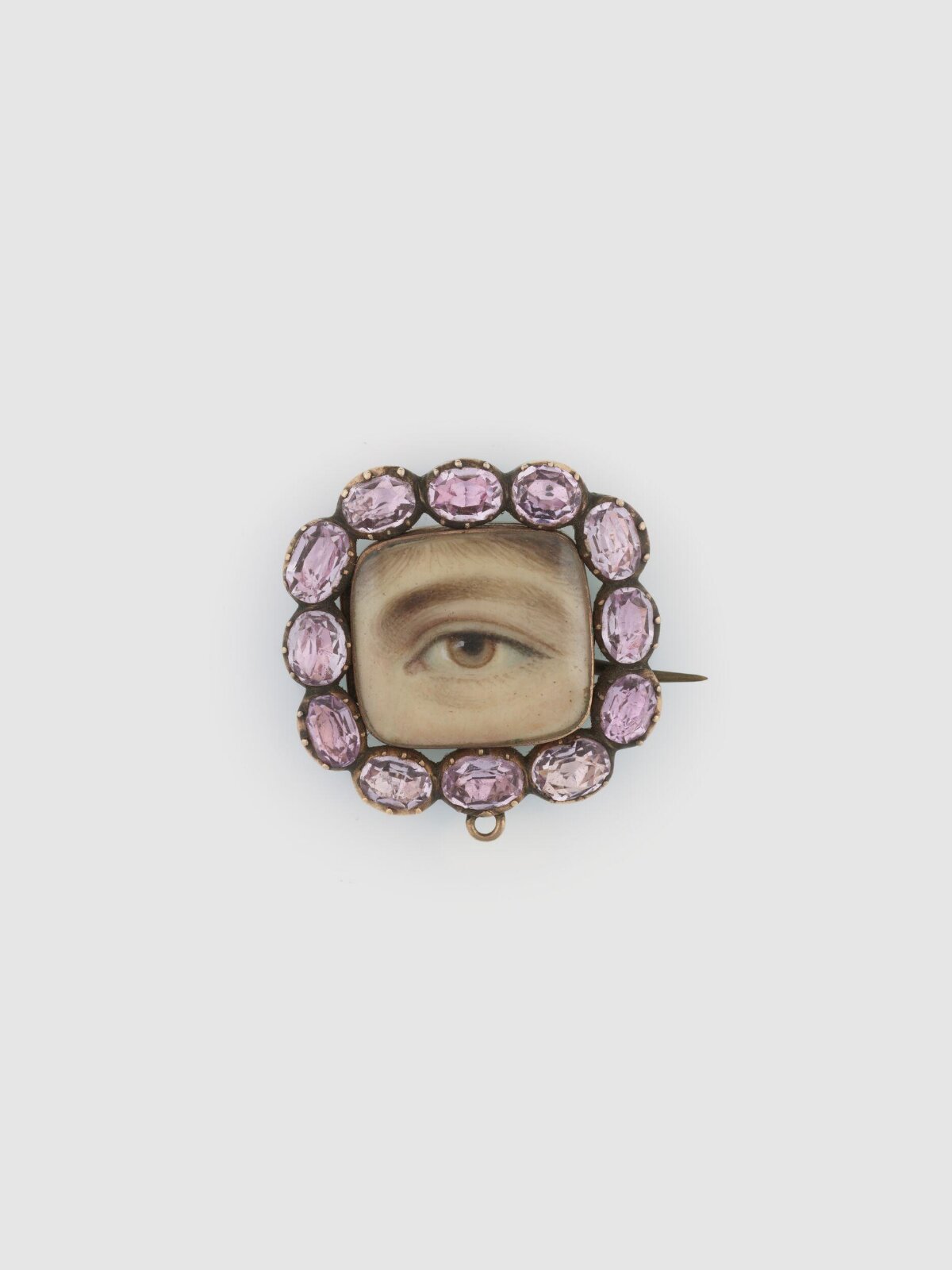
Eye miniature
Será possível contemplá-la?
De momento, não recebe

Museu Vitória e Alberto
Londres, Reino Unido
Pertence à coleção, mas de momento não está exposta.
- Verificado
- há 8 dias
- Neste estado desde
- 25 de set. de 2026
- Fonte
- Os dados da própria coleção do museu
About the painting
Eye miniatures came into fashion at the end of the 18th century. They seem to have originated in France, and were a curious but brief anomaly in painting in miniature. They represented an extremely intense manifestation of an already emotionally charged art, apparently an attempt to capture ‘the window of the soul’, the supposed reflection of a person’s most intimate thoughts and feelings. Often, as here, the result was a compelling piece of jewellery. But sometimes the result was merely anatomical and unpleasing, or uncanny and disturbing.
Read on
The eye is one of the oldest and most powerful symbols. In Italy one often finds a large eye gazing down from a cupola, the all-seeing eye of God, and the Masonic Order, for example, adopted the eye as its symbol. In France, the state police adopted the eye as a symbol of watchfulness for buckles and belts. During the Revolution of 1789 it was apparently taken over by adherents of the Revolutionary party to signal a member’s allegiances to initiates. In Britain, it seems to have had a much more innocent role as a love token. Some eye miniatures even glisten with a trompe-l’oeil tear, or even a diamond set to imitate a tear. Most eye miniatures are unsigned, due to the minuteness of the background. All too often the name of the person whose eye is depicted is unknown.
This eye miniature is set in a square frame edged with 12 pink stones. The eye has a brown iris and the face is close up. As seen by the viewer, it is of a right eye facing left.
Museu Vitória e Alberto
Pormenores
- Número de inventário
- P.54-1977
What it shows
No catálogo
Fontes
- Museu Vitória e Alberto: the museum's own open data · obtido há 8 dias
- Imagem: Museu Vitória e Alberto — © Victoria and Albert Museum, London