 Maurits Cornelis EscherPaíses Baixos, 1898–1972
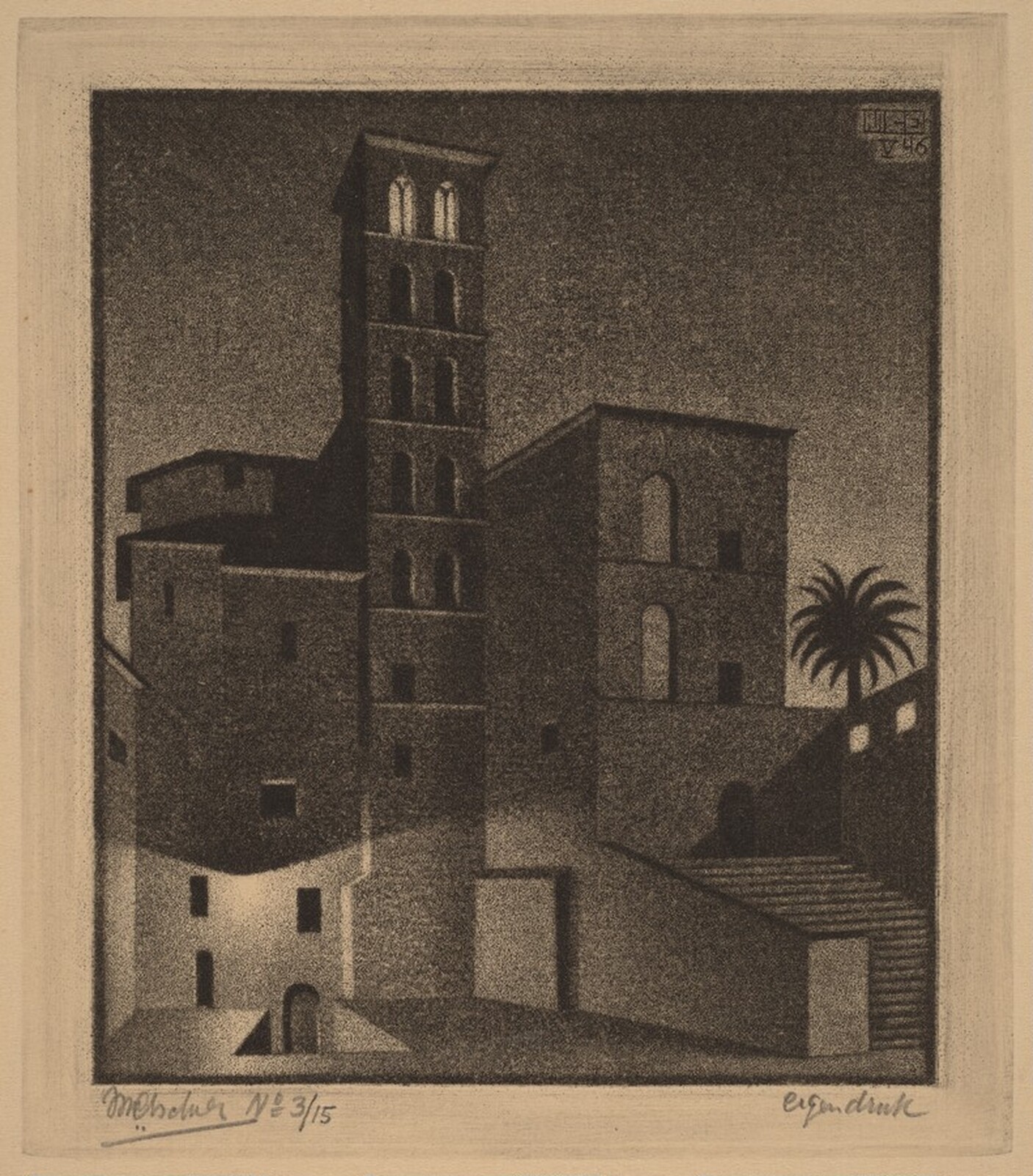
Dusk
Dá para ver?
Não está exposta no momento
Onde está “Dusk” hoje? Coleção: Galeria Nacional de Arte, Washington, D.C. Não está exposta no momento. Verificado 16 de novembro de 2026.

Washington, D.C., Estados Unidos
Pertence à coleção, mas no momento não está exposta.
- Verificado
- Com este status desde
- Fonte
- O museu
Sobre a obra
M. C. Escher’s Dusk, a mezzotint from 1946, depicts Rome’s Santi Giovanni e Paolo and is now in the National Gallery of Art, Washington. A tower with repeated windows rises above steps and shadowed buildings; a palm appears at the right. This impression is in the second state, which may also be the final one.
Detalhes
- Número de inventário
- 1975.95.1
O que mostra
No catálogo
Fontes
- Galeria Nacional de Arte
- Imagem: Galeria Nacional de Arte — © the artist or rights holder
Na vida de Maurits Cornelis Escher
A vida inteira1 February 1944 – 1946
The death of his teacher Mesquita
On 1 February 1944 the Nazis arrested Samuel de Mesquita, who was of Jewish origin, with his family and sent them to Auschwitz; almost at once after arrival — presumably on 11 February — he and his wife were killed in the gas chamber. Escher helped to send his teacher’s works to the Stedelijk Museum in Amsterdam, keeping for himself a single sketch bearing the print of a German boot, and in 1946 organised a memorial exhibition there.
c. 1945
The end of the occupation: a diploma and an exhibition of the unyielding
Escher lived through the German occupation in the Netherlands. Before the end of the war he designed a diploma for the Temporary Academy in Eindhoven — an institution in the liberated south-east of the country — and immediately after the war he took part in an exhibition of artists who had refused to collaborate with the Nazi regime.
1946–1951
Mezzotint: a brief experiment
In 1946 Escher became interested in intaglio printing, but it took too much time: until 1951 he made no more than seven mezzotint prints and never returned to intaglio, preferring tonal contrast to linear outline. These few works are considered masterpieces of the technique.


