 Arkhip KuindzhiUcrânia, 1842–1910
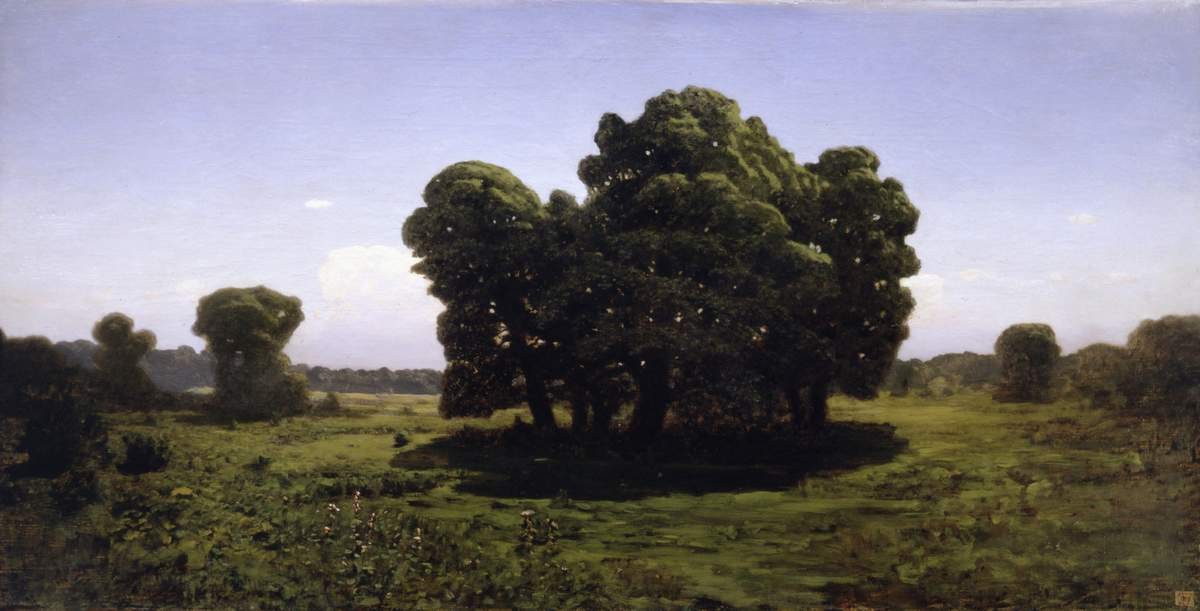
Дубы
Posso vê-la?
Sim, exposta agora
Onde está «Дубы» hoje? Museu Russo, Mikhaylovskiy dvorets, Zal 35. A. I. Kuindzhi, São Petersburgo. Sim, exposta agora. Verificado 28 de setembro de 2026.

Fechado· abre amanhã às 10:00
Exposta ao público.
- Verificado
- Neste estado desde
- Fonte
- O museu
Sobre a pintura
Nas palavras do museu — em russo
Декоративные в своей нарядной торжественности „Дубы“ (1900—1905) – художественная метафора мощи мироздания, извечных сил природы, которую художник преображает в соответствии со своим романтическим представлением о мире. В этой проникнутой эпическим духом, подчеркнуто архитектоничной, построенной на основе тщательного отбора природных форм картине художник концентрирует внимание на могучих деревьях, расположенных в центре поляны. Центричная композиция словно подчеркивает вековую устойчивость природы, а высокая точка зрения – ее пространственный размах.
Ler mais
Куиндживские дубы не просто стоят на земле, торжествуя во всей своей естественной красоте, как у И. И. Шишкина, но становятся центром Вселенной, одним из важных ее элементов. В произведении ощущается особый интерес к живописно-пластическим проблемам, свойственный искусству рубежного периода. Обобщенность форм, цветовой и композиционный ритм являются носителями эмоционального содержания. В трактовке дубов, кроны которых, сливаясь вместе, напоминают фантастическое, упирающееся в небо растение, ощущается скрытая напряженность, свойственная целому ряду работ Куинджи позднего времени.
Ирина Шувалова. Куинджи в Русском музее // Архип Куинджи. СПб, 2010. С.22.
Museu Russo
Pormenores
- Número de inventário
- Ж-1537
O que mostra
No catálogo
Fontes
- Museu Russo
- Imagem: Museu Russo — © State Russian Museum
Na vida de Arkhip Kuindzhi
A vida inteira1882–1901
Twenty years of seclusion
The reasons for the seclusion are unknown; he was probably tired of the fuss and of accusations of cheap effects. The public thought he had exhausted himself, but he worked tirelessly, searching for pigments and grounds resistant to the air, and created about five hundred sketches and finished works and about three hundred graphic works.
1901
Breaks his seclusion: four paintings
In 1901 Kuindzhi showed his students, and then some friends, four paintings: the finished “Evening in Ukraine”, “Christ in the Garden of Gethsemane”, the third version of “The Birch Grove” and the already known “The Dnieper in the Morning”. The viewers were enraptured, and people talked of the artist again.
1901
Cape Kuindzhi on Novaya Zemlya
In 1901 members of the expedition of the painter A. A. Borisov surveyed a cape on Novaya Zemlya in the Kara Sea and named it Cape Kuindzhi.
1901
The last public exhibition
In November 1901 the last public exhibition of Kuindzhi’s work took place; after it nobody saw his new paintings until his death. Witnesses explained this by his fear of sceptical visitors, but the explanation satisfied few.
1904
A gift to the Academy: 100,000 roubles for prizes
In 1904 Kuindzhi gave the Academy of Arts 100,000 roubles to fund 24 annual prizes.