 Roy LichtensteinEstados Unidos, 1923–1997
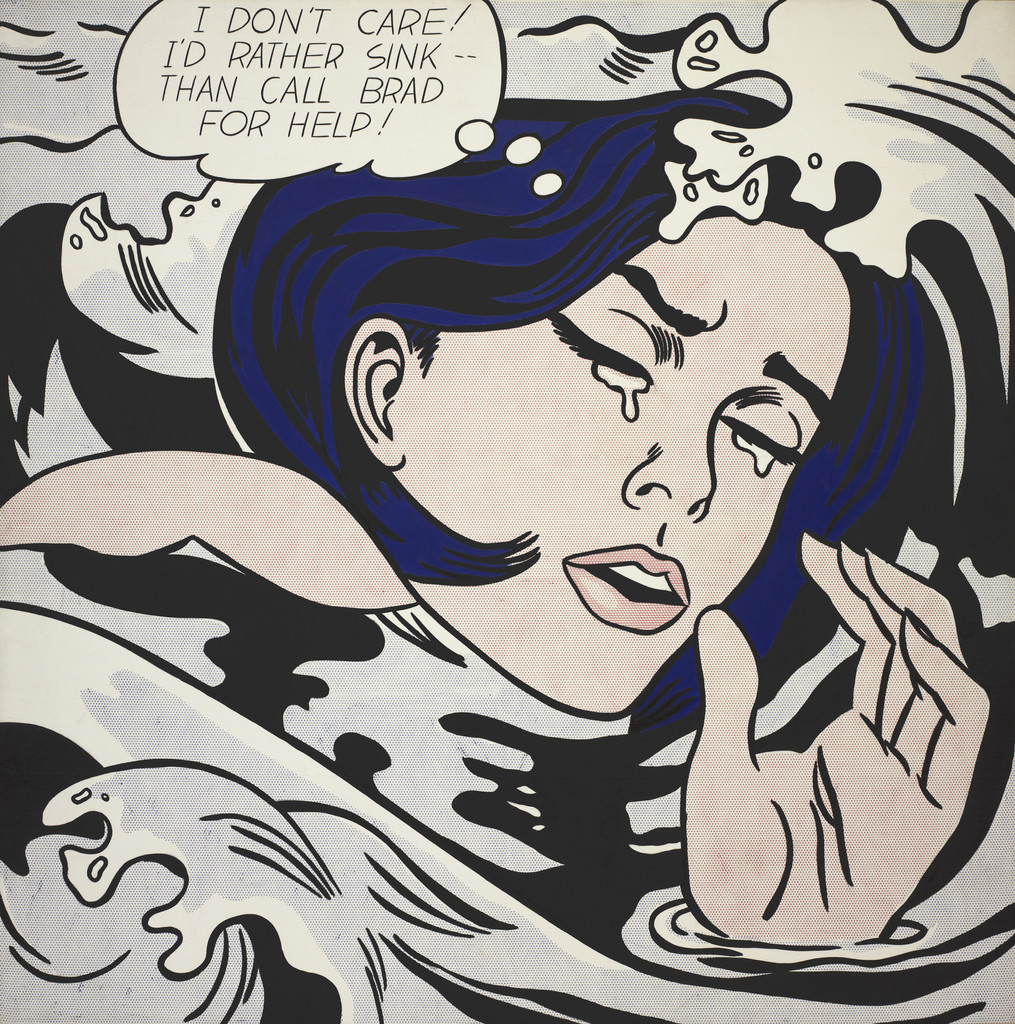
Drowning Girl
Será possível contemplá-la?
De momento, não recebe

Nova Iorque, Estados Unidos
Pertence à coleção, mas de momento não está exposta.
- Verificado
- Fonte
- O museu
Sobre a pintura
Drowning Girl is a 1963 American painting in oil and synthetic polymer paint on canvas by Roy Lichtenstein, based on original art by Tony Abruzzo. The painting is considered among Lichtenstein's most significant works, perhaps on a par with his acclaimed 1963 diptych Whaam!. One of the most representative paintings of the pop art movement, Drowning Girl was acquired by the Museum of Modern Art in 1971.
Ler mais
The painting has been described as a "masterpiece of melodrama", and is one of the artist's earliest images depicting women in tragic situations, a theme to which he often returned in the mid-1960s. It shows a teary-eyed woman on a turbulent sea. She is emotionally distressed, seemingly from a romance. Using the conventions of comic book art, a thought bubble reads: "I Don't Care! I'd Rather Sink — Than Call Brad For Help!" This narrative element highlights the clichéd melodrama, while its graphics — including Ben-Day dots that echo the effect of the printing process — reiterate Lichtenstein's theme of painterly work that imitates mechanized reproduction. The work is derived from a 1962 DC Comics panel; both the graphical and narrative elements of the work are cropped from the source image. It also borrows from Hokusai's The Great Wave off Kanagawa and from elements of modernist artists Jean Arp and Joan Miró. It is one of several Lichtenstein works that mention a character named Brad who is absent from the picture.
Pormenores
- Número de inventário
- 685.1971
No catálogo
Fontes
- Museu de Arte Moderna
- Imagem: Museu de Arte Moderna — © the artist or rights holder
Entretanto, na vida de Roy Lichtenstein
A vida inteira1961
The turn to Pop Art: a challenge from his son
In 1961 Lichtenstein began his first Pop paintings, using cartoon images and techniques derived from commercial printing; the first work to use hard-edged figures and Ben-Day dots on a large scale was “Look Mickey”. The push came from his son, who, as the artist told it, pointed to a Mickey Mouse comic book and doubted that his father could paint as well.
1961
Leo Castelli begins showing his work
In 1961 Leo Castelli began displaying Lichtenstein’s work at his gallery in New York.
1962
The Castelli show sells out before it opens
Lichtenstein’s first one-man show at the Castelli gallery took place in 1962: the entire collection was bought by influential collectors before it even opened. The Leo Castelli Gallery has represented him exclusively since then.
1963–1964
Leaves Rutgers and returns to New York
In September 1963 Lichtenstein took a leave of absence from Douglass College at Rutgers; in 1964 he moved back to New York to be at the centre of the art scene and resigned from Rutgers to concentrate on his painting.
1964
The first American to exhibit at the Tate Gallery
Lichtenstein became the first American to exhibit at the Tate Gallery in London, in the show “’54–’64: Painting and Sculpture of a Decade”.
1964
Life magazine asks: “Is He the Worst Artist in the U.S.?”
When Lichtenstein’s work was first exhibited, many critics challenged its originality and called it vulgar and empty; a Life magazine article of 1964 was headed “Is He the Worst Artist in the U.S.?”. The artist replied that the closer his work is to the original, the more threatening and critical its content.


![Untitled [pyramid], Roy Lichtenstein, c. 1970](https://whitneymedia.org/assets/artwork/61776/2019_234_14_cropped.jpg)
![Untitled [pyramid], Roy Lichtenstein, c. 1970](https://whitneymedia.org/assets/artwork/61778/2019_234_16_cropped.jpg)
![Untitled [pyramid], Roy Lichtenstein, c. 1970](https://whitneymedia.org/assets/artwork/61777/2019_234_15_cropped.jpg)
![Untitled [pyramid], Roy Lichtenstein, c. 1970](https://whitneymedia.org/assets/artwork/61763/2019_234_1_cropped.jpg)