ART WIKI32 963 em exposição
MapaColeçãoArtistasMuseusExposiçõesRevista
Entrar

ART WIKI

Onde está a obra-prima, e a que horas se abre a porta.

Coleções: Art Institute of Chicago, Galeria Nacional de Arte, Galeria Tretiakov, Getty Villa, Harvard Art Museums, Hermitage, Hirshhorn Museum and Sculpture Garden, Instituto de Artes de Minneapolis, Museu de Arte de Cleveland, Museu de Arte Moderna, Museu do Louvre, Museu Estatal de Amesterdão, Museu J. Paul Getty, Museu Metropolitano de Arte, Museu Nacional de Arte da Dinamarca, Museu Pushkin, Museu Russo, Museu Smithsoniano de Arte Americana, Museu Vitória e Alberto, Museu Whitney de Arte Americana, National Museum of Asian Art, National Portrait Gallery, Catálogo Estatal do Fundo Museológico da Rússia (274 museus), Europeana (19 museus), Wikidata (6 museus), Paris Musées (12 museus) e Joconde, a base de museus do Ministério da Cultura de França (495 museus). As imagens pertencem aos titulares dos direitos.

Secções

  • Mapa
  • Pesquisa
  • Coleção
  • Obras-primas
  • Em exposição agora
  • Artistas

Mais

  • Museus e galerias
  • Exposições
  • Revista
  • De onde vêm os dados
  • Privacidade e cookies
InícioMapaCatálogo
  1. Coleção/
  2. Art Institute of Chicago/
  3. Drive in the Knife
Drive in the Knife, Matta, May 1943
Matta, retratoMattaChile, 1911–2002

Drive in the Knife

May 1943 · Painting

Sobre a pintura

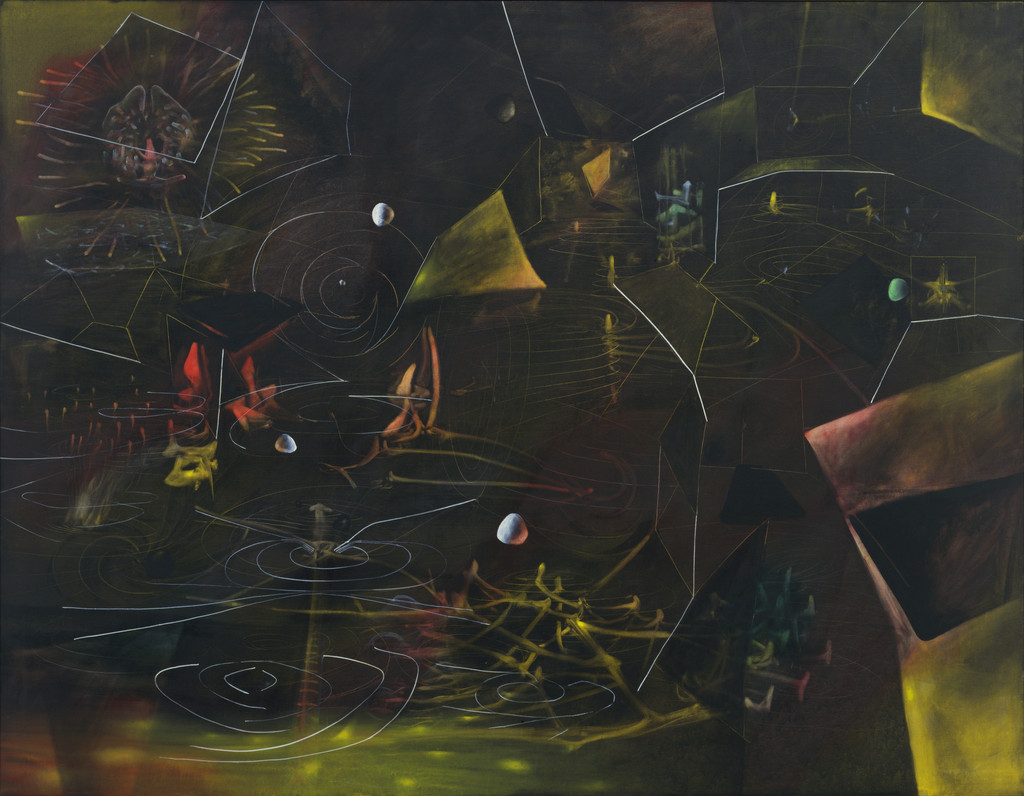
Matta’s idiosyncratic spelling of plenter (for planter), one of the words in the title of this work, is characteristic; he may have had in mind a verbal play on the phrase plenter le drapeau (hoist the flag) as a subversive, antipatriotic gesture. The title otherwise appears to have no direct relation to the image, except to underline its gestural drama, and perhaps to highlight the two solid, axlike shapes that stand out against swirling paint masses and lines.

Continuar a ler

This painting can be linked to a series of works, begun in 1942, in which Matta explored the perspectival and spatial ideas in Marcel Duchamp’s great painting on glass, The Bride Stripped Bare by Her Bachelors, Even, also known as The Large Glass (1915–23, Philadelphia Museum of Art; Philadelphia Museum of Art, Handbook of the Collections, 1995, p. 316, ill.). The two artists were particularly close during the World War II period, which they spent, along with other Surrealists, in New York. The Large Glass must lie behind the concept of Les Grands Transparents, the title of Matta’s illustration to Breton’s “Prolegomènes à un troisième manifeste du surréalisme ou non” (VVV 1 [June 1942], pp. 18–26).

In this article Breton spoke of man’s unease in the presence of a cosmic vastness unmediated by the presence of a God, not despairingly but as a salutary recognition of the limits of human rationality and self-importance. In the section subtitled “Les Grands Transparents,” Breton conjured a universe close to Matta’s: “Man is perhaps not the center, the focus of the universe. One may go so far as to believe that there exist above him, on the animal level, beings whose behavior is as alien to him as his own must be to the may-fly or the whale” (ibid., p. 25).

Romy Golan has shown how Matta’s evolving ideas of psychological and metaphorical space during this period draw upon Duchamp’s work (Romy Golan, “Matta Duchamp et le mythe: Un Nouveau Paradigme pour la dernière phase du surréalisme,” in Paris, Musée national d’arte moderne, Matta, 1985, exh. cat., pp. 37–51). The strange, part-human, part-mechanical structure in Duchamp’s 1912 painting Bride (Philadelphia Museum of Art; Pontus Hulten, ed., Marcel Duchamp: Work and Life, Cambridge, Mass., 1993, p. 98, ill.), for instance, may have prompted Matta’s combinations of solid and transparent shapes in paintings of this period. It has also been suggested that the sweeping, weblike lines, prominent in Drive in the Knife, echo the lines of cracks in The Large Glass (Golan, in Paris 1985, p. 42).

This seems a plausible explanation for the odd role of these lines in Matta’s paintings, where they sometimes appear to mimic perspectival marks and at other times appear to wander irrationally in space. This idea of transparency is further emphasized in Drive in the Knife through patches of bare canvas.

— Entry, Dawn Ades, Surrealist Art: The Lindy and Edwin Bergman Collection at the Art Institute of Chicago, 1997, p. 192-93.

Pormenores

May 1943 · aos 32 anos
19112002
Número de inventário
2018.298

Mais obras de Matta

Todas as obras

Na mesma sala · Gallery 397, Art Institute of Chicago

Página do museu

Art Institute of Chicago · CC BY 4.0

Será possível contemplá-la?

Sim, recebe visitas

Art Institute of Chicago

Chicago, Estados Unidos

Sala397

Exposta ao público. Quem o garante vem indicado abaixo.

Verificado
há 3 dias
Neste estado desde
19 de ago. de 2026
Fonte
O museu
No mapaPágina do museu

No catálogo

PinturasÓleoPintura francesaModernismoSéculo XXSurrealismoModern Latin American ArtChile

Fontes

  • Art Institute of Chicago
  • Imagem: Art Institute of Chicago — © the artist or rights holder
Genesis, Matta, 1942

Genesis

1942 · Galeria Nacional de Arte

The Vertigo of Eros, Roberto Matta, 1944

The Vertigo of Eros

1944 · Museu de Arte Moderna

The Earth Is a Man, Matta, 1942

The Earth Is a Man

1942 · Art Institute of Chicago

Untitled, Matta, n.d.

Untitled

n.d. · Art Institute of Chicago

Untitled, Matta, 1938/39

Untitled

1938/39 · Art Institute of Chicago

Untitled (Psychological Morphology), Matta, 1939

Untitled (Psychological Morphology)

1939 · Art Institute of Chicago

Untitled (Flying People Eaters), Matta, 1942

Untitled (Flying People Eaters)

1942 · Art Institute of Chicago

Medraumonde, Matta, 1945/46

Medraumonde

1945/46 · Art Institute of Chicago

Juan Soriano De Lacandón, Leonora Carrington, 1964

Leonora Carrington

Juan Soriano De Lacandón, 1964

Untitled (Butterfly Habitat), Joseph Cornell, c. 1940

Joseph Cornell

Untitled (Butterfly Habitat), c. 1940

Untitled, Balthus, c. 1972

Balthus

Untitled, c. 1972

Untitled (For Trista), Joseph Cornell, c. 1969

Joseph Cornell

Untitled (For Trista), c. 1969

Untitled (Satie and Ravel), Joseph Cornell, March 14, 1968–early September 1969

Joseph Cornell

Untitled (Satie and Ravel), March 14, 1968–early September 1969

The Tiara, Joseph Cornell, 1966/67

Joseph Cornell

The Tiara, 1966/67

Untitled (L'Abeille), Joseph Cornell, April 7, 1966

Joseph Cornell

Untitled (L'Abeille), April 7, 1966

Now, Voyager, Joseph Cornell, 1966

Joseph Cornell

Now, Voyager, 1966