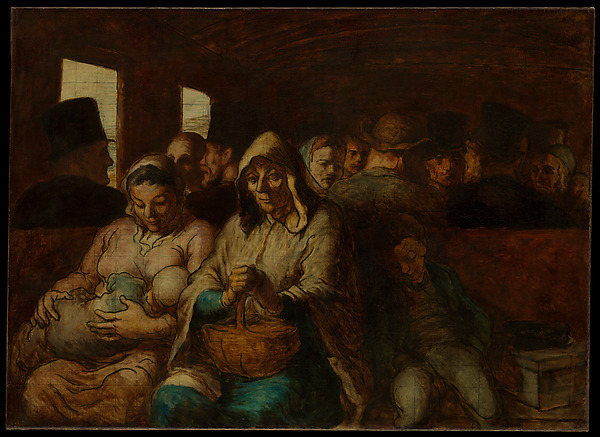
Honoré DaumierFrança, 1808–1879
Drie oude mannen spelen een bordspel
Posso vê-la?
Desconhecido
Onde está «Drie oude mannen spelen een bordspel» hoje? Coleção: Museu Estatal de Amesterdão, Amesterdão. Desconhecido.

Amesterdão, Países Baixos
O proprietário é conhecido; não se sabe se hoje está exposta.
- Fonte
- O museu
Pormenores
- Número de inventário
- RP-P-OB-41.043
O que mostra
No catálogo
Fontes
- Museu Estatal de Amesterdão
- Imagem: Museu Estatal de Amesterdão — public domain
Na vida de Honoré Daumier
A vida inteiramid-1840s
The Series "Les Gens de Justice"
Around the mid-1840s Daumier began publishing his famous caricatures of lawyers, "Les Gens de Justice," a biting satire of judges, attorneys, and defendants that eventually comprised 39 subjects.
1846
Move to the Île Saint-Louis; Meeting Baudelaire
In 1846 the couple moved to 9 Quai d'Anjou on the Île Saint-Louis, where they lived until 1863. Writers and artists gathered at the nearby Hôtel de Lauzun; there Daumier met Baudelaire, who became his close friend and champion, and grew close to Corot, Courbet, Delacroix, Millet, and Rousseau.
16 April 1846
Marriage to Alexandrine Dassy
On 16 April 1846 Daumier married Alexandrine Dassy.
1848
Sketch "The Republic" Among Competition Finalists
On Courbet's advice, Daumier submitted an oil sketch, "The Republic" (now in the Musée d'Orsay), to the competition for an allegory of the new Republic; it was very well received and was among the twenty finalists, but Daumier never executed the finished painting.
1848
Albums on the Revolution of 1848
The Revolution of 1848 provided the material for two of Daumier's albums, "Parliamentary Idylls" and "The Representatives Represented"; he once again launched a political campaign in the pages of Le Charivari.
1849
First Participation in the Salon
In 1849 Daumier exhibited at the Salon for the first time, showing the painting "The Miller, His Son, and the Donkey"; from the late 1840s he devoted himself increasingly to painting.