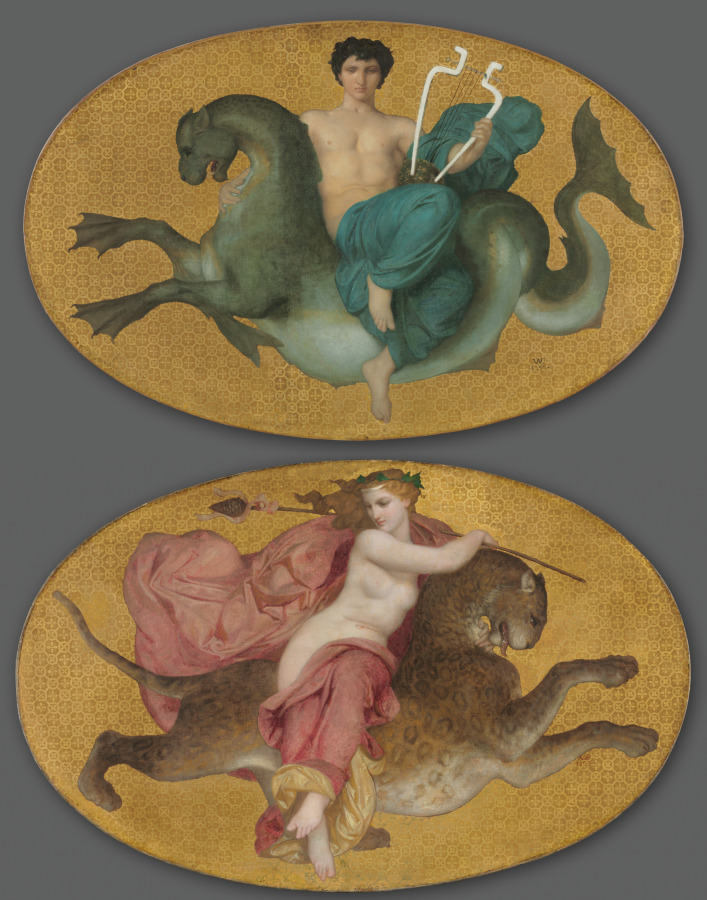
William-Adolphe BouguereauFrança, 1825–1905
Dante e Virgílio no Inferno
Dante and Virgil in Hell
Posso vê-la?
Desconhecido
Onde está «Dante e Virgílio no Inferno» hoje? Coleção: Museu de Orsay, Paris. Desconhecido.

Paris, França
O proprietário é conhecido; não se sabe se hoje está exposta.
- Neste estado desde
- Fonte
- O museu
Sobre a pintura
Dante e Virgílio no inferno (em francês: Dante et Virgile) é um quadro do pintor academicista William-Adolphe Bouguereau, que foi realizado em 1850 e que se encontra no Museu de Orsay em Paris, França.
O pintor usa um episódio da Divina Comédia, de Dante, que descreve a entrada de Virgílio e de Dante no oitavo círculo do inferno, onde encontram-se os falsificadores. Lá eles assistem a uma luta entre duas almas condenadas: Capocchio, um herege alquimista, é atacado e mordido no pescoço por Gianni Schicchi, personagem real que viveu no século XIII em Florença e que tinha usurpado a identidade de um homem morto, a fim de reivindicar sua herança de forma fraudulenta e enviado por isso ao inferno.
Bouguereau usou a Divina Comédia como fonte de inspiração em outra de suas obras, Alma conduzida ao Paraíso pelos anjos.
Jean-Léon Gérôme tem uma obra homônima.
Pormenores
- Número de inventário
- RF 2010 8
No catálogo
Fontes
- Wikidata
- Imagem: Museu de Orsay — William-Adolphe Bouguereau · Public domain · Wikimedia Commons
Na vida de William-Adolphe Bouguereau
A vida inteira1846–1850 · Formação
Beaux-Arts de Paris
1848–1850
The Prix de Rome: three attempts
In April 1848 Bouguereau enters the Prix de Rome competition for the first time, but soon riots break out in Paris and he enrols in the National Guard; he fails to win in 1848 (third place by some accounts, second prize by others) or in 1849. In 1850 his “Zenobia Found on the Banks of the Araxes” wins a joint first prize: it receives fewer votes than Paul Baudry’s work, but because of the revolution of 1848 no one was sent to Italy and a vacancy has arisen at the French Academy in Rome.
1850
The Salon of 1850: attacks on “Dante and Virgil”
The large canvas “Dante and Virgil in Hell” (281 × 225 cm), apparently inspired by Delacroix’s painting of the same subject, is meant to surpass Delacroix in the rendering of passions, and its naturalism to make viewers believe in the cruelty of the forces ruling Hell; at the Salon of 1850 it provokes attacks from critics and the disgust of the public.
1851–1853 · Formação
French Academy in Rome
1851–1854
Through Italy with Curzon: copies of Raphael, Titian, Assisi
At the French Academy in Rome Bouguereau meets G. Boulanger and J. Lenepveu, but becomes closest friends with the landscape painter P. Curzon; together they make many journeys through Italy — Naples, Pompeii, Siena, Perugia, Assisi, Florence, Pisa, Milan, Ravenna. Bouguereau visits almost all the museums and private collections, copies ancient Roman monuments, makes a replica of the complete cycle of frescoes in the basilica of San Francesco in Assisi, and copies Raphael’s “Triumph of Galatea” and Titian’s “Triumph of Flora”.
1851–1854
His tastes and the “discovery” of Giotto
In Italy Bouguereau’s tastes take shape: he names Michelangelo, Raphael and Leonardo as his chief authorities, finds Botticelli too “nervous”, counts Correggio among the geniuses but denies that status to Mantegna, whom he finds “soulless”. In Padua and Assisi he immerses himself in Giotto and discovers in his gestures and faces a link between Proto-Renaissance painting and French gallant painting of the eighteenth century — a “discovery” that will shape his work for the rest of his life and shows in two paintings called “Idyll” (1850 and 1851), reminiscent of Rococo pastorals.