Édouard ManetFrança, 1832–1883
Boy with Pitcher (La Régalade)
Posso vê-la?
Sim, exposta agora
Onde está «Boy with Pitcher (La Régalade)» hoje? Art Institute of Chicago, Sala 222, Chicago. Sim, exposta agora. Verificado 29 de setembro de 2026.

Chicago, Estados Unidos
Fecha em breve· até às 17:00
Exposta ao público.
- Verificado
- Neste estado desde
- Fonte
- O museu
Sobre a pintura
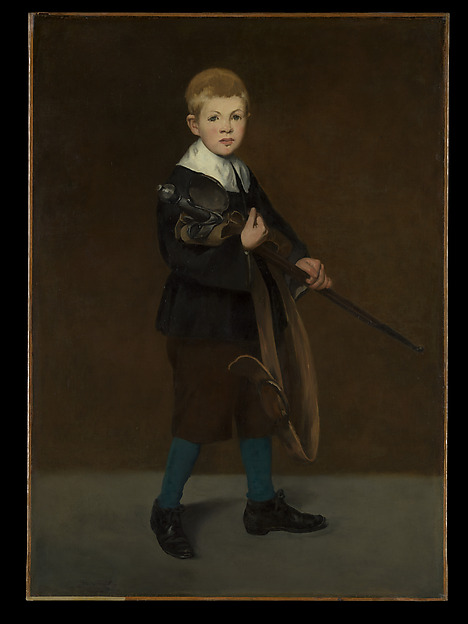
X-radiographs have revealed that this painting is a fragment of Les Gitanos, a large portrait of an itinerant family that Édouard Manet exhibited in 1863 and 1867. Apparently dissatisfied with the composition, he cut the painting into sections, which he reconceived as individual works of art. Two of these sections, Bohémien and Still Life with Bag and Garlic, are in the collection of the Louvre Abu Dhabi; the final section, Bohémienne, is lost.
To make this portion a standalone work, Manet painted over the head of the woman, which was originally under the boy’s shoulder, and replaced the blue sky with a dark background. He then renamed the painting La Régalade, which means to pour liquid from a bottle down the throat without touching the lips.
Art Institute of ChicagoCC BY 4.0
Pormenores
- Número de inventário
- 1968.303
O que mostra
No catálogo
Fontes
- Art Institute of Chicago
- Imagem: Art Institute of Chicago — CC0
Na vida de Édouard Manet
A vida inteira1861
His first participation in the Salon
In 1861 the Salon accepted two canvases by Manet: “Portrait of Monsieur and Madame Manet” and “The Spanish Singer”. Critics received the portrait coldly, while “The Spanish Singer” was admired by Théophile Gautier and, because of its popularity, hung in a more conspicuous place; the work intrigued young artists and brought new business to his studio.
1862
“Music in the Tuileries”: the fury of the public
In 1862 Manet exhibited “Music in the Tuileries” (probably painted in 1860), where the strollers include the poet Baudelaire, the musician Offenbach and the artist himself. It mostly provoked fury: the thick brushstrokes looked crude and unfinished, several visitors threatened to destroy the canvas; Delacroix defended it, and the controversy made Manet a well-known name in Paris.
1863
“The Luncheon on the Grass” at the Salon des Refusés
The Salon of 1863 rejected “The Luncheon on the Grass” (originally “Le Bain”), and Manet exhibited it at the Salon des Refusés, a parallel exhibition initiated by Napoleon III after a public outcry, the jury having accepted only 2,217 of more than 5,000 submissions. The juxtaposition of dressed men and a nude woman and the sketch-like handling caused a scandal; one critic compared the brushwork to a “floor mop”.
1863
Marries Suzanne Leenhoff
In 1863, a year after his father's death, Manet married Suzanne Leenhoff at a Protestant church: a Dutch-born piano teacher two years his senior with whom he had been romantically involved for about ten years. Auguste Manet had employed her to teach his sons the piano, and she may also have been Auguste's mistress.
1865
“Olympia” at the Salon: a scandal
In 1865 the Salon accepted “Olympia”, and the frank depiction of a self-assured prostitute created a scandal; according to Antonin Proust, only the precautions taken by the administration prevented the painting from being punctured and torn. The popular press caricatured it, while the avant-garde, including Courbet, Cézanne and Monet, championed it.
1867
His own pavilion near the Pont de l'Alma
In 1867, during the World's Fair in Paris, Manet set up his own pavilion near the Pont de l'Alma and showed fifty of his best works of the past ten years. Possibly this step led to his works being accepted at the next two Salons.