ART WIKI32 963 em exposição
MapaColeçãoArtistasMuseusExposiçõesRevista
Entrar

ART WIKI

Onde está a obra-prima, e a que horas se abre a porta.

Coleções: Art Institute of Chicago, Galeria Nacional de Arte, Galeria Tretiakov, Getty Villa, Harvard Art Museums, Hermitage, Hirshhorn Museum and Sculpture Garden, Instituto de Artes de Minneapolis, Museu de Arte de Cleveland, Museu de Arte Moderna, Museu do Louvre, Museu Estatal de Amesterdão, Museu J. Paul Getty, Museu Metropolitano de Arte, Museu Nacional de Arte da Dinamarca, Museu Pushkin, Museu Russo, Museu Smithsoniano de Arte Americana, Museu Vitória e Alberto, Museu Whitney de Arte Americana, National Museum of Asian Art, National Portrait Gallery, Catálogo Estatal do Fundo Museológico da Rússia (274 museus), Europeana (19 museus), Wikidata (6 museus), Paris Musées (12 museus) e Joconde, a base de museus do Ministério da Cultura de França (495 museus). As imagens pertencem aos titulares dos direitos.

Secções

  • Mapa
  • Pesquisa
  • Coleção
  • Obras-primas
  • Em exposição agora
  • Artistas

Mais

  • Museus e galerias
  • Exposições
  • Revista
  • De onde vêm os dados
  • Privacidade e cookies
InícioMapaCatálogo
  1. Coleção/
  2. Art Institute of Chicago/
  3. Beata Beatrix
Beata Beatrix, Dante Gabriel Rossetti, 1871–72

Beata Beatrix

1871–72 · Painting

Sobre a pintura

Both a poet and a painter, Dante Gabriel Rossetti was a founder of the Pre-Raphaelite Brotherhood, a circle of Victorian artists who were united in their regard for medieval aesthetics. Named after the thirteenth-century poet Dante Alighieri, Rossetti found inspiration for Beata Beatrix in his namesake’s La vita nuova (The New Life; 1295). Rossetti’s scene draws a parallel between Dante’s love for the late Beatrice and his own affection for his recently deceased wife and muse, Elizabeth Siddal. While this picture is a tribute to Siddal, Rossetti was adamant that it does not represent her death. Rather, the work portrays her as if in a trance or altered spiritual state.

Continuar a ler

Rossetti’s symbolism combines details from his personal life with those from La Vita Nuova. “The Dove” was the artist’s nickname for Siddal, and a haloed dove delivers her a white poppy, a symbol of laudanum—a derivative of opium—which caused her death by overdose. Above rises the Ponte Vecchio, the Florentine bridge that served as the setting of Dante’s poem. To the upper left is the personification of Love and to the right the figure of Dante, who doubles as a representation of Rossetti himself. The sundial shadows the number nine, the age Dante first saw Beatrice as well as the hour and day of her death. Rossetti designed the frame, and at the top right he inscribed, “How doth the city sit solitary.” This quote from La Vita Nuova refers to the city of Florence’s mourning of Beatrice.

Given the deeply personal nature of the work, Rossetti initially refused his patron William Graham’s request to create a replica, although he eventually yielded. The Art Institute’s painting is this second version, which is the only one to have a predella—the painted scene at the bottom of the frame—depicting Beatrice and Dante’s reunion in paradise. With this addition, Rossetti provides the medieval love story with a happy conclusion, perhaps suggesting that he, too, had begun to come to terms with his own profound grief.

Entretanto, na vida de Dante Gabriel Rossetti

A vida inteira
  1. 1869

    Poems from the grave: the exhumation

    Prevailed upon by friends, in particular Charles Augustus Howell, Rossetti in 1869 had his poems exhumed from his wife’s grave in order to collate and publish them.

  2. 1869–1874

    Kelmscott Manor: a summer house and a retreat

    In 1869 Morris and Rossetti rented Kelmscott Manor at Kelmscott, Oxfordshire, as a summer home, but it became a retreat for Rossetti and Jane Morris: they spent summers there with the Morrises’ children while William Morris travelled to Iceland in 1871 and 1873.

  3. 1870

    The 1870 “Poems”

    In 1870 Rossetti published the volume “Poems by D. G. Rossetti,” collating the recovered texts and some translations, such as his 1869 “Ballad of Dead Ladies” after Villon; the word “yesteryear” is credited to Rossetti as a neologism used for the first time in this translation.

  4. 1871

    Love for Jane Morris

    In 1871 Rossetti fell in love again — with Jane, the wife of his friend William Morris; they became lovers, and Jane sat for him often.

  5. October 1871 – May 1872

    Buchanan’s attack: the “fleshly school of poetry”

    In October 1871 Robert Buchanan attacked both Rossetti’s poems and his morality in The Contemporary Review; against the advice of his brother William Michael, Rossetti issued a written reply in December, and in May 1872 Buchanan published a 100-page pamphlet, “The Fleshly School of Poetry and Other Phenomena of the Day.”

Mais obras de Dante Gabriel Rossetti

Todas as obras

Na mesma sala · Gallery 223, Art Institute of Chicago

Página do museu

Sobre o mesmo tema · Love

Todas as obras sobre o tema

Art Institute of Chicago · CC BY 4.0

Pormenores

1871–72 · aos 43 anos
18281882
Número de inventário
1925.722

Fontes

  • Art Institute of Chicago
  • Imagem: Art Institute of Chicago — CC0
  • June – September 1872

    The breakdown of 1872: laudanum and Scotland

    In June 1872, after the savage criticism of his poems, Rossetti suffered a mental breakdown in which he attempted unsuccessfully to kill himself with an overdose of laudanum. He spent nine weeks recuperating in Scotland and in September joined Jane Morris at Kelmscott, but spent his days in a haze of chloral and whisky.

  • Dante Gabriel Rossetti, retratoDante Gabriel RossettiInglaterra, 1828–1882

    Será possível contemplá-la?

    Sim, recebe visitas

    Art Institute of Chicago

    Chicago, Estados Unidos

    Sala223

    Exposta ao público. Quem o garante vem indicado abaixo.

    Verificado
    há 3 dias
    Neste estado desde
    19 de ago. de 2026
    Fonte
    O museu
    No mapaPágina do museu
    The Blessed Damozel, Dante Gabriel Rossetti, 1871-1878

    The Blessed Damozel

    1871-1878 · Harvard Art Museums

    A Sea-Spell, Dante Gabriel Rossetti, 1875-1877

    A Sea-Spell

    1875-1877 · Harvard Art Museums

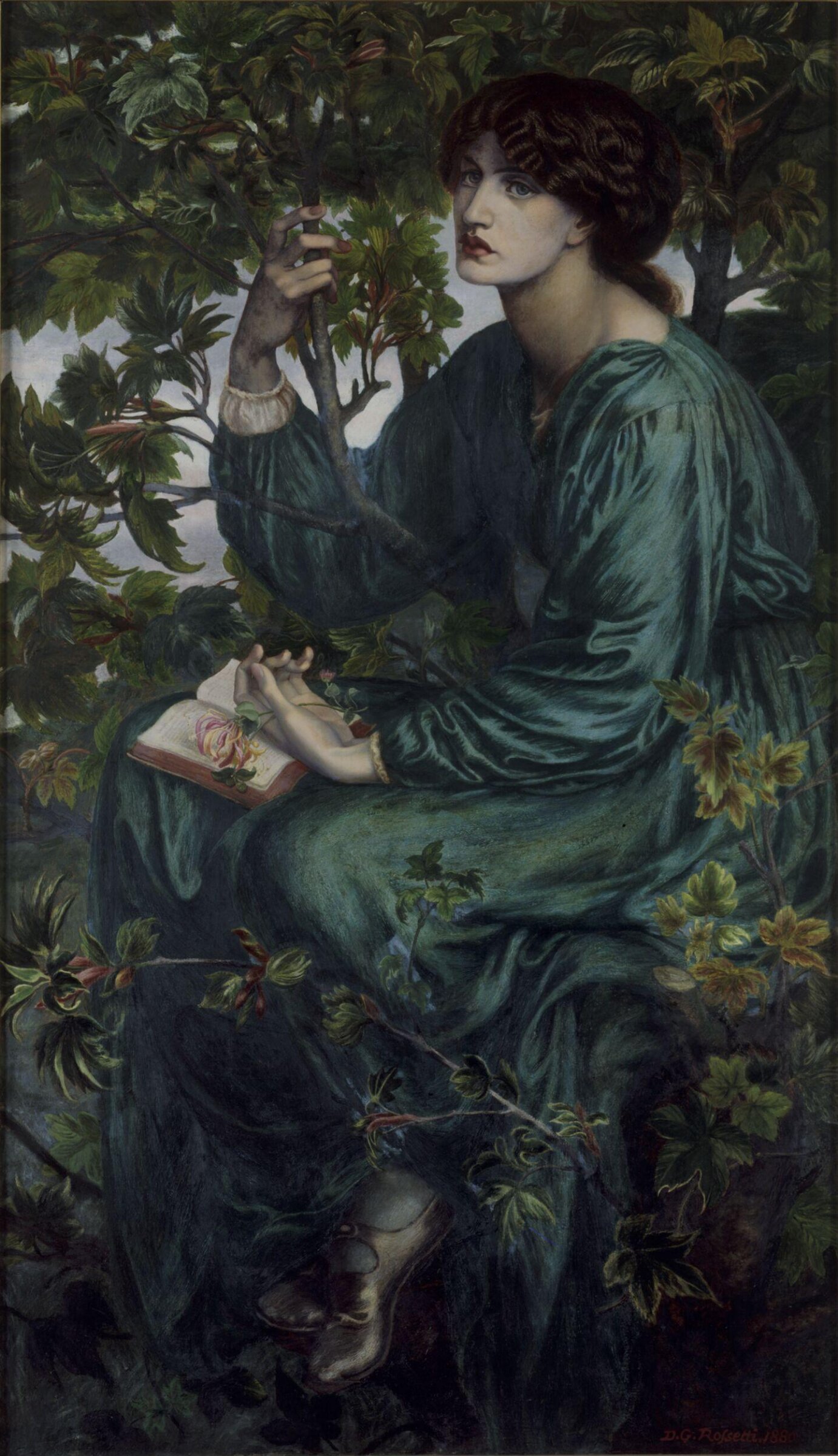
    The Day Dream, Dante Gabriel Rossetti, 1880

    The Day Dream

    1880 · Museu Vitória e Alberto

    The Girlhood of Mary Virgin, Dante Gabriel Rossetti, 1840s

    The Girlhood of Mary Virgin

    1840s · National Gallery

    Vrouwenkop, Dante Gabriel Rossetti, 1838 - 1882

    Vrouwenkop

    1838 - 1882 · Museu Estatal de Amesterdão

    Ecce Ancilla Domini, Dante Gabriel Rossetti, 1850

    Ecce Ancilla Domini

    1850 · National Gallery

    Portrait of Elizabeth Siddal Resting, Holding a Parasol, Dante Gabriel Rossetti, about 1852–1855

    Portrait of Elizabeth Siddal Resting, Holding a Parasol

    about 1852–1855 · Não exposta · Museu J. Paul Getty

    Paolo and Francesca da Rimini, Dante Gabriel Rossetti, 1855

    Paolo and Francesca da Rimini

    1855 · National Gallery

    Hercules and the Lernaean Hydra, Gustave Moreau, 1875–76

    Gustave Moreau

    Hercules and the Lernaean Hydra, 1875–76

    The Bathers, William Adolphe Bouguereau, 1884

    William-Adolphe Bouguereau

    The Bathers, 1884

    Chariot Race, Jean Léon Gérôme, 1876

    Jean-Léon Gérôme

    Chariot Race, 1876

    Odalisque, Jules Joseph Lefebvre, 1874

    Jules Joseph Lefebvre

    Odalisque, 1874

    Portrait of a Woman, Jean Léon Gérôme, 1851

    Jean-Léon Gérôme

    Portrait of a Woman, 1851

    The First Whisper of Love, John Douglas Miller, c. 1889

    John Douglas Miller

    The First Whisper of Love, c. 1889

    Woman from Brittany, Pascal-Adolphe-Jean Dagnan-Bouveret, 1886

    Pascal-Adolphe-Jean Dagnan-Bouveret

    Woman from Brittany, 1886

    Afternoon Tea, Jean-François Rafaëlli, c. 1880

    Raffaëlli, Jean Francois

    Afternoon Tea, c. 1880

    El amour y la muerte (Love and Death), Francisco Goya, published 1799

    Francisco de Goya

    El amour y la muerte (Love and Death), published 1799

    Não exposta · Galeria Nacional de Arte

    The Battle of Love, Paul Cezanne, c. 1880

    Paul Cézanne

    The Battle of Love, c. 1880

    Não exposta · Galeria Nacional de Arte

    Love as Folly, Jean Honoré Fragonard, c. 1773/1776

    Jean-Honoré Fragonard

    Love as Folly, c. 1773/1776

    Não exposta · Galeria Nacional de Arte

    Love as Folly, Jean Honoré Fragonard, c. 1773/1776

    Jean-Honoré Fragonard

    Love as Folly, c. 1773/1776

    Não exposta · Galeria Nacional de Arte

    Love the Sentinel, Jean Honoré Fragonard, c. 1773/1776

    Jean-Honoré Fragonard

    Love the Sentinel, c. 1773/1776

    Não exposta · Galeria Nacional de Arte

    The Tumble, François-Philippe Charpentier, after Jean Honoré Fragonard, 1766

    Jean-Honoré Fragonard

    The Tumble, 1766

    Não exposta · Galeria Nacional de Arte

    Love the Sentinel, Jean Honoré Fragonard, c. 1773/1776

    Jean-Honoré Fragonard

    Love the Sentinel, c. 1773/1776

    Não exposta · Galeria Nacional de Arte

    Les attitudes sont faciles et chastes, Maurice Denis, Ambroise Vollard (publisher), Auguste Clot, 1892/1899, published 1911

    Denis, Maurice

    Les attitudes sont faciles et chastes, 1892/1899, published 1911

    Não exposta · Galeria Nacional de Arte

    O que mostra

    LoveMulherWildernessWhite (color)ÁrvoreSpiritualRed (color)PoppiesNumbersNatureMusical instrumentsHeavenGreen (color)
    Foliage
    Flowers
    Doves
    Morte
    Bushes
    Ponte
    Bird
    Century of Progress
    World's fairs
    Chicago World's Fairs

    No catálogo

    PinturasÓleoPintura britânicaRealismoImpressionismoSéculo XIXPre-RaphaeliteInglaterra