Apollo Crowning Himself
About the sculpture
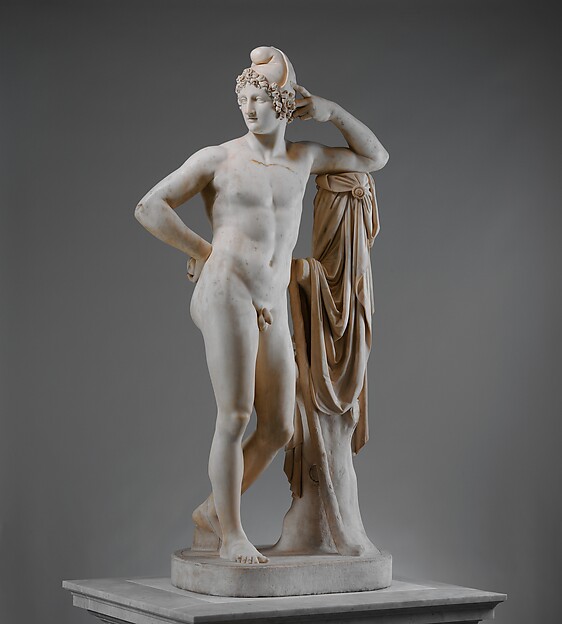
As Ovid told the story in his *Metamorphoses,* when the beautiful nymph Daphne finally escaped the pursuing Apollo by turning into a laurel tree, the Roman god of music and poetry pledged his unrequited love: "Although you cannot be my wife, you shall at least be my tree; I shall always wear you on my hair, on my quiver, O Laurel." In this marble, half-life-size statue inspired by this episode of the *Metamorphoses,* Apollo crowns himself with a laurel wreath. Nude except for sandals, his lyre hangs on the tree trunk that supports a piece of rumpled drapery. He stands in *contrapposto,* a balanced stance characterized by the opposition of straight and bent limbs, in a moment of reflection after the dramatic chase. Apollo's nudity, his broad, muscular chest, and his relaxed, balanced pose all recall famous antique representations of the god.
Read on
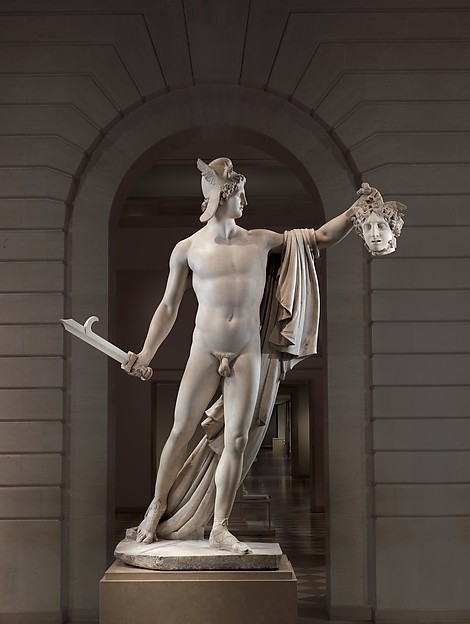
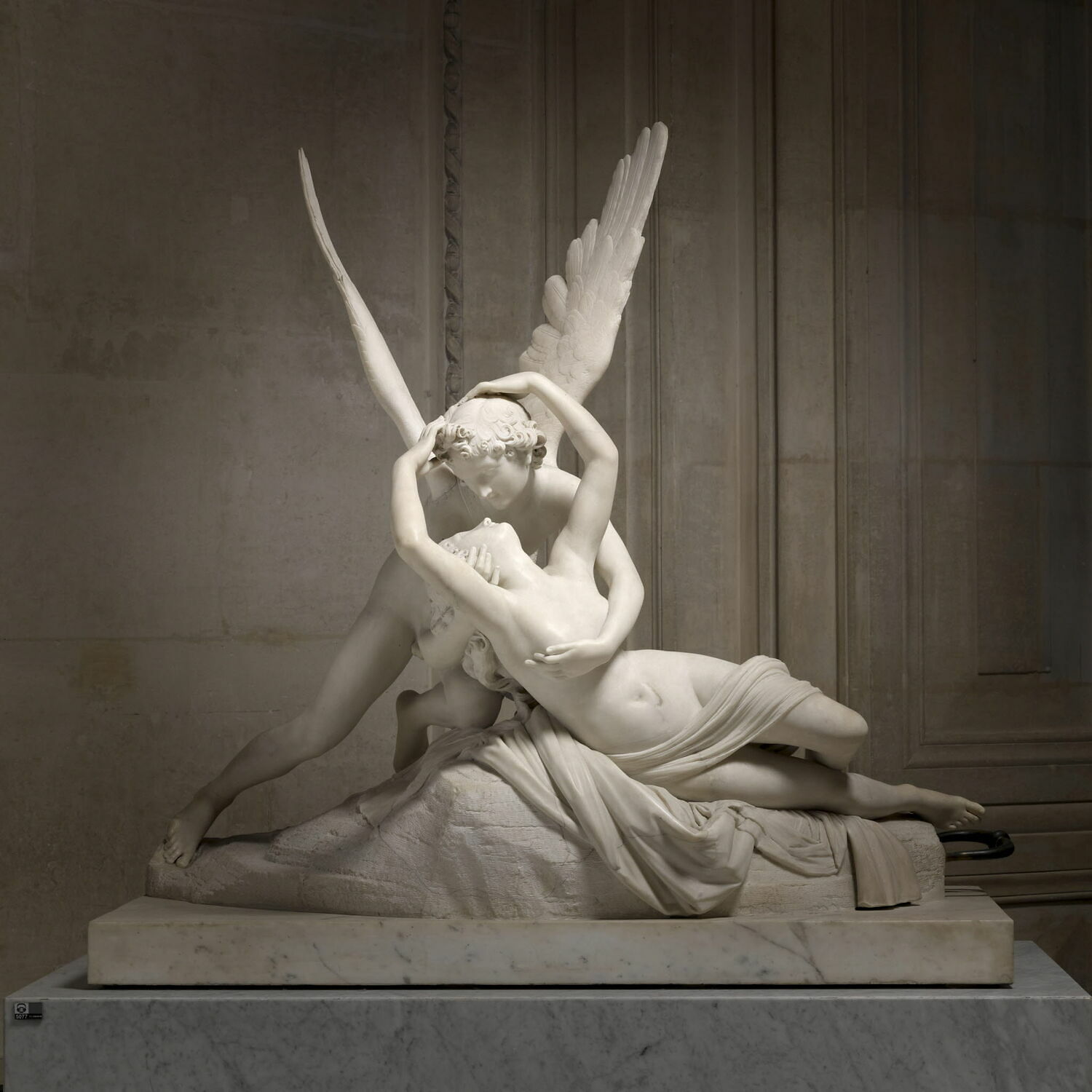
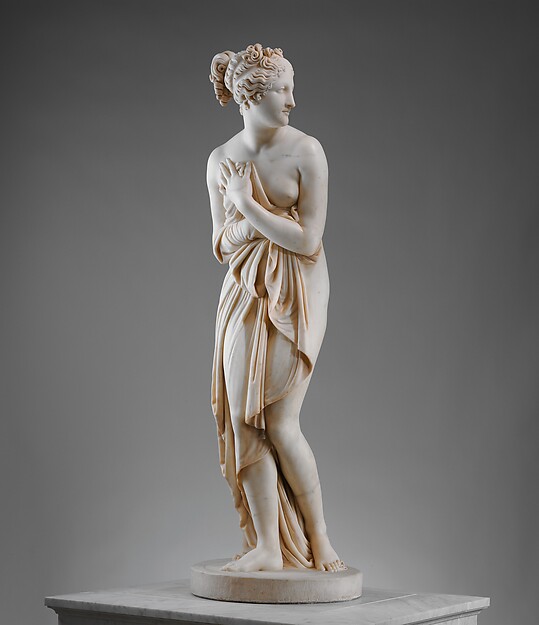
But while sculptor Antonio Canova clearly emulated several antiques, his *Apollo* is not a copy of an already existing statue. The commission for the marble was the result of a competition organized by Don Abbondio Rezzonico, nephew of the Venetian Pope Clement XIII. It is Canova's first fully classicizing work, carved in the Neoclassical style for which he soon became famous.
Entretanto, na vida de Antonio Canova
A vida inteira1775–1800
Shows his statues by candlelight
In the last quarter of the eighteenth century it became fashionable to view galleries at night by torchlight, and Canova seized on the fad: he displayed his works in his studio by candlelight and finished the statues by candlelight with special tools, softening the transitions between the parts of the nude. He then rubbed the marble with pumice, sometimes for weeks or months, and if need be with tripoli and lead.
1779 · Carreira
the Venetian Academy, but not a teacher
In 1779 Canova was elected a member of the Venice Academy of Fine Arts; he declined an offer to teach, but gave the Academy a terracotta statue of Apollo in gratitude.
1779–1780
Leaves Venice for Rome
Dreaming of living and working in Rome, “the capital of art”, Canova left Venice in October 1779 and, accompanied by the architect Giannantonio Selva and stopping in Bologna and Florence, reached Rome — on 4 November 1779 or, by other accounts, on 28 December 1780. He studied the antiquities and sketched the works of Michelangelo, but his first Roman works were received coolly.
22 January – 28 February 1780
Naples: Sanmartino’s “Veiled Christ”
From 22 January to 28 February 1780 he stayed in Naples as a guest of Contarina Barbarigo; he saw the Farnese collection and the Sansevero Chapel, where he so admired Giuseppe Sanmartino’s “Veiled Christ” that he tried to buy it, as well as the veiled figures by his fellow Venetian Antonio Corradini.