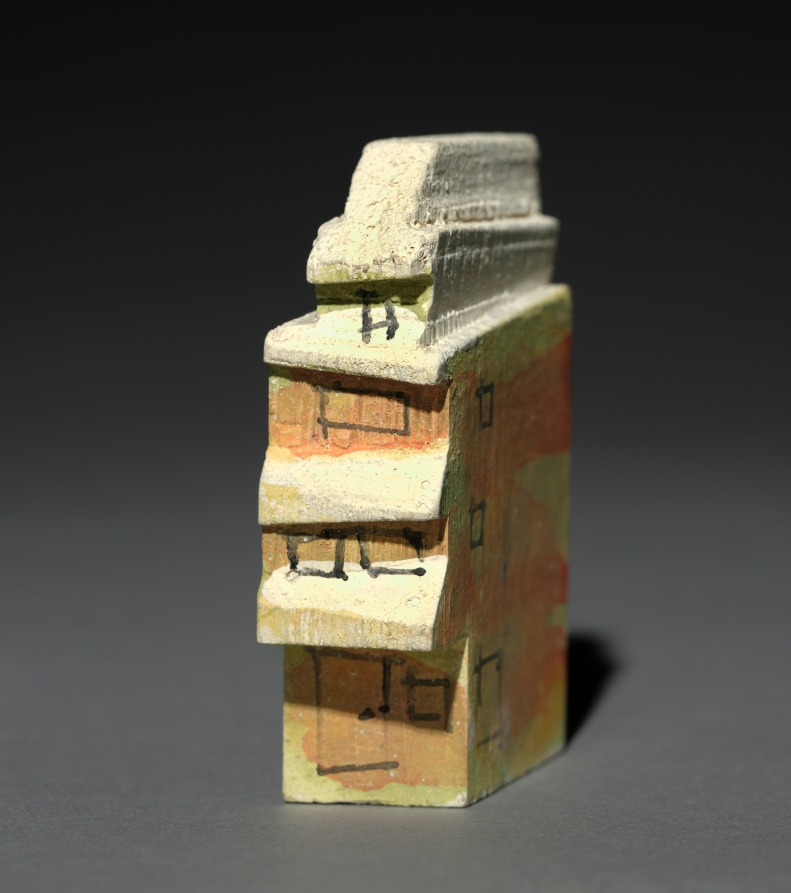
 Lyonel FeiningerNiemcy, 1871–1956
House
Czy można zobaczyć?
Obecnie poza wystawą
Gdzie jest teraz „House”? Kolekcja: Cleveland Museum of Art, Cleveland. Obecnie poza wystawą. Sprawdzono 2 listopada 2026.

Cleveland, Stany Zjednoczone
Należy do kolekcji, ale obecnie nie jest wystawione.
- Sprawdzono
- Ten status od
- Źródło
- Muzeum
O rzeźbie
Over the course of several decades, Lyonel Feininger made hundreds of sawn and painted wood toys that that he gifted to family and friends at Christmas. The artist once described the humorous vein in his work as the "childlike joyous and fantastic-bizarre Feininger world."
Cleveland Museum of Art
Szczegóły
- Numer inwentarzowy
- 1985.170.3
W katalogu
Źródła
- Cleveland Museum of Art
- Zdjęcie: Cleveland Museum of Art — © 2007 Artists Rights Society (ARS), New York / VG Bild-Kunst, Bonn
Z życia: Lyonel Feininger
Cały życiorys1919
First faculty member of the Bauhaus
When Walter Gropius founds the Bauhaus, Feininger becomes his first faculty appointment and the master artist in charge of the printmaking workshop. Among those who attend his workshops are Ludwig Hirschfeld-Mack, Hans Friedrich Grohs and Margarete Koehler-Bittkow.
1924
Founding of “The Blue Four”
In 1924 he becomes one of the founders of the exhibition society “The Blue Four” (German: Blaue Vier).
1928
Start of his photographic work
From 1928 until the mid-1950s he produces a large body of photographic work; in Dessau his neighbor is the experimental photographer László Moholy-Nagy, who encourages him. He keeps the photographs within his circle of friends and never shows them to the public in his lifetime, giving only a few prints to Walter Gropius and Alfred H. Barr Jr.
1933
The Nazis declare his art “degenerate”
When the Nazis come to power in 1933, the situation becomes unbearable for Feininger and his wife; the Nazis declare his work “degenerate.”
1936
His work at a “degenerate art” exhibition
In 1936 his work is shown in a “degenerate art” (Entartete Kunst) exhibition.
1936–1937
Leaving Germany for America
After the 1936 “degenerate art” exhibition but before the 1937 exhibition in Munich, Feininger and his wife leave for America; by other accounts, this happened in 1938. He first teaches at Mills College, then returns to New York.