Edgar DegasFrancja, 1834–1917
Fin d'arabesque
Czy można zobaczyć?
Nie wiadomo
Gdzie jest teraz „Fin d'arabesque”? Kolekcja: Musée d’Orsay, Paryż. Nie wiadomo, czy jest dziś na wystawie.

Paryż, Francja
Wiemy, do kogo należy, ale nie wiemy, czy jest dziś na wystawie.
- Ten status od
- Źródło
- Muzeum
O obrazie
Fin d’arabesque, or End of an Arabesque, is Edgar Degas’s painting of the 1870s at the Musée d’Orsay in Paris. The dancer carries a bouquet in her right hand as she takes a bow. Oil and pastel combine on a narrow canvas, 67.4 by 38 centimeters. The work appeared in the third impressionist exhibition.
Szczegóły
- Numer inwentarzowy
- RF 4040
W katalogu
Źródła
- Wikidata
- Zdjęcie: Musée d’Orsay — Edgar Degas · Public domain · Wikimedia Commons
Z życia: Edgar Degas
Cały życiorys1870
A volunteer in the war; a flaw in his eyesight
When the Franco-Prussian War broke out Degas volunteered; at the first shooting practice it turned out that he saw poorly with his right eye. It was the first sign of the macular degeneration that left him almost blind at the end of his life; he was transferred to the artillery and served there to the end of the war.
early 1870s
Meets Durand-Ruel
Degas met the dealer Durand-Ruel, later the most prominent of the trusted dealers with whom he planned his strategy at auctions.
październik 1872 – marzec 1873 · Miejsce zamieszkania
New Orleans
1873–1874
His brother's debts: he sells his house and collection
After his father's death Degas learned that his brother René had run up enormous business debts. To save the family's reputation he sold his house and an inherited art collection and for the first time in his life depended on sales of his own work.
1874
The first Impressionist exhibition
Disenchanted with the Salon, Degas joined a group of young artists organizing an independent exhibiting society. He took a leading role in organizing the eight shows of 1874–1886 and exhibited in all but one, despite constant conflicts with the group.
1881
“The Little Dancer of Fourteen Years” on show
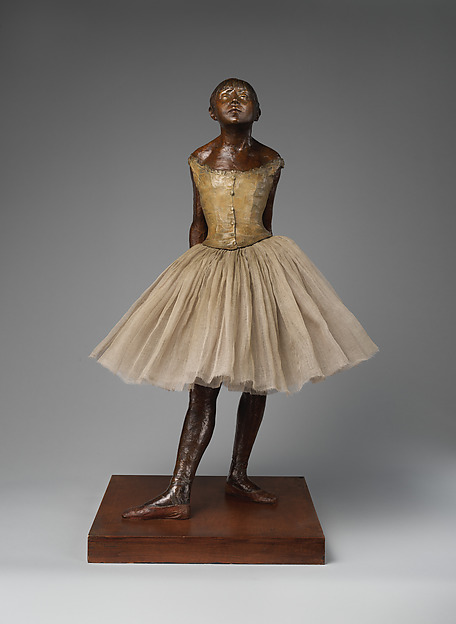
The nearly life-size wax figure with real hair and a cloth tutu, modelled on Marie van Goethem, provoked a strong reaction: critics found its realism extraordinary, but many denounced the dancer as ugly. It was the only sculpture Degas showed in his lifetime.