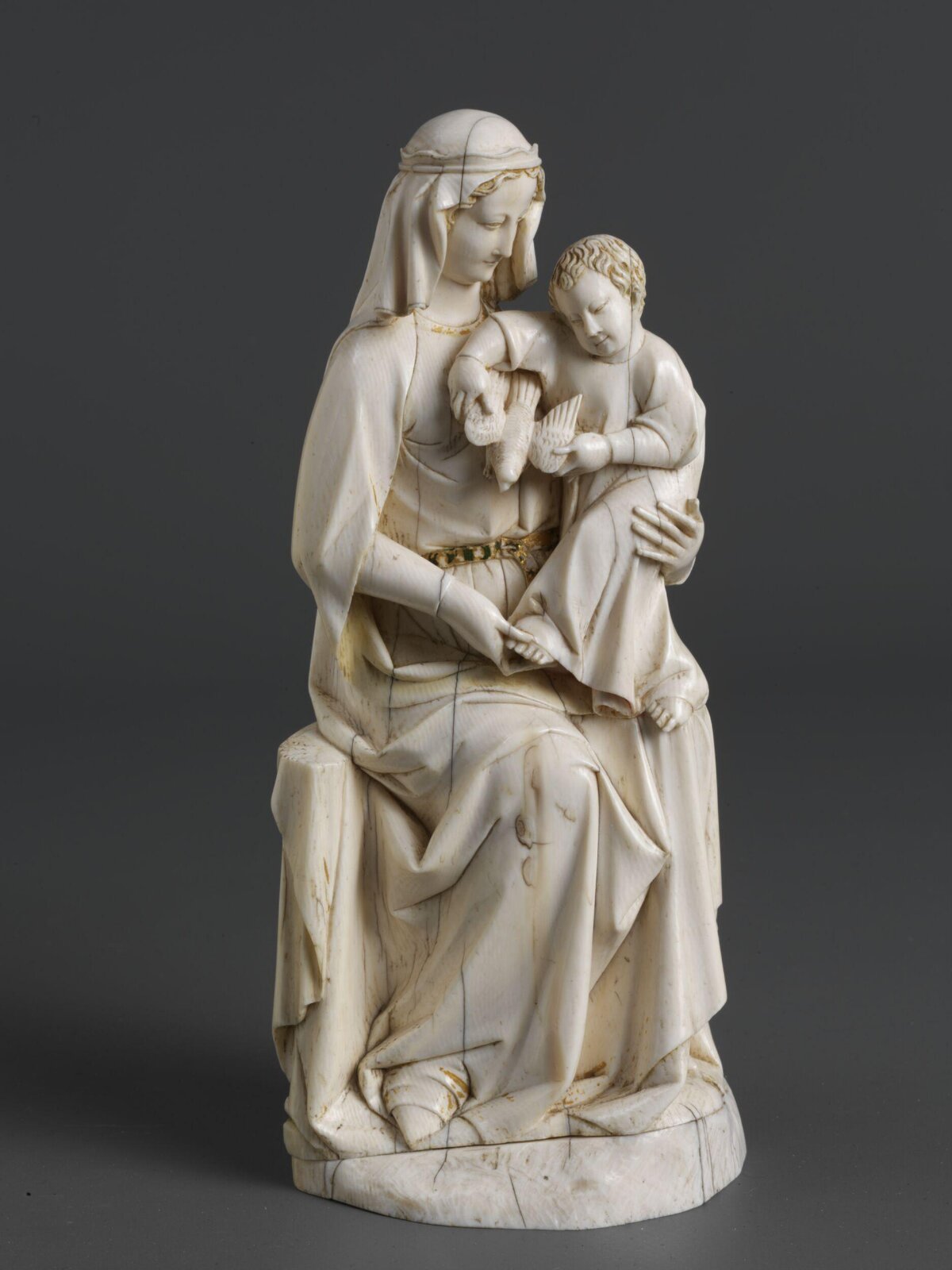
Virgin and Child
Mag men het zien?
Ja, het ontvangt bezoek

Victoria and Albert Museum
Londen, Verenigd Koninkrijk
ZaalMedieval & Renaissance, Room 9, The Dorothy and Michael Hintze Gallery
Publiek tentoongesteld. Wie daarvoor instaat, staat hieronder.
- Gecontroleerd
- 9 dagen geleden
- Ongewijzigd sinds
- 25 sep 2026
- Bron
- De eigen collectiegegevens van het museum
About the sculpture
During the 13th century, Paris became Europe’s leading centre for ivory carving. The white colour and lustrous surface of ivory suited the Gothic taste for delicacy and refinement. Touches of colour emphasised the sheen of the unpainted areas. The clearly affectionate relationship between the Virgin and Christ is typical of the Gothic style.
This is one of the finest seated Virgin and Child statuettes. Stylistically it occupies a transitional position between the best works of the third quarter of the thirteenth century, such as the Sainte-Chapelle Virgin in the Louvre and the so-called 'Frigolet Virgin' now in the Thomson Collection in Toronto.
Read on
Three dimensional images of the Virgin and Child were ubiquitous from the twelfth to the fifteenth centuries, produced in a wide range of materials and sizes and testifying the overwhelming devotion to th Virgin. Together with the Crucifixion, statues and statuettes of the Virgin and Child were the pricipal objects of devotion in the Christian Church, and vast numbers were made for ecclesisastical, monastic and private worship.
Victoria and Albert Museum
Gegevens
- Inventarisnummer
- 200-1867
What it shows
In de catalogus
Bronnen
- Victoria and Albert Museum: the museum's own open data · opgehaald 9 dagen geleden
- Afbeelding: Victoria and Albert Museum — © Victoria and Albert Museum, London







