Paul GauguinFrankrijk, 1848–1903
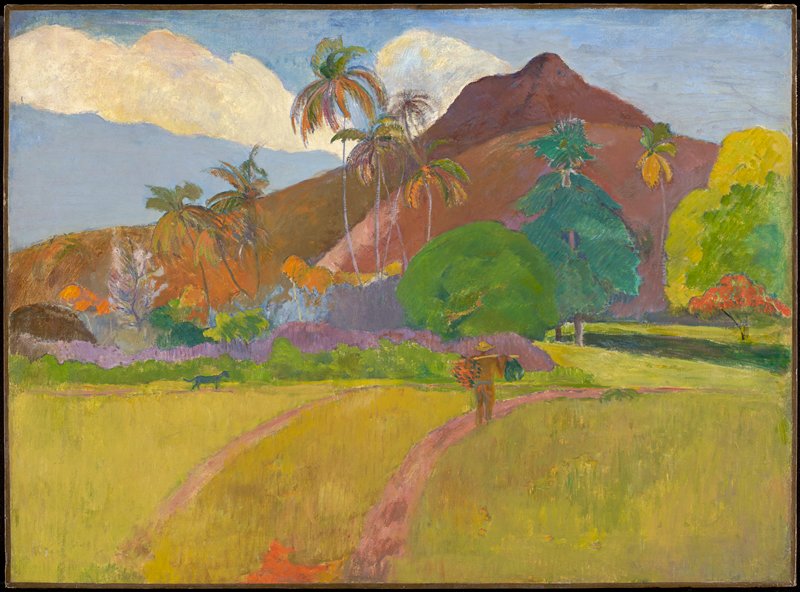
Fatata Te Moua (At the Foot of a Mountain)
Kan ik het zien?
Ja, nu te zien
Waar is „Fatata Te Moua (At the Foot of a Mountain)” nu? Hermitage, Zaal 411, Sint-Petersburg. Ja, nu te zien. Gecontroleerd 29 augustus 2026.

Sint-Petersburg, Rusland
Gesloten· gaat morgen om 12:00 open
Publiek tentoongesteld.
- Gecontroleerd
- Ongewijzigd sinds
- Bron
- Het museum
Over het schilderij
Fatata te Mouà (Aan de voet van een berg) (Frans:Au pied de la montagne) is een schilderij van Paul Gauguin. Hij schilderde het in 1892 op Tahiti. Sinds 1948 maakt het deel uit van de collectie van de Hermitage in Sint-Petersburg.
In de woorden van het museum — in het Russisch
Картина была исполнена на острове Таити, в Полинезии, привлекшей Гогена романтической экзотикой и гармонией естественной жизни. Известный путешественник Б. Даниельссон, видевший места, где работал художник, подчеркнул достоверность в передаче мотива: "Население так сократилось, что хижины стояли рядом. И, как на этой картине, редко можно было увидеть больше одного всадника или прохожего". Яркая, эффектная природа островов Океании передана обобщёнными пятнами звучных "пряных" красок. Большое дерево у подножия горы, ставшее главным компонентом этого пейзажа, изображено живописцем и в других произведениях. Со временем гора обрела в системе духовно-символических образов Гогена связь с таитянской богиней Луны Хиной.
Hermitage
Gegevens
- Inventarisnummer
- ГЭ-8977
In de catalogus
Bronnen
- Hermitage
- Afbeelding: Hermitage — Museum open access
In het leven van Paul Gauguin
Het hele leven1870s–1891 · Werkzaam in
Paris
1886–1891 · Werkzaam in
Pont-Aven
1891
Successful Auction at the Hôtel Drouot
A successful auction of paintings at the Hôtel Drouot in Paris in February 1891, aided by a glowing review from Octave Mirbeau, together with a banquet and a benefit concert, provided the funds for the journey to Tahiti.
1 April 1891
Departure for Tahiti
On 1 April 1891, after a final visit to his wife and children in Copenhagen, Gauguin sailed for Tahiti, intending to escape European civilization and "everything that is artificial and conventional." He spent his first three months in Papeete, then set up a studio in a bamboo hut at Mataiea.
1891–1901 · Werkzaam in
Tahiti
1893
Return to France
In August 1893 Gauguin returned to France, where he continued painting Tahitian subjects such as Mahana no atua and Nave nave moe; he rented an apartment on rue Vercingétorix on the edge of Montparnasse and held a weekly salon, cultivating an exotic image.