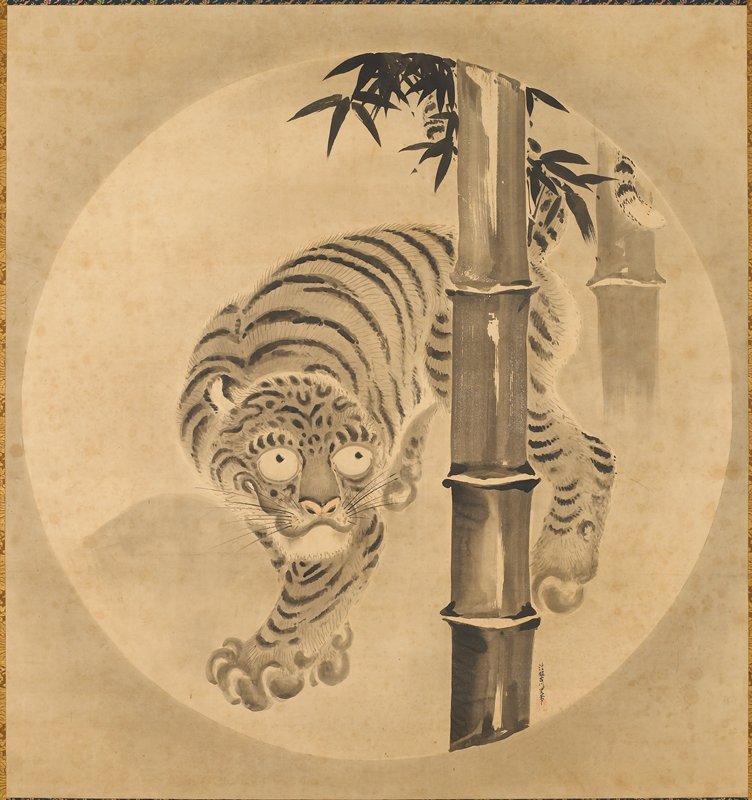
Tiger Emerging from Bamboo
Kan ik het zien?
Nu niet te zien
Waar is „Tiger Emerging from Bamboo” nu? Collectie: Minneapolis Institute of Art, Minneapolis. Nu niet te zien. Gecontroleerd 29 september 2026.

Minneapolis, Verenigde Staten
Het hoort bij de collectie, maar is momenteel niet tentoongesteld.
- Gecontroleerd
- Ongewijzigd sinds
- Bron
- Het museum
Over het schilderij
Tigers as a subject for painting became popular among Japanese artists as early as the 15th century when Chinese examples were brought to Japan. Within Zen monasteries, they became symbols of the earthbound spirit and were often paired with images of dragons, emblems of the soaring enlightened spirit. Among Japan's military elite, they were symbols of power, and artists often painted them among thick trunks of bamboo, a plant admired for its strength and resiliency. Within the context of an impressive reception hall, such large scale paintings contributed to the grandeur of the setting. Since tigers were not native to Japan, artists had to conjecture how they actually looked based on imported hides. As a result, they often appear to be overgrown domestic cats.
Lees meer
As a teenager Kano Tsunenobu succeeded his father Naonobu (1607–1650) to become head of the Kobikichō atelier, the highest ranking of several branch studios of the prominent Kano House of painters. As such, Tsunenobu served as painter-in-attendance (goyō-eshi) to the ruling Tokugawa shoguns in the Japanese capital Edo (now Tokyo). One of the foremost painters of his day, Tsunenobu was also known for his vast knowledge of old Chinese and Japanese paintings and was widely active as an authenticator.
Minneapolis Institute of Art
Gegevens
- Inventarisnummer
- 2012.1.1
In de catalogus
Bronnen
- Minneapolis Institute of Art
- Afbeelding: Minneapolis Institute of Art — public domain
![Scenes of Tea Cultivation [right of a pair], Kano Tsunenobu, 17th century](https://img.artsmia.org/web_objects_cache/060000/500/90/60599/mia_8028241_800.jpg)
![Scenes of Tea Cultivation [left of a pair], Kano Tsunenobu, 17th century](https://img.artsmia.org/web_objects_cache/060000/500/90/60598/mia_8028224_800.jpg)


![Heron and Reeds [left of a pair of Swallow and Heron], Kano Tsunenobu, late 17th–early 18th century](https://img.artsmia.org/web_objects_cache/037000/600/40/37640/mia_6002333_800.jpg)
![Swallow on a Lotus [right of a pair of Swallow and Heron], Kano Tsunenobu, late 17th–early 18th century](https://img.artsmia.org/web_objects_cache/037000/600/30/37639/mia_6002332_800.jpg)