Gustave CourbetFrankrijk, 1819–1877
de gewund man
The Wounded Man
Mag men het zien?
Onbekend
Waar is „de gewund man” nu? Collectie: Musée d'Orsay, Parijs. Onbekend.

Parijs, Frankrijk
De eigenaar is bekend; of het werk nu te zien is, is onbekend.
- Ongewijzigd sinds
- Bron
- Het museum
Over het schilderij
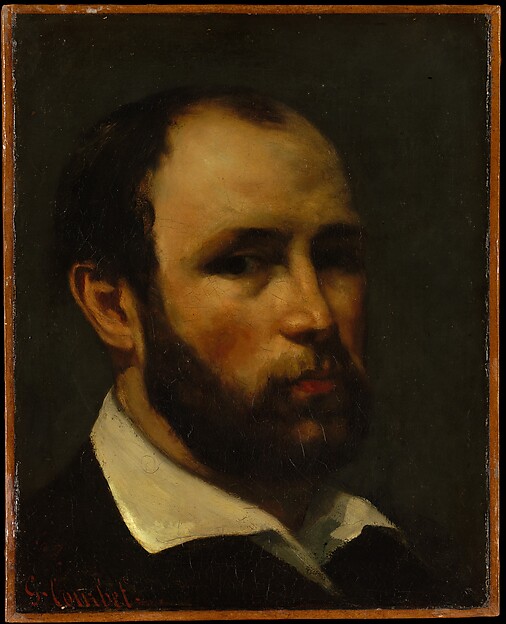
The Wounded Man (French: L'Homme blessé) is an oil-on-canvas self-portrait created between 1844 and 1854 by the French Realist painter Gustave Courbet. In it, Courbet depicts himself in a romantic theme as a suffering, heroic man. Originally, the composition featured a woman leaning on the artist's shoulder. Sometime before May 1854, Courbet replaced her with a sword, and added a red bloodstain on his shirt. Courbet's decision to depict himself as a wounded man may have arisen from his distress at the dissolution, circa 1851, of his 14-year relationship with Virginie Binet, with whom he had a son.
Gegevens
- Inventarisnummer
- RF 338
In de catalogus
Bronnen
- Wikidata
- Afbeelding: Musée d'Orsay — Gustave Courbet · Public domain · Wikimedia Commons
Intussen, in het leven van Gustave Courbet
Het hele leven1844
“Self-Portrait with Black Dog” accepted by the 1844 Salon
“Self-Portrait with Black Dog” (c. 1842–44) was accepted for exhibition at the Salon of 1844.
c. 1844 – 1847
Brasserie Andler: the realists' circle
Around these years Courbet built ties in Paris artistic circles: he frequented the Brasserie Andler next to his studio, where proponents of realism in art and literature gathered, among them Charles Baudelaire and Honoré Daumier.
1844–1847
Ornans, Belgium and the Netherlands
Between 1844 and 1847 Courbet visited Ornans several times and also travelled to Belgium and the Netherlands, where he made contact with picture dealers. His trip to Holland in 1847 further strengthened his admiration for Rembrandt and Hals.