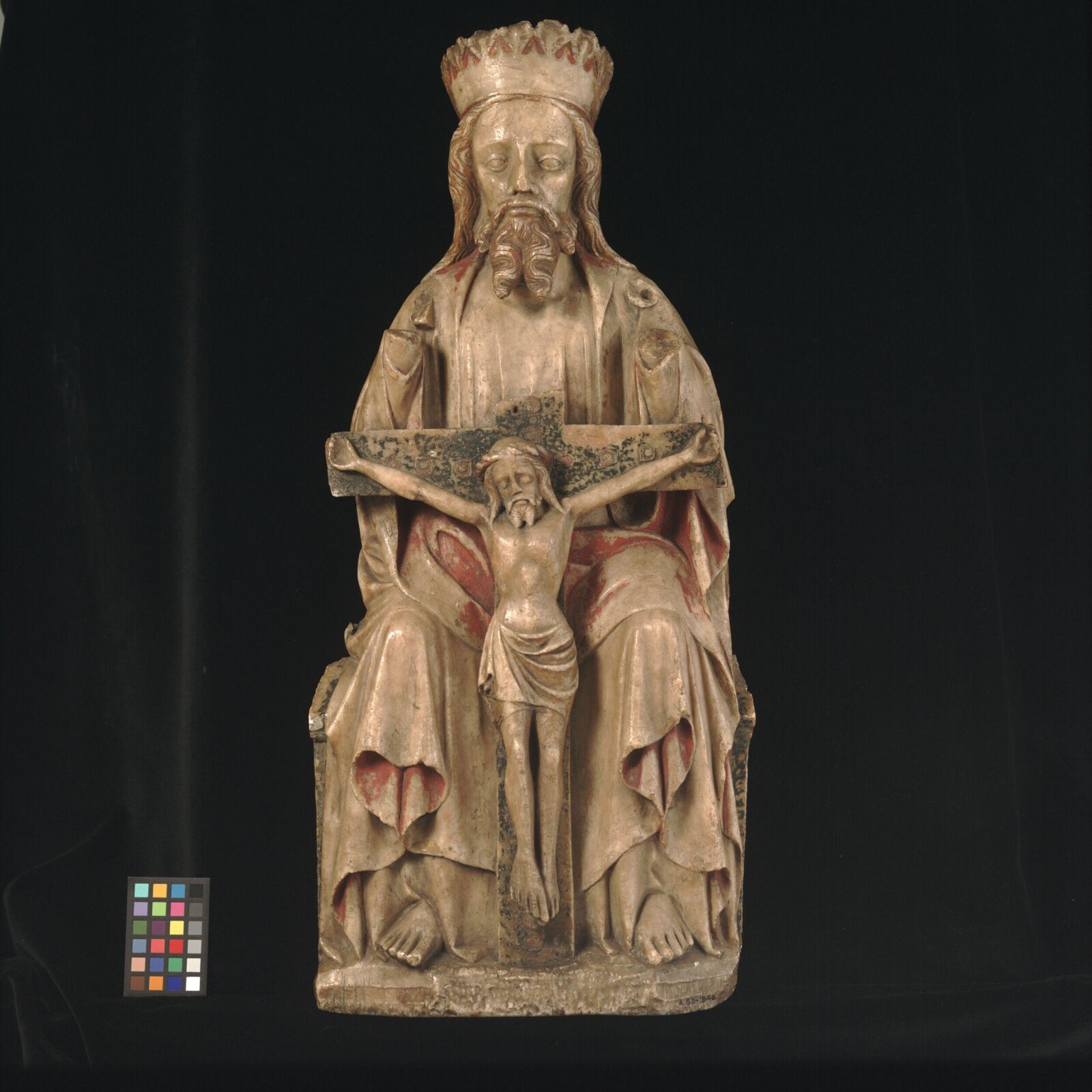
The Trinity
Mag men het zien?
Ontvangt momenteel niet

Victoria and Albert Museum
Londen, Verenigd Koninkrijk
Het hoort bij de collectie, maar is momenteel niet tentoongesteld.
- Gecontroleerd
- 7 dagen geleden
- Ongewijzigd sinds
- 25 sep 2026
- Bron
- De eigen collectiegegevens van het museum
About the sculpture
This alabaster statuette depicting the Trinity is made in England in ca. 1400.
The large figure of the Trinity shows God the Father, crowned and with a forked beard with carved eyelids. He is enthroned and wears a gown and a cloak with his hands presumably raised in blessing. Between his knees there is a cross bearing the bearded Christ, wearing the torse and a loincloth with his head inclined to the left. The Holy Spirit is not represented, although there is a small dowel hole at the top of the cross by which the Dove was probably attached.
Read on
The carving of alabaster, mostly quarried in Tutbury and Chellaston near Nottingham, took on industrial proportions in England between the middle of the 14th and the early 16th centuries. The market for altarpieces and smaller devotional images was a large one. It included not only religious foundations but also the merchant classes. Many hundreds of English alabasters were exported, some as far afield as Iceland and Santiago de Compostela in north-west Spain.
Alabaster - a form of gypsum - is a comparatively soft material and is therefore easy to carve. It can also be polished. Its natural colour was especially useful for the representation of faces and flesh, which would normally remain unpainted.
Victoria and Albert Museum
Gegevens
- Inventarisnummer
- A.53-1946
What it shows
In de catalogus
Bronnen
- Victoria and Albert Museum: the museum's own open data · opgehaald 7 dagen geleden
- Afbeelding: Victoria and Albert Museum — © Victoria and Albert Museum, London