Giorgio de ChiricoItalië, 1888–1978
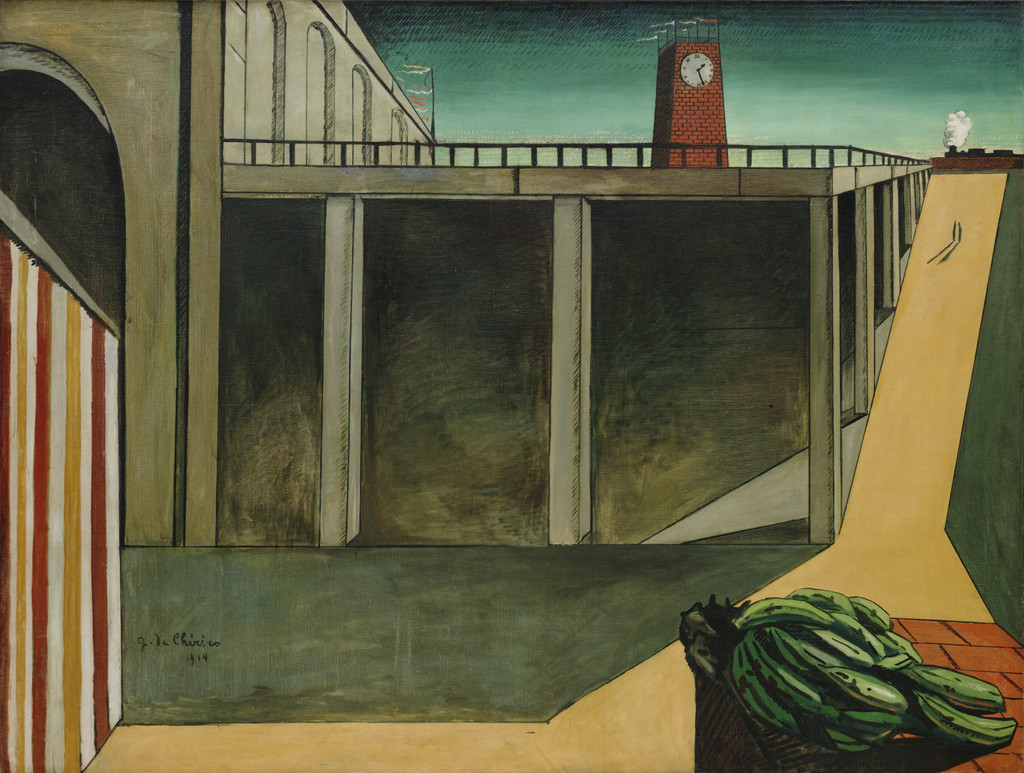
The Philosopher's Conquest
Kan ik het zien?
Ja, nu te zien
Waar is „The Philosopher's Conquest” nu? Art Institute of Chicago, Zaal 396, Chicago. Ja, nu te zien. Gecontroleerd 29 september 2026.

Chicago, Verenigde Staten
Nu open· tot 17:00
Publiek tentoongesteld.
- Gecontroleerd
- Ongewijzigd sinds
- Bron
- Het museum
Over het schilderij
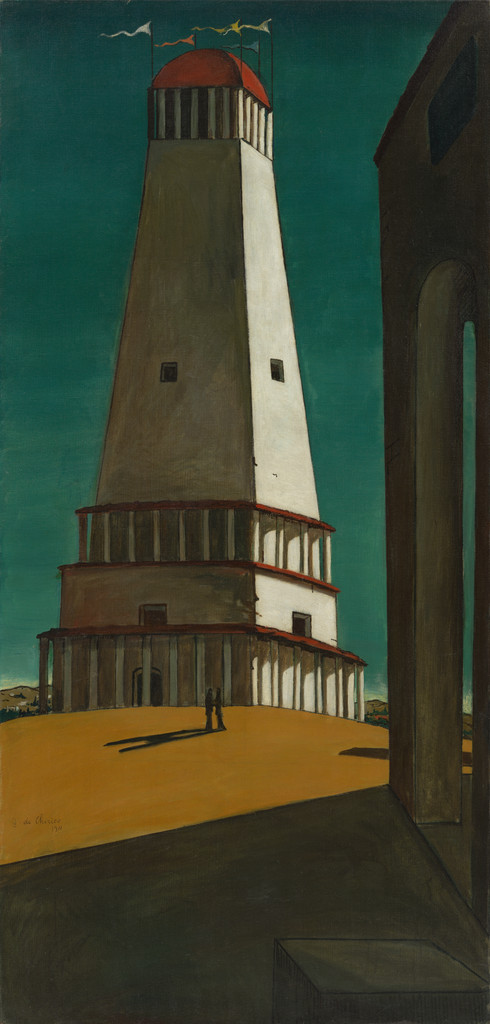
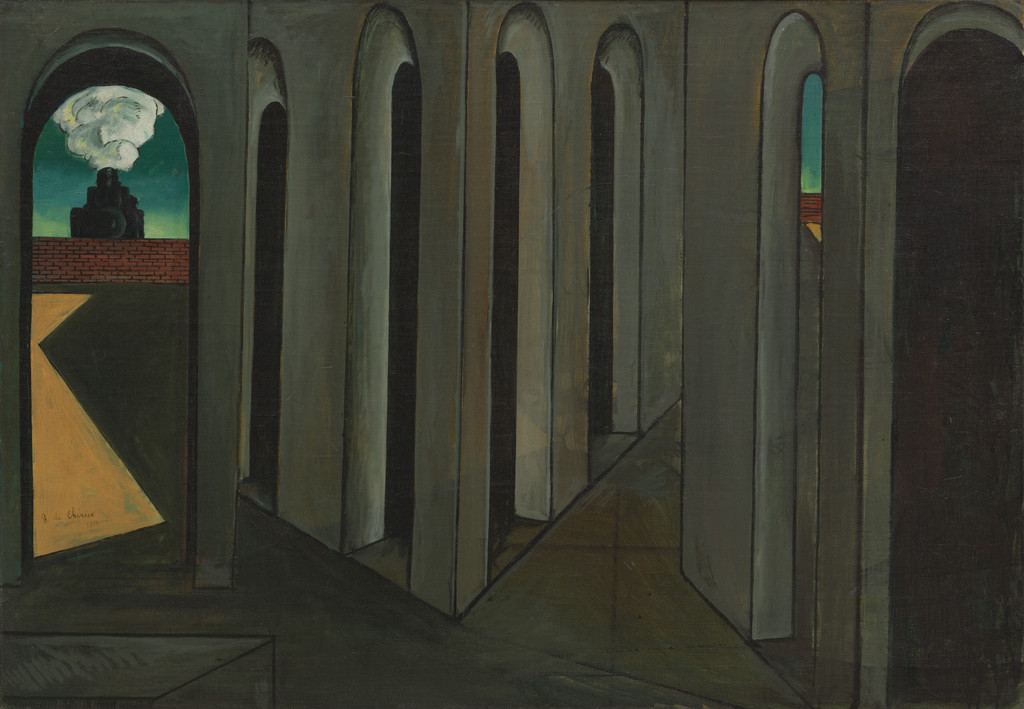
The work of Giorgio de Chirico represents an unexpected form of classicism in early avant-garde painting. This canvas, one of six in a series, combines a Mediterranean cityscape with still-life objects. Familiar elements appear in many of de Chirico’s paintings like pieces of a mysterious puzzle: a classical arcade, oddly oversize artichokes, a cannon and cannonballs, a clock, an industrial brick chimney, a monumental tower, a running train, and a square-rigged sailing ship. Here the stage set for this extraordinary juxtaposition of objects is an Italian piazza, virtually deserted except for the menacing shadowy figures outside the edge of the scene.
Lees meer
De Chirico represented objects with a matter-of-fact, though intentionally crude, precision. He painted his scenes flatly, in bright colors, and illuminated them with a cold white light. Rendered in this clear style, works like The Philosopher’s Conquest seem rife with meaning, though they remain resolutely enigmatic. Indeed, by juxtaposing incongruous objects, the artist sought to produce a metaphysical quality, what he called “art that in certain aspects resembles . . . the restlessness of myth.” De Chirico’s works would profoundly affect the Surrealists, who in the 1920s and 1930s attempted to portray dreams and images of the subconscious in their work.
This is one of thirty-five works that comprise the Winterbotham Collection. Click here to learn more about the collection.
Art Institute of ChicagoCC BY 4.0
Gegevens
- Inventarisnummer
- 1939.405
Wat het toont
In de catalogus
Bronnen
- Art Institute of Chicago
- Afbeelding: Art Institute of Chicago — © the artist or rights holder
In het leven van Giorgio de Chirico
Het hele leven1911
Moving to Paris, to his brother Andrea
In July 1911 de Chirico moves to Paris, where he joins his younger brother Andrea, who would become the writer, painter and composer known as Alberto Savinio. The move is sometimes dated to 1910.
1911
Turin: the city's “metaphysical aspect”
In July 1911, on his way to Paris, de Chirico spends a few days in Turin; he is profoundly moved by what he calls the “metaphysical aspect” of the city, especially the architecture of its archways and piazzas.
1912
First shows at the Salon d'Automne
From 1912 de Chirico takes part in the exhibitions of the Salon d'Automne: through his brother he meets Pierre Laprade, a member of the jury, and shows three works, among them “The Enigma of the Oracle” and a self-portrait.
1913
The first sale: “The Red Tower”
In 1913 de Chirico exhibits at the Salon des Indépendants and the Salon d'Automne; his work is noticed by Pablo Picasso and Guillaume Apollinaire, and “The Red Tower” becomes the first painting he sells.
1914
A contract with the dealer Paul Guillaume
In 1914, through Apollinaire, de Chirico meets the art dealer Paul Guillaume, with whom he signs a contract for his artistic output.
1915
Return to Italy and the hospital at Ferrara
At the outbreak of the First World War de Chirico returns to Italy; on his arrival in May 1915 he enlists in the army but is considered unfit for work and assigned to the hospital at Ferrara. The shop windows of the town inspire a series of paintings featuring biscuits, maps and geometric constructions in indoor settings.