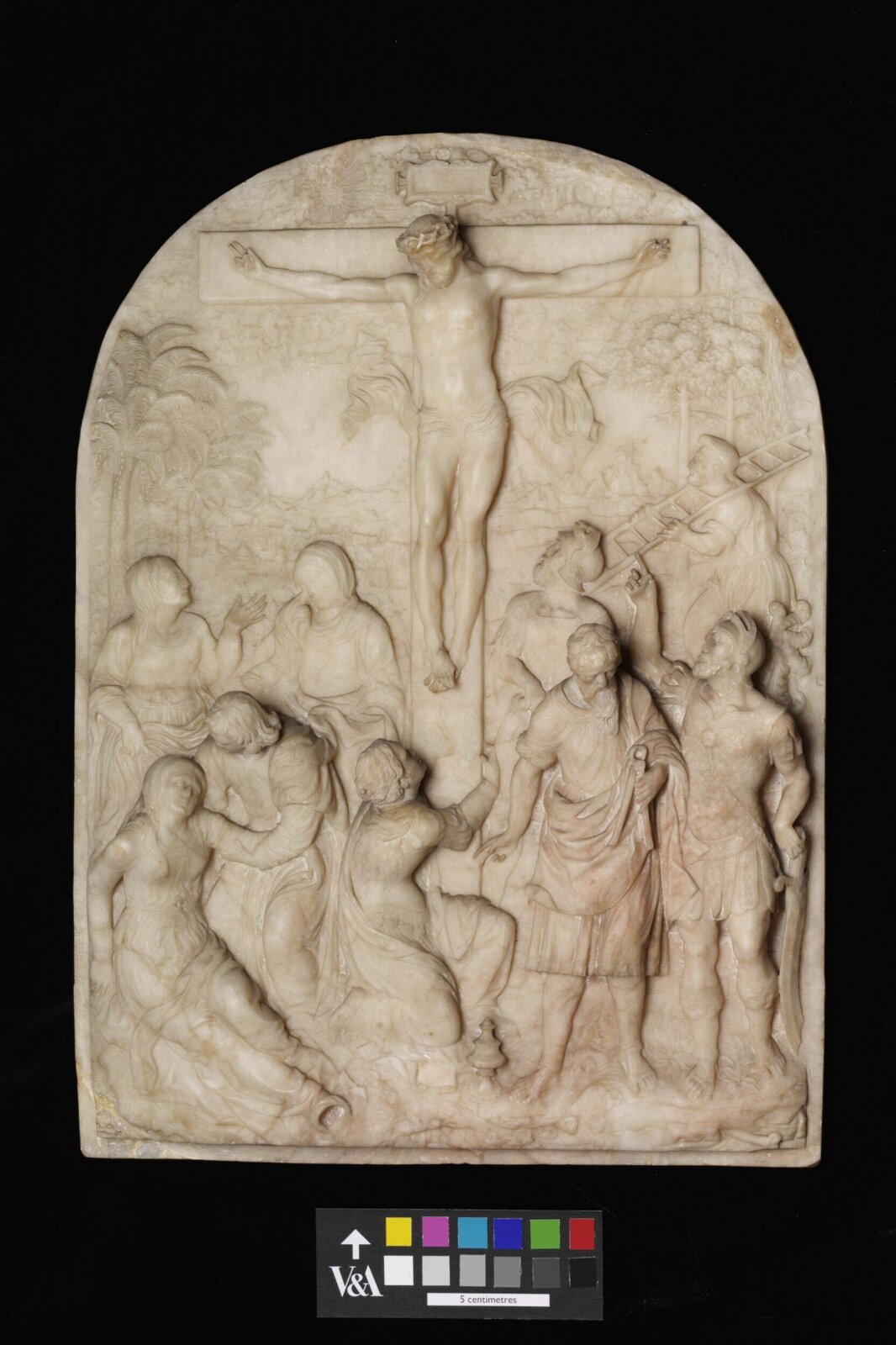
The Crucifixion
Mag men het zien?
Ja, het ontvangt bezoek

Victoria and Albert Museum
Londen, Verenigd Koninkrijk
ZaalSculpture, Room 111, The Gilbert Bayes Gallery
Publiek tentoongesteld. Wie daarvoor instaat, staat hieronder.
- Gecontroleerd
- 9 dagen geleden
- Ongewijzigd sinds
- 25 sep 2026
- Bron
- De eigen collectiegegevens van het museum
About the sculpture
The techniques used in carving in wood and stone were fundamentally the same. First the sculptor carved the rough shape of the piece, a process known as ‘blocking out’. Then, he would work the surface with knives or chisels and abrasives. The figure was generally held horizontally at a workbench and attached to cylindrical shafts, so the sculptor could turn the piece as he carved. Small-scale pieces were generally carved at a workbench.
The relief shows the range of effects made possible by the relative softness of alabaster. The sculptor has carved the figures in the foreground in high relief, but rendered the background – with the city of Jerusalem, the clouds and mountains – in low relief. This gives the scene a sense of perspective.
Read on
There are two sorts of alabaster. Calcite alabaster is very hard and was used in ancient times. This object is made of gypsum alabaster which is a fine-grained, soft and smooth stone. Although at first glance it looks a little like marble, which it was intended to imitate, it was much easier to carve due to its softness, and alabaster objects were therefore significantly cheaper to produce. England was a major centre for the production of objects such as this one. During period, they were exported in very large numbers to Europe where they survive, unlike many examples which remained in England and were destroyed or greatly damaged during the Reformation.
Victoria and Albert Museum
Gegevens
- Inventarisnummer
- A.10-1916
What it shows
In de catalogus
Bronnen
- Victoria and Albert Museum: the museum's own open data · opgehaald 9 dagen geleden
- Afbeelding: Victoria and Albert Museum — © Victoria and Albert Museum, London