Edgar DegasFrankrijk, 1834–1917
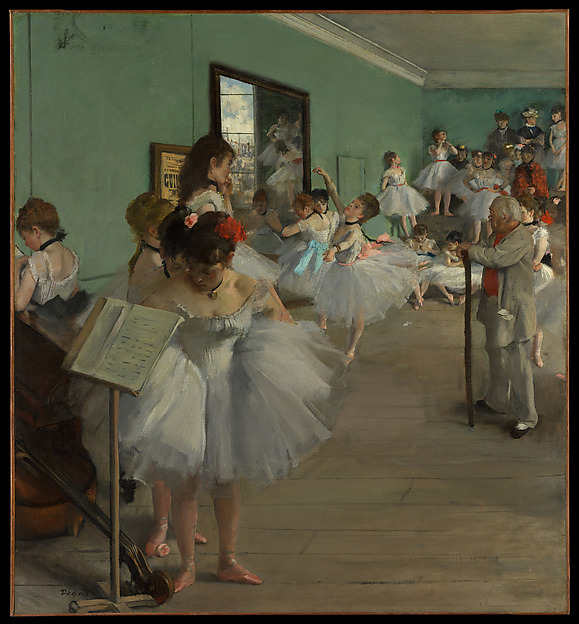
De balletklas
The Ballet Class
Mag men het zien?
Onbekend: het museum bewaart het stilzwijgen

Musée d'Orsay
Parijs, Frankrijk
De eigenaar is bekend. Of het vandaag te zien is, zegt het museum niet, en gissen hebben wij niet geleerd.
- Ongewijzigd sinds
- Bron
- De eigen collectiegegevens van het museum
About the painting
La classe de danse (De balletklas) is een schilderij van de Franse impressionistische kunstschilder Edgar Degas, geschilderd in 1873-1876, olieverf op doek, 85,5 × 75 centimeter groot. Het toont de ballerina's van het corps van de Opera van Parijs, wachtend op de beoordeling van hun leraar Jules Perrot. Graaf Isaac de Camondo, een bekend verzamelaar van impressionistische kunst, liet het schilderij in 1911 na aan het Louvre. Sinds 1986 bevindt het zich in het Musée d'Orsay te Parijs. Een variant van het schilderij is te zien in het Metropolitan Museum of Art in New York.
Gegevens
- Inventarisnummer
- RF 1976
In de catalogus
Bronnen
- Wikidata · opgehaald 7 dagen geleden
- Afbeelding: Musée d'Orsay — Edgar Degas · Public domain · Wikimedia Commons
Intussen, in het leven van Edgar Degas
Het hele levenlate 1860s
The turn to modern life: racecourses, milliners, laundresses
By the late 1860s Degas had moved from history painting to an original observation of contemporary life: racecourse scenes let him paint horses and riders in a modern setting, and then he turned to women at work — milliners and laundresses.
late 1860s
Begins modelling in wax
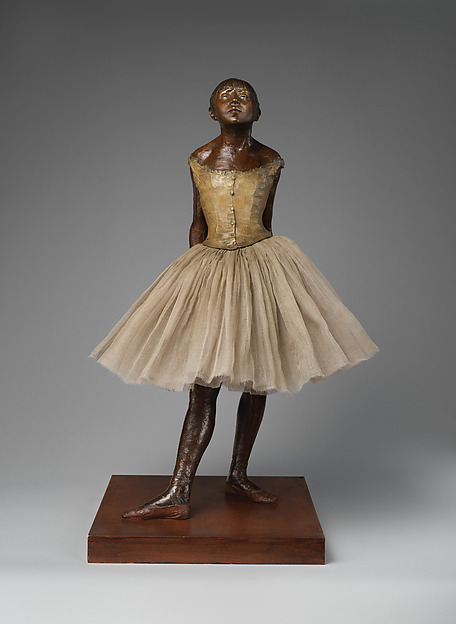
Degas modelled small wax figures of dancers, bathers and jockeys for himself, in place of studies. He never worked in bronze or stone; he valued wax for its changeability, and his sculptor friend Bartholomé encouraged him.
1870
A volunteer in the war; a flaw in his eyesight
When the Franco-Prussian War broke out Degas volunteered; at the first shooting practice it turned out that he saw poorly with his right eye. It was the first sign of the macular degeneration that left him almost blind at the end of his life; he was transferred to the artillery and served there to the end of the war.
early 1870s
Meets Durand-Ruel
Degas met the dealer Durand-Ruel, later the most prominent of the trusted dealers with whom he planned his strategy at auctions.
oktober 1872 – maart 1873 · Woonplaats
New Orleans
1873–1874
His brother's debts: he sells his house and collection
After his father's death Degas learned that his brother René had run up enormous business debts. To save the family's reputation he sold his house and an inherited art collection and for the first time in his life depended on sales of his own work.