Bernard, EmileFrankrijk, 1868–1941
Symbolic Self-Portrait
Mag men het zien?
Onbekend

Parijs, Frankrijk
De eigenaar is bekend; of het werk nu te zien is, is onbekend.
- Ongewijzigd sinds
- Bron
- Het museum
Gegevens
- Inventarisnummer
- RF 2008 53
In de catalogus
Bronnen
- Wikidata
- Afbeelding: Musée d'Orsay — Émile Bernard · Public domain · Wikimedia Commons
Intussen, in het leven van Bernard, Emile
Het hele leven1890
A religious crisis and a turn to the Middle Ages
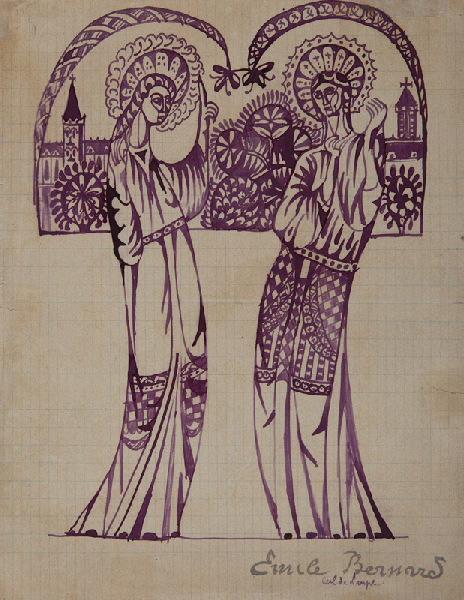
In 1890 Bernard goes through a religious crisis and turns to the subjects and themes of medieval art. In the same year he sets out to revive symbolism, which he saw as Christian in essence — the invisible expressed through the visible.
1891
The break with Gauguin
In 1891 Bernard breaks off his friendship with Gauguin. It was always his great frustration that Gauguin never named him as an influence on pictorial symbolism; one writer says his rivalry with Gauguin led him “out of spite” towards classicism.
1891
Among the Symbolists and the Nabis
In 1891 Bernard joins the group of Symbolist painters that includes Odilon Redon and Ferdinand Hodler, and in the same year becomes a member of the Nabis.
1893–1903
Journeys through Egypt, Italy and Spain
From 1893 to 1903 Bernard travels in Egypt, Italy and Spain, painting mostly religious and Symbolist canvases, and his style grows more eclectic. One writer holds that it was in the Middle East, in a period of great crisis, that he turned to classicism.
1893–1903
Travel: Egypt