Joseph Mallord William TurnerVerenigd Koninkrijk, 1775–1851
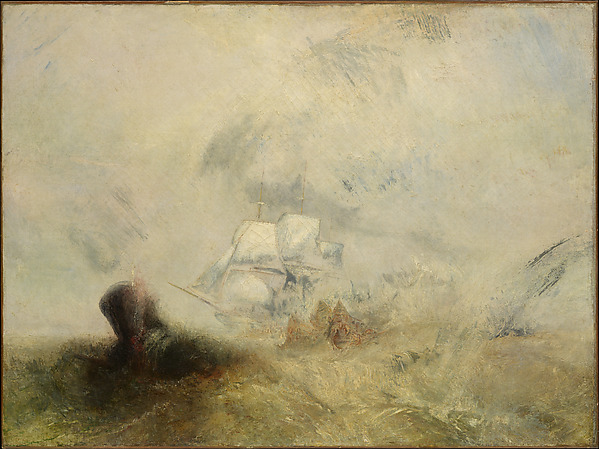
Sun Rising through Vapour
Kan ik het zien?
Onbekend
Waar is „Sun Rising through Vapour” nu? Collectie: National Gallery, Londen. Onbekend.

Londen, Verenigd Koninkrijk
De eigenaar is bekend; of het werk nu te zien is, is onbekend.
- Ongewijzigd sinds
- Bron
- Het museum
Gegevens
- Inventarisnummer
- NG479
In de catalogus
Bronnen
- Wikidata
- Afbeelding: National Gallery — J. M. W. Turner · Public domain · Wikimedia Commons
In het leven van Joseph Mallord William Turner
Het hele leven1798
The large watercolours of North Wales
The large watercolour views he made in North Wales in 1798, such as his depiction of Caernarvon Castle, are counted among the great landscapes of European art; by the age of 25, according to Wilson, he had developed watercolour into a new medium capable of much the same expressive power as oils.
4 November 1799
Elected an associate of the Royal Academy
On 4 November 1799 Turner, by then a popular artist, was elected an associate (corresponding) member of the Royal Academy.
1801
The triumph of the “Bridgewater Sea Piece” at the Academy
“Dutch Boats in a Gale” (the “Bridgewater Sea Piece”), commissioned for 250 guineas by the Duke of Bridgewater, one of the richest men in England, “took the Academy by storm” and was hung in the best location of the whole exhibition: in the Great Room, centred, opposite the entrance.
10 February 1802
Becomes a Royal Academician
On 10 February 1802 he was granted the title of Royal Academician, which gave him the right to exhibit without passing the selection committee that previewed all works.
1802–1803
Paris and the Swiss Alps in a year of peace
In the only year without war in Europe between 1793 and 1814 (the Peace of Amiens, 1802–1803) a consortium of noblemen sponsored a visit to Paris, where he saw old master paintings in the Louvre, and then he toured the Swiss Alps; his Alpine sketches later let him represent “the sublime” in paintings such as “Snow Storm: Hannibal and his Army Crossing the Alps” (1812).
1804
Opens his own gallery
Distrustful of dealers, he opened his own gallery so that he could sell directly and group the pictures he wanted seen together, something he could not control at the Royal Academy exhibitions; his father left his barbershop to help in the gallery and studio. For over a decade the gallery was a regular feature of the London exhibition season.