 Auguste RodinFrankrijk, 1840–1917
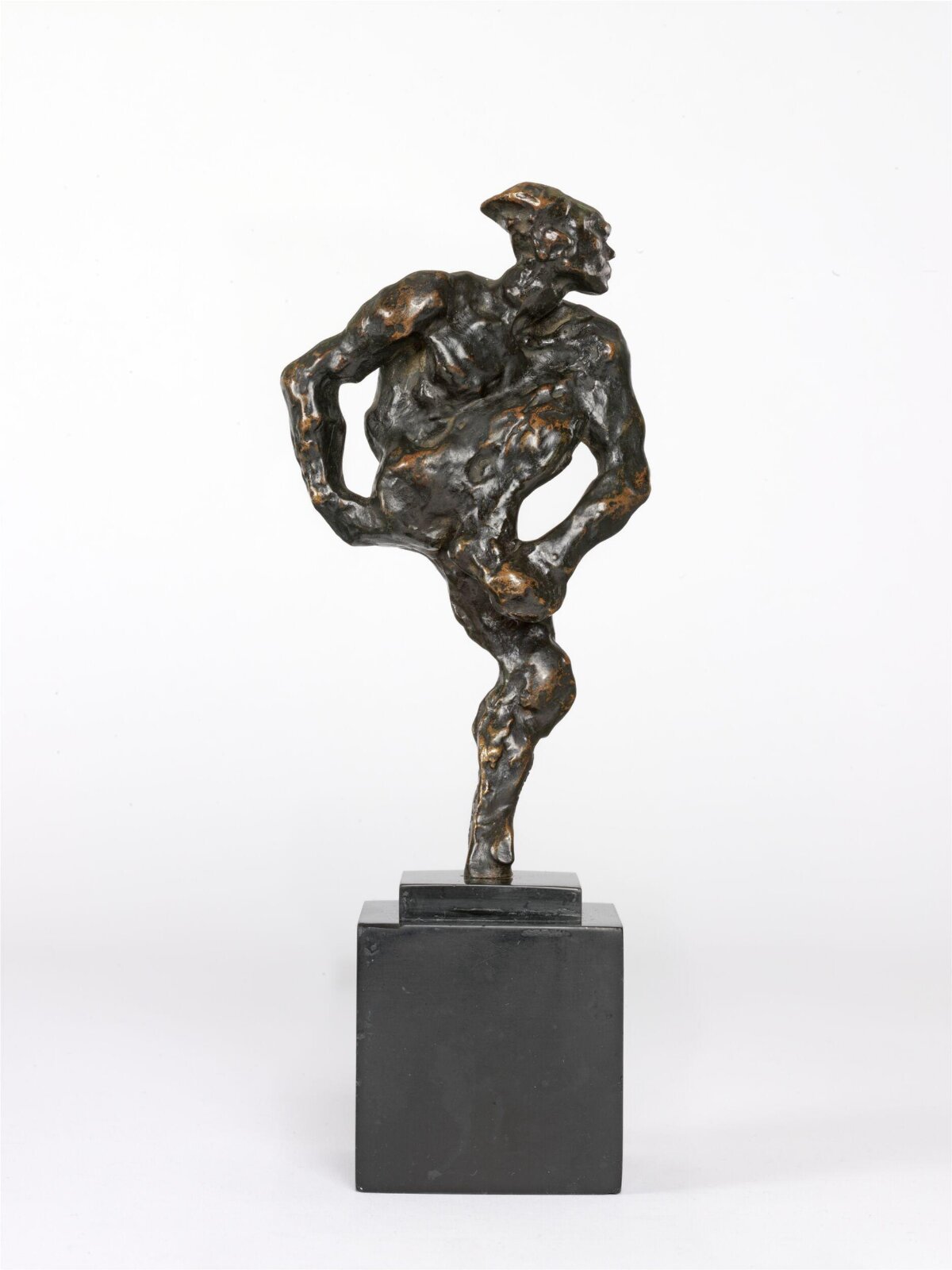
Study after Nijinsky
Mag men het zien?
Ontvangt momenteel niet

Victoria and Albert Museum
Londen, Verenigd Koninkrijk
Het hoort bij de collectie, maar is momenteel niet tentoongesteld.
- Gecontroleerd
- 9 dagen geleden
- Ongewijzigd sinds
- 25 sep 2026
- Bron
- De eigen collectiegegevens van het museum
About the sculpture
Auguste Rodin (1840-1917) was fascinated by bodies in motion, particularly dancers, and consequently he was intrigued by Vaslav Nijinsky (1889-1950), just as he had previously been fascinated by Loie Fuller, Isadora Duncan and the Cambodian dancers. The ground-breaking work of these dancers performing in individual styles provided him with a new repertory of gestures and movement. Rodin was 72 when he sculpted this figure that depicts Nijinsky gathering momentum, ready to leap into the air. It does not portray him in any specific role, but instead encapsulates and embodies the astonishing energy Nijinsky brought to a range of characters. The dancer posed at Rodin's studio, despite Diaghilev's reluctance to allow his lover to model.
Read on
According to Richard Buckle, Rodin had been present when the Russian dancers made their Paris debut in 1909 and significantly lent his name to an article published in Le Matin in May 1912 defending Nijinsky's controversial ballet L'Après-midi d'un faune. Nijinsky appparently posed for Rodin in July 1912, to thank the sculptor for the support. Rodin's original sculpture was the plaster figure now in the Rodin Museum Paris, and it was not cast in bronze until 1958-1959 when 13 casts were made by the Georges Rudier foundry. The V&A's bronze is number 7. In 1963 when it was in the Roland, Browse and Delbanco gallery in London it was titles Etude d'apres Nijinsky or Study after Nijinsky.
Originally started in Rue Charlot, Paris in 1874 by Alexis Rudier (d.1897) and his son Eugène (1875-1952), the Rudier Foundry cast some of the works of the most important sculptors of the late 19th and early 20th centuries including Aristide Maillol, Honoré Daumier and Auguste Rodin. Eugène negotiated the exclusive rights to cast Rodin works owned by the Rodin Museum in the Hôtel Biron, Paris, to whom Rodin bequeathed all his works. Following the death of Eugène in 1952 and the closure of the foundry, the Musée Rodin used the foundry in Châtillon-sous-Bagneux, south-west Paris, run by Eugène's cousin Raymond-Georges Rudier (1905-1994) and his son Bernard, that operated between 1939 and 1993.
Victoria and Albert Museum
Gegevens
- Inventarisnummer
- S.523-2019
In de catalogus
Bronnen
- Victoria and Albert Museum: the museum's own open data · opgehaald 9 dagen geleden
- Afbeelding: Victoria and Albert Museum — © Victoria and Albert Museum, London