 Giorgio MorandiItalië, 1890–1964
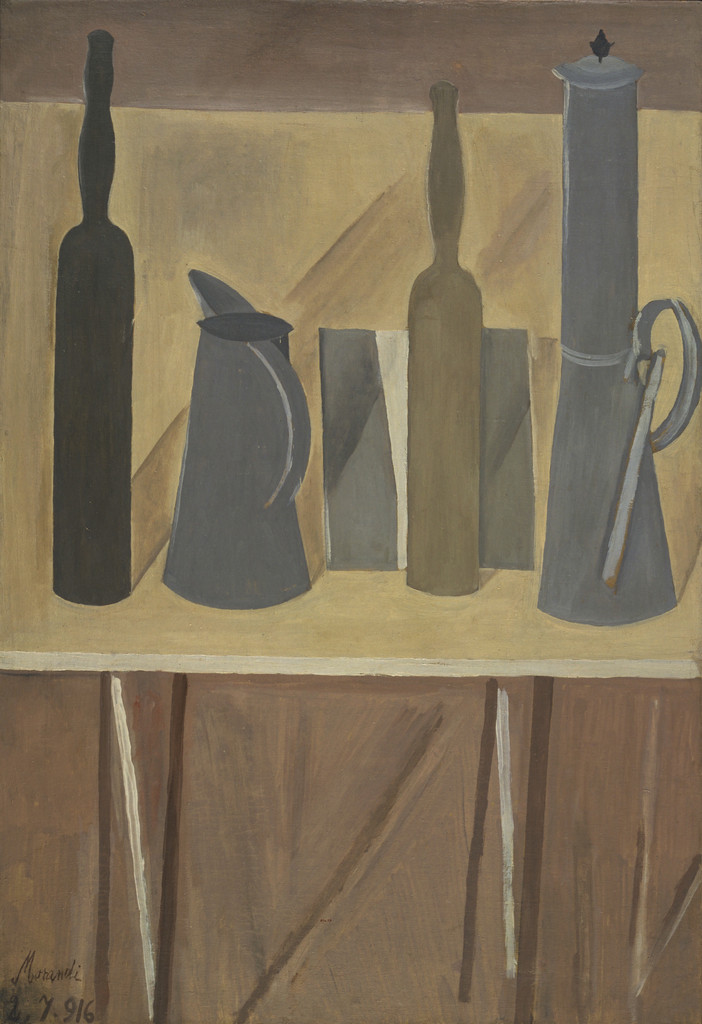
Still Life
Mag men het zien?
Ontvangt momenteel niet

Museum of Modern Art
New York, Verenigde Staten
Het hoort bij de collectie, maar is momenteel niet tentoongesteld.
- Gecontroleerd
- Bron
- Het museum
Gegevens
- Inventarisnummer
- 286.1949
In de catalogus
Bronnen
- Museum of Modern Art
- Afbeelding: Museum of Modern Art — © the artist or rights holder
Intussen, in het leven van Giorgio Morandi
Het hele leven1913–1914
Futurist exhibitions and meetings with Boccioni and Carrà
He takes part in several Futurist exhibitions in Bologna and Rome, meets Umberto Boccioni and Carlo Carrà and is praised by Tommaso Marinetti, though his own search follows the French Cubists and, in part, Henri Rousseau. By other accounts he began exhibiting in 1914, in Bologna alongside Mario Bacchelli, Osvaldo Licini, Severo Pozzati and Giacomo Vespignani, and at the First Free Futurist Exhibition at the Sprovieri Gallery in Rome.
1914–1929
Drawing teacher in Bologna's elementary schools
He is appointed instructor of drawing in the elementary schools of Bologna, a post he holds until 1929; his family's financial difficulties keep him in his home city.
1915
Called up, then a nervous breakdown
After Italy enters the First World War in the summer of 1915, he is conscripted; because he is very tall, he is assigned to a grenadier regiment. After two months of service he suffers a nervous breakdown and is discharged.
1916–1922
Drawing close to metaphysical painting
From 1916 to 1919 his explorations bring him close to the Metaphysical painters: Giorgio de Chirico, Arturo Martini and above all Carlo Carrà. From 1918 to 1922 he works in the Metaphysical manner, his last major stylistic shift.
1917
A serious illness
He falls seriously ill again, after the breakdown of 1915, and can hardly work.
1918–1921
The “Valori Plastici” group and Mario Broglio
In the first post-war years he joins the Valori Plastici group with de Chirico, Martini and Carrà, collaborates with the magazine founded by Mario Broglio in 1918, and meets de Chirico. Broglio is the first to sign an exclusive contract with him and begins to sell his work; in 1921 he organises a touring exhibition of the group in Berlin, Dresden, Hanover and Munich.