Edward Carrick
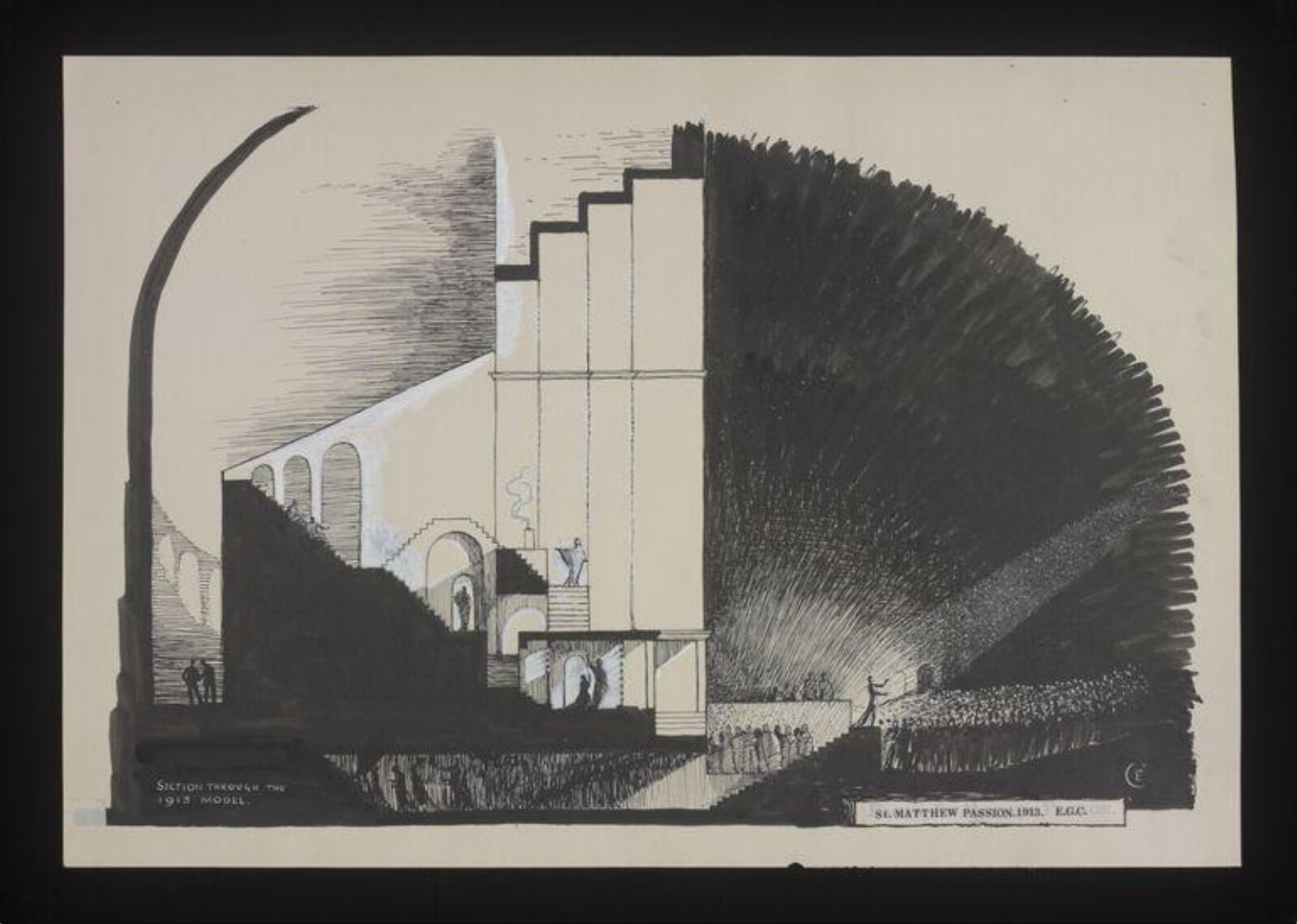
St Matthew Passion. 1913. E.G.C.
Mag men het zien?
Ontvangt momenteel niet

Victoria and Albert Museum
Londen, Verenigd Koninkrijk
Het hoort bij de collectie, maar is momenteel niet tentoongesteld.
- Gecontroleerd
- Ongewijzigd sinds
- Bron
- Het museum
Over het werk
Drawing by Edward Craig (Edward Carrick, 1905-1998) showing a section through the 1913 model for Edward Gordon Craig's proposed staging of Bach's St Matthew Passion, drawn in 1972.
Verder lezen
Edward Gordon Craig (1872-1966) was introduced to Bach's St Matthew Passion as early as 1899 by the composer Martin Shaw. The possibility of staging the oratario was to occupy Craig for the rest of his active life. In his book Edward Gordon Craig (1983) Christopher Innes describes how Craig was inspired in 1910 by the proportions of a 12th century church at Giornico with its 'altar on a bridge curving over a triple archway leading down to the crypt'. By 1913-14 Craig had built a nine foot high model of his stage at his school in the Arena Goldoni, Florence, but during World War I the Italian Government requisitioned the building and the model was dismantled. At this time Craig already envisaged a huge theatre, specially erected for performances of the oratorio that would accommodate 8,000-10,000 people.
He has hopes that Mussolini would construct a temporary theatre but the proposal came to nothing. After World War II the most significant sections of the St Matthew Passion model were sent to Craig and on his instruction the remainder were burnt. Some of the model pieces were acquired by the Unversity of California, and Craig kept the rest as mementos.
Craig's son, the artist and theatre designer Edward Craig who worked under the name Edward Carrick, used his father's model pieces, plus some measurements, original sketches and photographs, to reconstruct the model for the Gordon Craig centenary exhibition, held at the Camden Arts Centre in 1972. The model was subsequently acquired by the Victoria and Albert Museum (S.273-1977). Carrick also made this drawing of the 1913 model which shows the set as it would appear in performance, with the different areas representing Heaven, Earth and Hell, and the Evangelist out in front of the 'action'.
Victoria and Albert Museum
Gegevens
- Inventarisnummer
- S.1570-2014
In de catalogus
Bronnen
- Victoria and Albert Museum
- Afbeelding: Victoria and Albert Museum — © Victoria and Albert Museum, London